

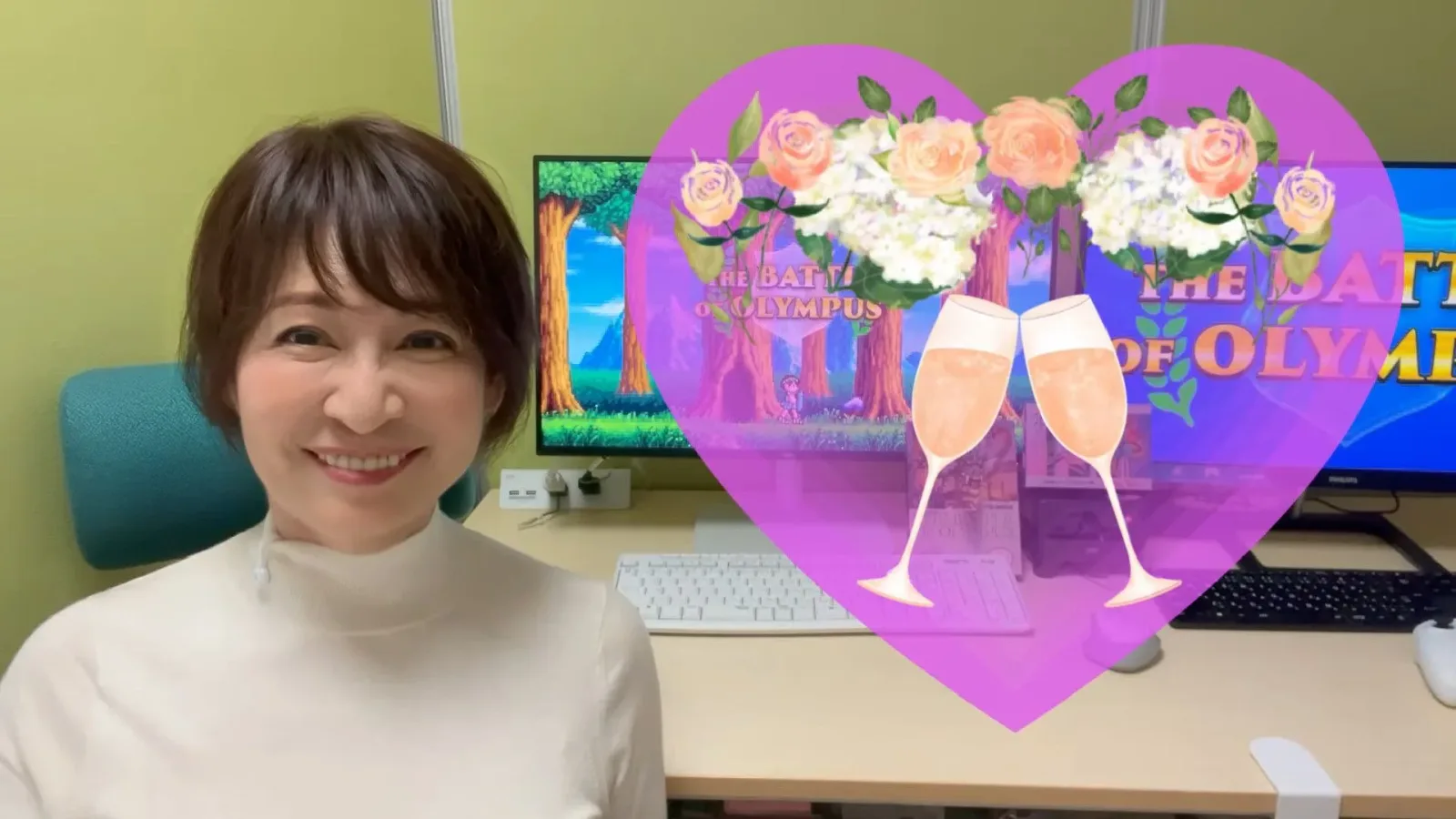
The Battle of Olympus, the 1988 Famicom action RPG that later reached the NES in other regions, is being rebuilt for a new generation. Original creators Reiko and Yukio Horimoto are personally developing a faithful remake for Steam, with an Early Access launch planned for January.
The project is an unusually personal return for the husband-and-wife team. The pair first made the game during the early years of their relationship, with their ambitions, creative partnership, and shared enthusiasm for making games helping to shape the final release. Nearly four decades later, they are returning to that work after discovering how strongly it has endured among players online.
For a title that did not become a major commercial success during its original run, The Battle of Olympus has developed a reputation as a cult favorite. Its mix of non-linear exploration, platforming, combat, item progression, and Greek mythology gave it an identity beyond its obvious genre inspirations. The remake will give its creators an opportunity to revisit that identity directly rather than handing the work to an outside team.
A long-delayed return to Olympus
The Battle of Olympus originally arrived on the Famicom in 1988 before appearing globally on the NES several years later. At the time, it was one of many fantasy-flavored games on a hugely competitive console, and its sales were described as modest. It was easy for games of that period to be overlooked, particularly when they arrived in genres already dominated by landmark Nintendo releases.
For useful background on this topic, read Oracle Preserves a Lost 1996 Amiga Dungeon Crawler for Modern Retro Fans.
Over time, however, the game found a more dedicated audience. Players continued to share gameplay footage, discuss its world and systems, and revisit its distinctive interpretation of ancient Greek mythology. That ongoing interest ultimately became the catalyst for the remake.
Reiko Horimoto said the project began with YouTube, where she saw that gameplay videos posted decades after the game's release were still receiving significant attention. More importantly, the comments left by viewers had a profound emotional effect on her. The appreciation expressed by players helped the original team look back at a formative project and see that it had mattered to people in ways they had not expected.
"The inspiration for this remake came from YouTube," Reiko said in a new project video, explaining that the kind comments beneath old gameplay uploads moved her to tears.
That audience response did more than create nostalgia. It appears to have given the Horimotos the confidence to take on a demanding reconstruction of a game from an era with radically different technical limits. Reiko's closing message frames the remake as a direct expression of gratitude to those who played, recorded, discussed, and continued to love The Battle of Olympus long after its initial release.
The original game was built by three people
The first The Battle of Olympus was a small-team production. Yukio Horimoto handled programming, Reiko Horimoto led the art and story work, and Kazuo Sawa composed the soundtrack. Together, the three-person group built an adventure that was ambitious for the hardware available to them.
Yukio had previously acknowledged the game's substantial debt to Zelda II: The Adventure of Link. The connection is readily visible in the side-scrolling action, role-playing elements, and exploratory structure. Yet The Battle of Olympus had its own strengths: an interconnected world, mythological settings and encounters, striking pixel art, and a challenge level that made discovery and progress feel earned.
Its story drew from the Greek myth of Orpheus and Eurydice, an influence that also carried personal significance for the team. Yukio has spoken about meeting the woman who would become his wife while the couple were making their first game. Their relationship and desire to build something together were inseparable from the creation of The Battle of Olympus.
That history makes this remake different from a typical retro revival. It is not simply a publisher revisiting an old catalog title because nostalgia is commercially attractive. The people who made its code, art direction, and narrative foundations are again at the center of development. Their description of the new version as "the culmination of our lives in game development" suggests that it is intended as both a restoration and a personal milestone.
Rebuilding rather than merely re-releasing
The Steam version is described as a faithful remake, not a simple port or emulated reissue. Reiko and Yukio Horimoto are recreating the code, redrawing the pixel art, and refining the game for modern PC players. At the same time, the stated goal is to preserve the original game's spirit, atmosphere, and challenge.
That balance will be central to the remake's appeal. Games from the NES and Famicom era often depend on a particular relationship between design and technical constraint. Limited color palettes, compact sprite work, terse dialogue, and tightly controlled environments were not just aesthetic choices; they were also responses to hardware restrictions. Updating such a game without erasing its character requires more than higher-resolution visuals or a smoother presentation.
The original artists worked within an especially narrow visual environment. Yukio previously described Reiko's challenge as creating the most beautiful graphics possible on a cartridge that allowed only 16 colors. Praise for the game's art has remained one of the reasons it is remembered. Redrawing those visuals for PC while retaining their mood will therefore be one of the remake's most closely watched tasks.
The same is true of difficulty and progression. The Battle of Olympus belongs to a period when players were expected to probe unfamiliar areas, learn enemy behavior through repetition, and gradually understand a world with limited guidance. Modern refinements could make the game easier to approach, but the team has explicitly emphasized keeping its challenge. That wording indicates that the remake is not aiming to turn the original into a fundamentally different kind of action RPG.
What the team has confirmed
- The remake is being developed by original creators Reiko and Yukio Horimoto.
- It is planned for Steam Early Access in January.
- The team is recreating its code and redrawing its pixel art.
- The remake is intended to be faithful to the original while being refined for modern PC players.
- Preserving the original atmosphere and challenge is a stated priority.
Specific details about the remake's exact feature set, its final scope, and its full release plans have not been outlined here. As a result, longtime fans will need to wait for further development updates to learn how the rebuilt version handles areas such as controls, presentation, quality-of-life changes, and the broader content plan during Early Access.
From original-game studio to decades of support work
The original game was created at Infinity, a studio that still exists today. But the modest sales of The Battle of Olympus meant the company could not continue producing original games in the way its creators had hoped. For much of the following four decades, Infinity worked on contract and support projects for other developers instead.
That background gives the new project added weight. A game that once represented a young team's attempt to compete at the highest standards of the NES era eventually became something its lead creators nearly left behind. Yukio said in a 2015 interview that he had almost forgotten about The Battle of Olympus. The online community's continued enthusiasm has clearly changed that relationship.
There is something fitting about a game rooted in an older form of discovery finding renewed life through modern video platforms. Many cult classics survive because players preserve them informally: through recordings, playthroughs, reviews, community conversations, and recommendations passed between generations. In this case, that preservation did not only keep the game visible. It reached the people who made it and inspired them to begin again.
For retro fans, the remake also represents a chance to assess The Battle of Olympus on its own terms. Its Zelda II influence is part of its history, but its world design, Greek-myth framing, and visual style earned it a following that has lasted well beyond the original hardware's active life. A carefully handled PC remake could introduce those qualities to players who never encountered the NES release while giving veterans a new way to return.
A remake shaped by appreciation
Reiko's message about the project repeatedly returns to thankfulness. She thanked players who experienced The Battle of Olympus, people who uploaded videos, and commenters who shared their affection for the game. It is a reminder that a game's legacy is not always determined by launch sales or immediate mainstream recognition.
In 1988, The Battle of Olympus was one fantasy platforming adventure among many. In the years since, it has become a game with a small but lasting community, and that community has now helped create the conditions for an official remake led by the original couple behind it.
With Steam Early Access set for January, the new Battle of Olympus will test how successfully a deeply personal NES-era work can be rebuilt for PC without losing what made players seek it out decades later. The Horimotos' involvement offers the strongest possible connection to the original: the people who once pursued an ambitious adventure under severe cartridge limitations are now returning to it with the benefit of a lifetime in game development.
Community
Discussion
Start the conversation.
No comments have been posted yet.