

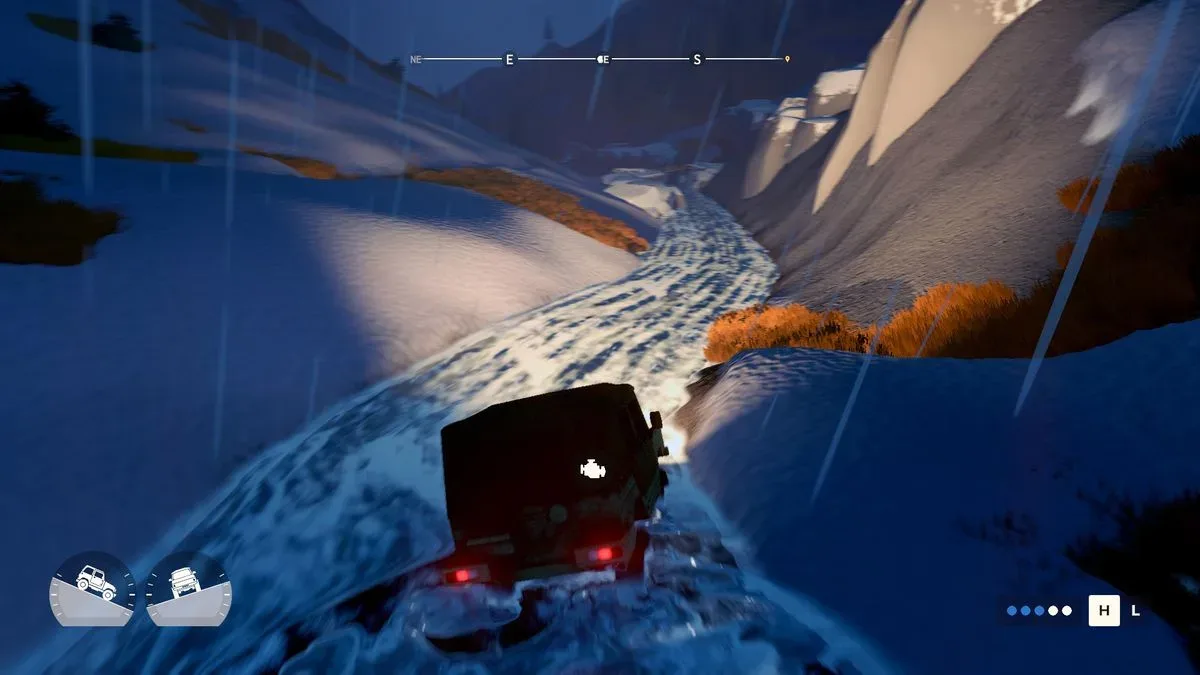
Over the Hill arrives with the promise of a serene off-road escape: a compact vehicle, enormous wild spaces, gentle music and the freedom to chart a route through forests, deserts, marshes and snowy ground. Funselektor Labs has built a game that frequently looks ready to deliver exactly that kind of meditative road trip. Its low-poly visual identity, shifting weather and long-distance views can be striking, especially when sunlight catches a waterfall or headlights cut through a rain-soaked night.
But beneath that inviting presentation is an unusually demanding driving experience. Over the Hill is less about cruising through beautiful landscapes than enduring them. Steep inclines, poor traction, slippery surfaces and awkward obstacles turn basic forward movement into a persistent struggle, particularly during the opening hours before meaningful tire upgrades arrive. The game has moments of real tension and beauty, and its best designed routes are genuinely satisfying. Yet the wider experience can feel laborious, sparse and frustratingly slow.
A wilderness built to resist the player
The central idea is simple: take an off-road vehicle into large natural regions and uncover their points of interest. In practice, the terrain is the game's true protagonist--and its greatest obstacle. Early on, trying to tackle even a moderately steep hill can result in a familiar cycle of wheelspin, sliding backward, bouncing against a tree and attempting the same approach again. There is a certain authenticity to the sensation of an underpowered vehicle losing its fight with a slope, but Over the Hill leans into that experience so heavily that it can become exhausting.
Upgraded tires eventually provide better grip, making the vehicle more capable and reducing some of the early frustration. They do not fundamentally transform the adventure, however. Even later in the game, travel is commonly a careful, low-speed negotiation with rocks, mud, snow and uneven ground. The vehicle seldom feels fast, and the overall pace can make long expeditions feel less like a liberating drive and more like an extended test of patience.
For useful background on this topic, read Among the Trolls Launches on Steam With a Finnish Folklore Mystery.
That deliberate pacing also changes how the game's open-world structure feels. Players can technically point their vehicle in nearly any direction, but many hills and slopes are simply impractical or impossible to climb. The result is an environment that initially appears open but often funnels drivers toward flatter, more manageable routes. This creates a curious contradiction: the game offers broad landscapes, yet frequently encourages a fairly linear path through them.
There is design value in that limitation. Rocks, exposed stone faces and narrow passages are positioned to create individual driving problems rather than allowing players to simply drive across the map without thought. Still, the illusion of total freedom fades once repeated attempts make it clear which parts of the world are realistically accessible.
The winch is Over the Hill's best idea
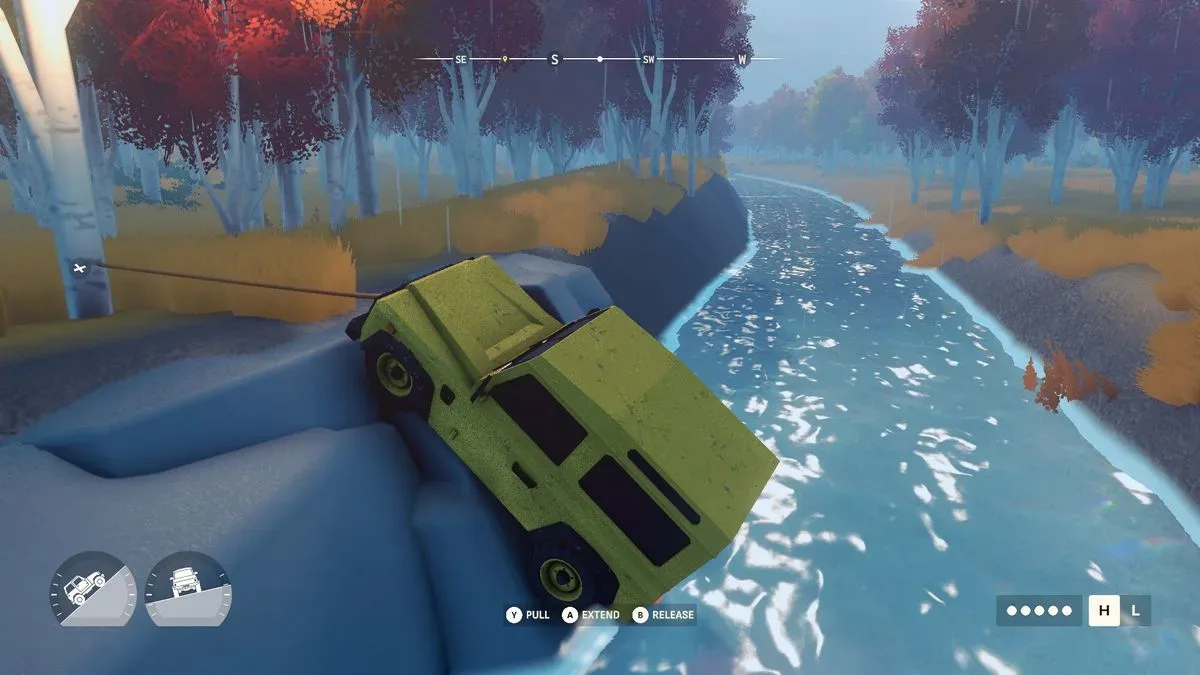
The standout mechanic is unquestionably the winch. With a quick button press on an Xbox controller, players can attach it to nearby trees and pull their vehicle free from mud, water, rocks or other hazards. It is intuitive, quick to deploy and immensely useful. When a truck becomes stranded at an ugly angle on a bank or begins sinking into difficult terrain, the winch can turn a seemingly hopeless situation into a recoverable one.
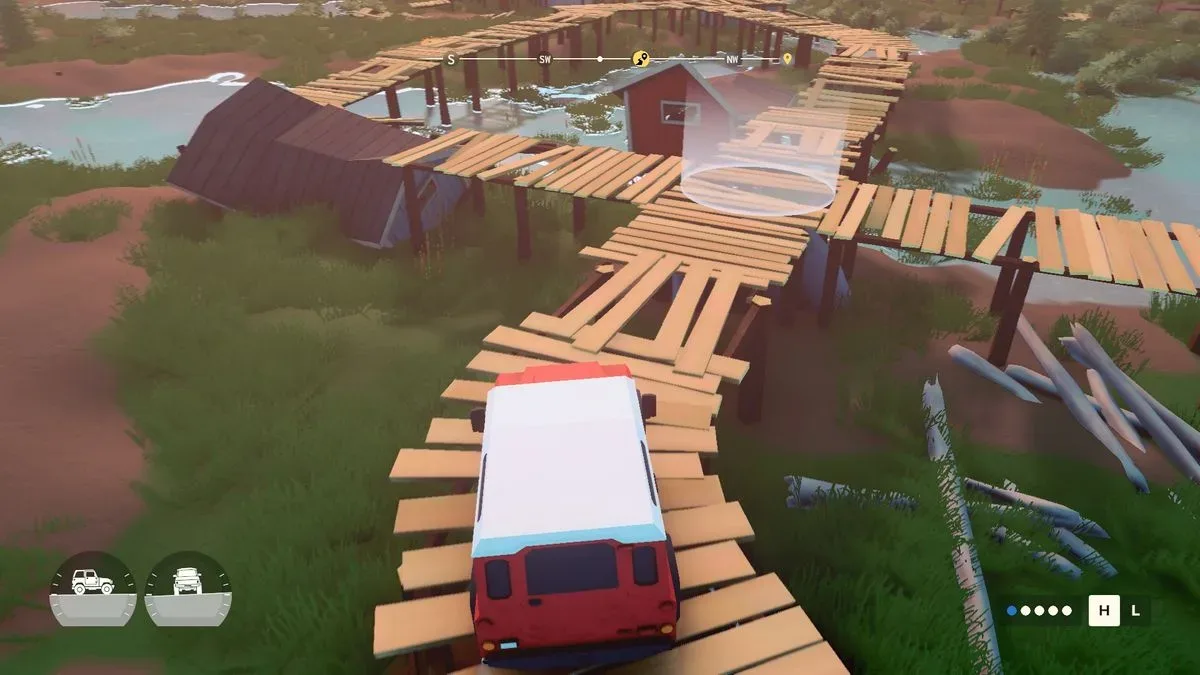
Later equipment expands those options. Players can gain an item that creates an anchor point in places where a suitable tree is unavailable, giving the winch even more flexibility. There are also limited-use wooden planks for bridging small gaps, along with a jack for recovering from a rollover. The jack does not physically interact with the vehicle's chassis; instead, it resets the vehicle's position. That makes it feel somewhat artificial in a game otherwise so committed to making drivers deal with the consequences of the landscape, but it can be a welcome escape from a failed maneuver.
These tools create some of the game's most compelling moments because they require improvisation. A rough route is not always about having enough speed or steering accurately. Sometimes it is about choosing the right tree, planning a winch angle, placing a plank at the right moment or deciding when to accept that a reset is necessary. Over the Hill is at its strongest when a difficult section becomes a small problem-solving exercise rather than a prolonged battle with traction.
Trails provide the clearest sense of purpose
For all of its open-world ambitions, Over the Hill becomes most enjoyable when it embraces more focused challenges. Its designated trails are the clearest example. These routes send players toward checkpoint circles placed along demanding tracks, adding a more overtly game-like structure to the slower exploration loop.
Several of these trails are thoughtfully built, using landscape features to establish a sense of progression and danger. The Bridal Veil trail in the second Canadian area is a notable highlight, combining a challenging route with an attractive waterfall setting. It demonstrates what Over the Hill can be when careful environmental design, visual atmosphere and a clearly defined objective meet. Rather than wandering through another broad stretch of difficult ground with little indication of why it matters, players are given a destination and a sequence of obstacles that feel intentionally arranged.
The game's larger maps are gradually revealed by driving through them, dispersing a fog of war and exposing question marks that mark points of interest. Those discoveries can include crates containing visual customization items, vehicles that need towing back to camp, or gates that begin trails. Clearing all of the icons in an area removes its fog entirely. There is no aggressive pressure to complete every objective, which suits the relaxed concept on paper, but it also means the experience can lack momentum. Once the novelty of uncovering icons wears off, the rewards do not always feel substantial enough to encourage another slow trek across the wilderness.
Atmosphere carries the journey, even when discovery does not
Funselektor Labs' visual style will be immediately recognizable to players familiar with Art of Rally. Over the Hill again uses a stylized, near-flat-shaded look, though its world is not entirely minimalist. Lighting, fog, rain and other weather effects help give each region personality. Storms can be especially impressive, with wind visibly moving trees across the landscape as the vehicle inches onward through difficult conditions.
The visual approach works best in places with strong terrain or dramatic weather. A wet night drive can be quietly memorable: rain striking the roof, headlamps shifting with every bump and the road ahead barely visible. Mountain routes can produce a convincing sense of danger when the vehicle clings to a narrow path with a severe drop beside it. Mud and snow also leave visible tracks, making a struggling vehicle's passage look suitably messy.
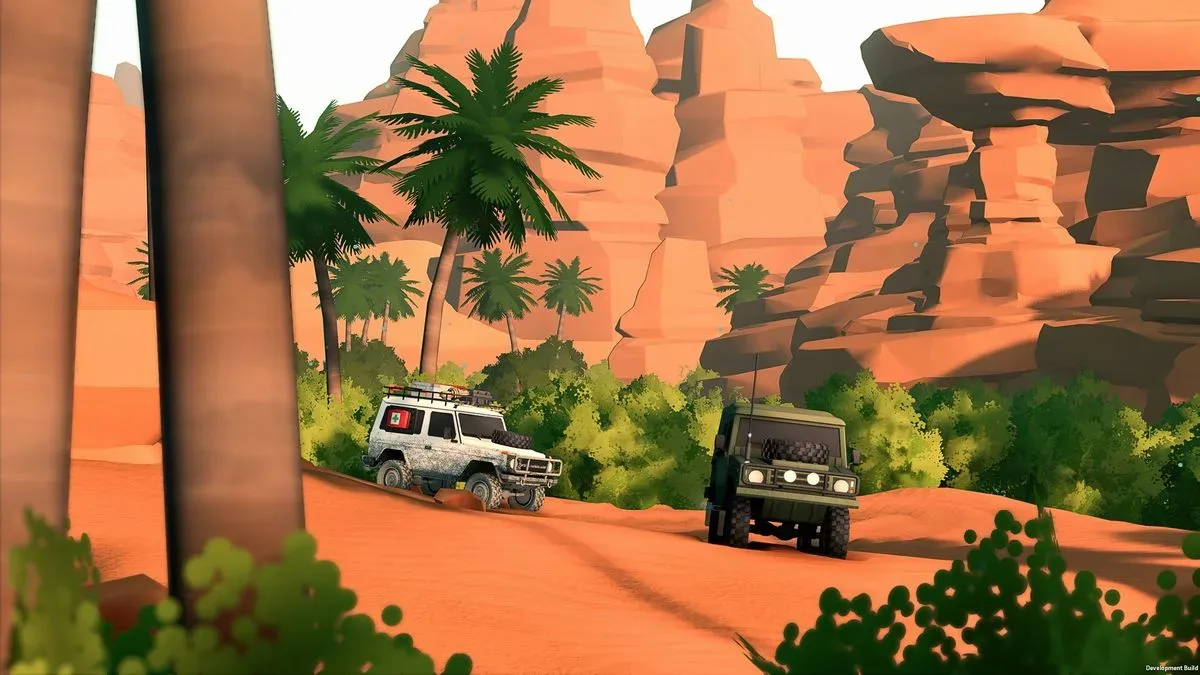
There are limitations. Sparse environments, including the Algerian desert, can look somewhat plain. The deformable ground effects are attractive at a glance, but they are not as convincing as those in more simulation-minded off-road games. Mud and snow deform to a set level rather than dynamically building, shifting or responding naturally when a vehicle reverses through the same spot. The system looks good enough to sell the immediate image of tires cutting ruts into soft ground, but it lacks the deeper physical detail that would make the terrain feel fully alive.
The audio plays a major role in maintaining the intended mood. Drivers can change tracks or albums through an in-car tape player, while the laid-back acoustic guitar selections are particularly well suited to the game's quieter stretches. This peaceful soundtrack can create an amusing contrast with the actual driving demands: the music suggests a leisurely holiday, while the vehicle is one bad angle away from becoming wedged against a rock.
Customization and solitude offer modest rewards
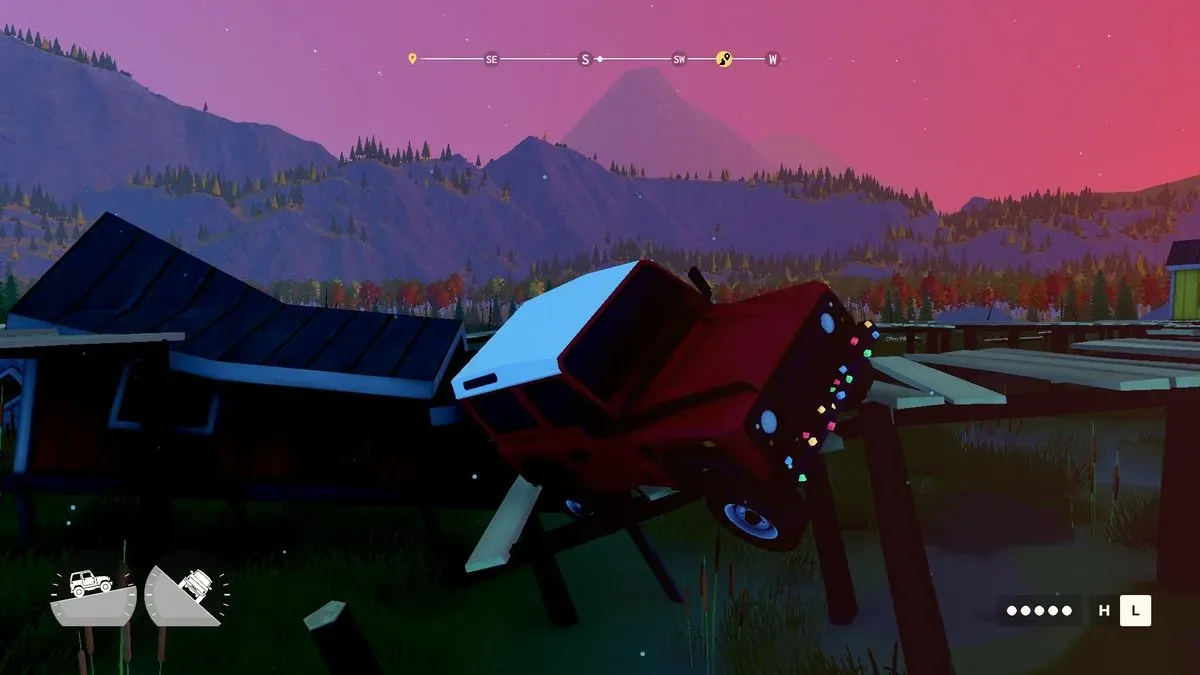
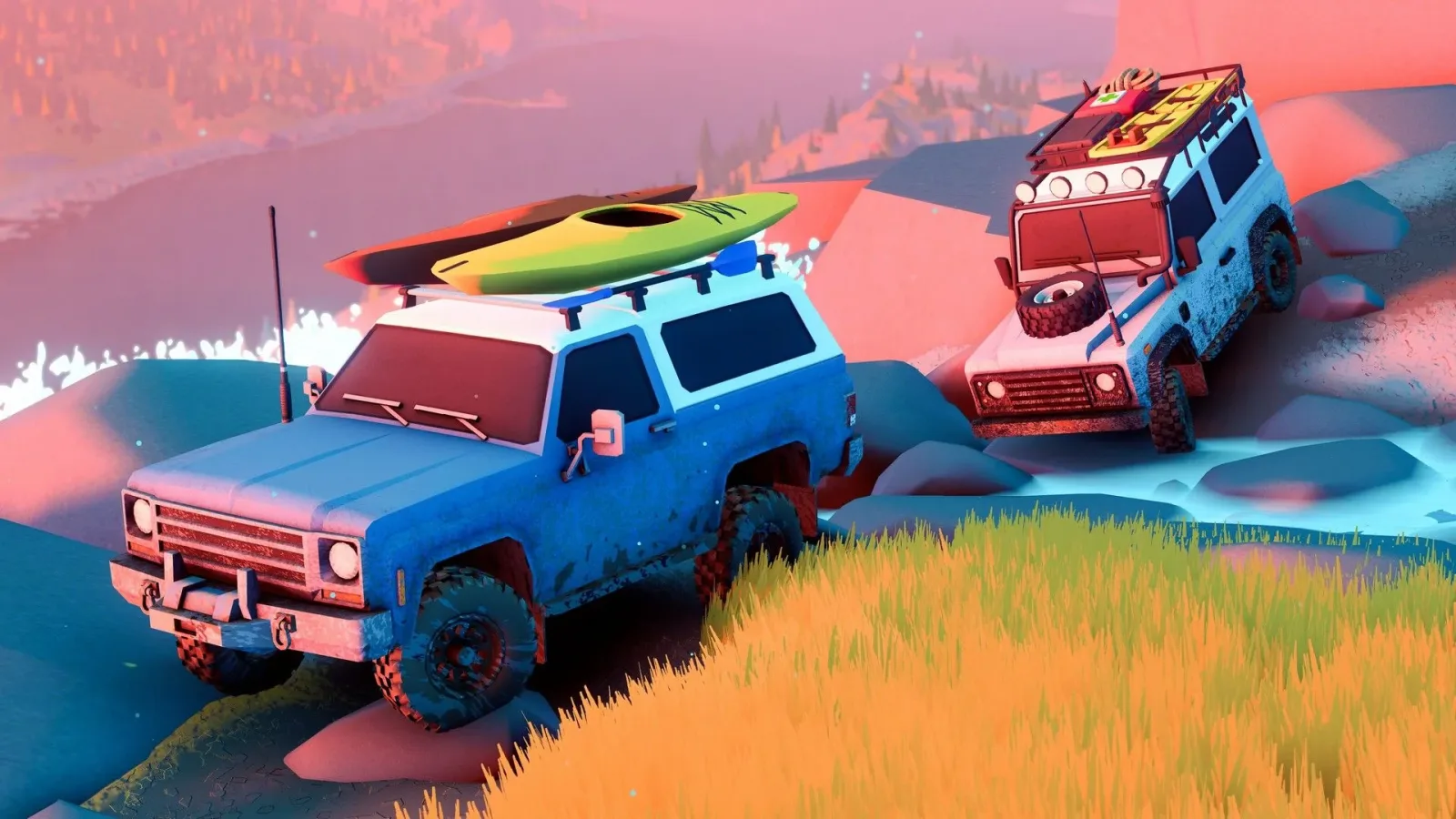
Exploration unlocks cosmetic options for the vehicle, including decorations that allow players to add a little personality to their truck. These are pleasant incentives rather than major progression rewards. The available choices can make a vehicle feel distinct, whether the player prefers a rugged expedition aesthetic or something more whimsical, such as festive lights and a wreath.
An instant camera allows players to photograph wildlife, another fitting feature for a game built around scenic travel. Wildlife sightings are not especially frequent, which makes occasional encounters--such as seeing an eagle--more memorable. Still, the camera is more of a nice extra than a system that strongly shapes the adventure.
There are a handful of mechanics in the world who sell upgrades and offer small amounts of dialogue, but Over the Hill is primarily a lonely experience. That isolation can be effective when the weather, scenery and music are all working together. It can also amplify the game's less engaging stretches, when there is little to do beyond watching a small vehicle slowly cross an empty landscape.
Co-op potential, strong performance and an uneven destination
Multiplayer offers a possible remedy for some of that solitude. Players can help one another with winches and cooperate on tasks such as pulling larger meteorites. However, the game was designed first around solo play, and online performance is still being improved. That makes co-op an appealing option with caveats rather than a definitive way to experience the game.
Performance is a brighter point. On PC, Over the Hill runs well on an Nvidia RTX 2070 laptop at Ultra settings. It also performs well on Steam Deck despite the game's expansive draw distances, with visible level-of-detail pop-in kept relatively restrained. That technical stability supports the atmosphere, letting players appreciate broad vistas without constant visual disruption.
Over the Hill launched on October 14, 2026 for PC, PlayStation 5, Xbox Series X and Nintendo Switch 2. It is a game with a distinctive identity and a number of excellent individual systems, especially its winch-based recoveries and curated trails. Its landscapes can be beautiful, its weather can be evocative, and its driving challenges occasionally produce the kind of hard-won success that off-road games do best.
Yet the game repeatedly mistakes friction for fulfillment. Too much of the journey is spent crawling through terrain that feels hostile without being consistently rewarding, while the world offers too little discovery to compensate for the pace. Players seeking an exacting, solitary off-road endurance trip may find a great deal to appreciate. Anyone expecting a breezy open-world drive through postcard scenery should prepare for a much tougher road.

Community
Discussion
Start the conversation.
No comments have been posted yet.