

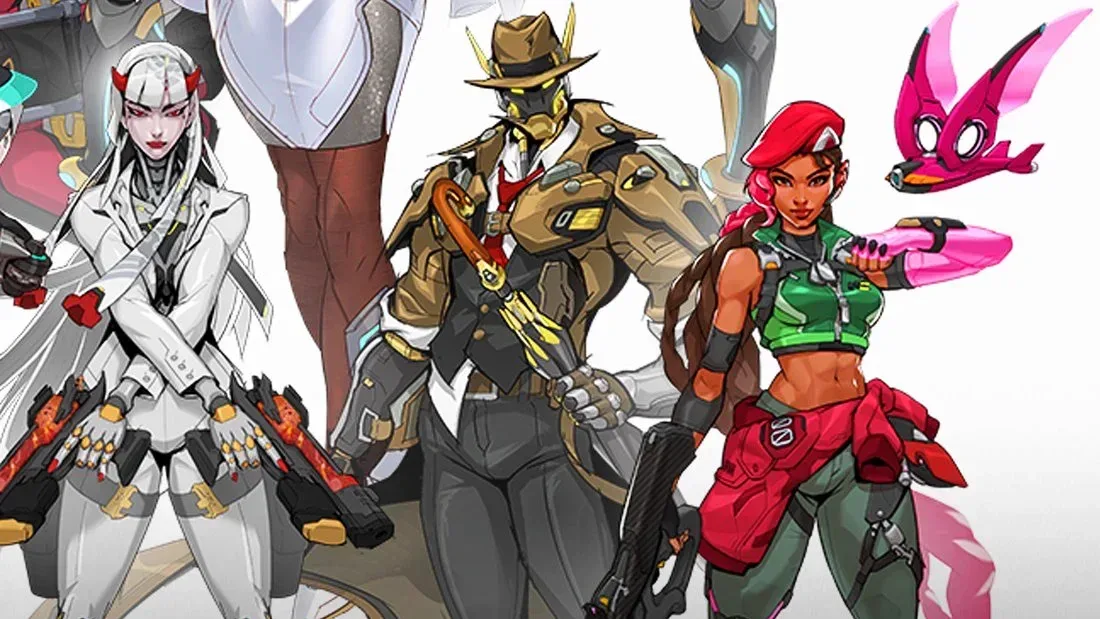
Overwatch's next playable hero is no longer headed for the support lineup. Hudson, the Omnic Detective positioned to help launch the shooter's next story arc, will instead arrive as a damage hero when he joins the game next month during Season 6. The role change is especially notable because Blizzard had said as recently as September's BlizzCon presentation that the character was being developed as a support.
The reversal has immediately become a major point of discussion among players. Hudson has attracted interest since his visual reveal, and support-focused fans had begun looking forward to seeing how the detective concept might work in a role built around healing, utility, and enabling teammates. Now, he will enter the game's most heavily populated class instead, adding another name to a damage roster that already far exceeds the tank and support pools.
Hudson's final role was discussed in an interview featuring game director Aaron Keller and associate director Alec Dawson. The developers confirmed both the hero's name and the fact that development ultimately took his design in a different direction than initially planned. Hudson had previously been referred to by fans as "Rigby," but that speculation is no longer necessary now that Blizzard has attached an official name to the Omnic Detective.
Embedded X/Twitter post
Embedded X/Twitter post
Embedded X/Twitter post
Why Hudson's role changed during development
Dawson explained that the choice came down to iteration and the fit between Hudson's mechanics, character concept, and in-game identity. Blizzard playtested and revised the hero extensively, and the team reportedly found that the part of Hudson's design it liked most did not work naturally within the support role. Rather than force those mechanics into a healing-oriented kit, the developers chose to lean into the version that felt strongest and most appropriate for a DPS character.
For useful background on this topic, read Love Locks Offers $5,000 Wedding or Divorce Prize for First 100,000-Lock Clear.
"As things developed, as the hero developed, as we look at the mechanics, how they match with the aesthetic, how they match with who the hero is supposed to be, how they're supposed to be represented in our game, season six's hero will be a DPS," Dawson said.
The associate director further said that the team's favorite core mechanic did not align with support gameplay, while it seemed to fit a damage hero much better. Specific details about that mechanic have not yet been revealed, so there is no clear answer as to whether Hudson will be built around precision shooting, mobility, reconnaissance, disruption, burst damage, or another style entirely. The detective theme leaves room for plenty of possibilities, but Blizzard has not confirmed enough to define his intended play pattern.
Keller offered another encouraging detail for players interested in Hudson regardless of class: the hero has been one of the best-received characters in internal testing. That does not necessarily answer concerns about role distribution, but it suggests Blizzard is confident in the character's gameplay identity after the pivot. With Hudson due next month, a fuller reveal could explain what the team discovered in testing and why his standout feature proved better suited to the damage category.
A crowded damage roster gets even larger
The strongest reaction to Hudson's reclassification has centered on a simple numbers problem. Before Hudson's arrival, 23 of Overwatch's 54 heroes belonged to the damage role. Tanks and supports have smaller selections, making every addition to those categories particularly meaningful for players who specialize in them. Moving a publicly identified support into DPS does not merely alter expectations for one character; it reinforces the perception that damage heroes receive more attention than the other roles.
That frustration is heightened by the hero rollout during Overwatch's 2026 soft reboot. Ten heroes have been released across the year, and Hudson will make five of those ten damage characters. The lineup is split as follows:
- Damage: Anran, Emre, Sierra, Shion, and Hudson
- Tank: Domina and D.Mon
- Support: Jetpack Cat, Mizuki, and Doctrine
On its own, a five-three-two split might not appear overwhelmingly lopsided. But it lands differently when added to the existing roster, where damage already has a substantial numerical lead. Damage players are gaining another option in the role with the most options, while support fans are losing a character many believed would help broaden their choices.
There was some recent movement in the opposite direction. Sombra, who had been a damage hero since her 2016 debut, was reworked into a support hero during the current season. For players hoping that this signaled a sustained attempt to close the role gap, Hudson's move can feel less like an extra support addition was delayed and more like a direct exchange: Sombra joins support, Hudson joins damage.
Support players feel the loss of a promised hero
Much of the negative response is not aimed at Hudson's design itself. Instead, it is rooted in the expectation created by the earlier support announcement. Players who enjoy healing, saving allies, controlling fights through utility, and helping teammates create their biggest moments had reason to assume the Omnic Detective would be designed for them. Some had already become attached to the character based on his aesthetic and premise before knowing any concrete ability details.
For these players, the issue is that the role change happened unusually late from their perspective. Hudson is expected next month, yet Blizzard had apparently reached a point where a central part of his kit made the support classification unsuitable. That has led some community members to question why such a fundamental mismatch was not recognized sooner, particularly if the Omnic Detective concept had been in development for a long time.
One frustrated support player argued that people upset by the decision have every reason to feel let down. Their concern was not simply that another DPS exists, but that Blizzard could have either rebuilt Hudson around a stronger support kit or reserved the preferred gameplay concept for a future damage hero. From that viewpoint, changing an announced hero's core role so close to release makes the original support plan feel less dependable.
That reaction also reflects a broader concern about planning. A hero's role influences everything from team composition and queue preferences to the kinds of players who will follow its development. Announcing a hero as support builds a particular audience. Altering that classification afterward may be a sensible production decision, but it inevitably changes the promise players believed they were being given.
Iteration can lead to unexpected but better results
Not everyone sees Hudson's new role as evidence of favoritism or poor planning. Other players have defended the decision as a normal consequence of game development. Early roles, concepts, and abilities are not always final, especially in a competitive live-service game where a new hero needs to be fun, readable, balanced, and distinct from the rest of the roster.
From that perspective, the most important question is whether Hudson works. If the most enjoyable, cohesive version of the Omnic Detective plays like a damage hero, then releasing a weakened or awkward support version simply to preserve an old announcement could create a worse outcome for everyone. A support character whose kit does not genuinely support allies--or whose central mechanic is constrained by the role--would not necessarily satisfy the players asking for more support representation.
One player responding to the backlash made that case directly, arguing that design is inherently iterative. A concept can begin in one place and, through prototyping and testing, reveal itself to be much stronger somewhere else. There is also no public indication that Hudson was shifted for reasons unrelated to his gameplay. The developers' explanation is that the hero's mechanics and fantasy aligned more effectively with DPS.
Both positions can coexist. It is reasonable for support players to be disappointed by the loss of a hero they expected to play, especially given the existing imbalance in roster size. It is also reasonable for Blizzard to avoid locking itself into an early label if testing shows that a different role better serves the character. The unanswered question is whether the eventual Hudson reveal will make that decision feel convincing.
What to expect before Season 6
Hudson's exact abilities remain unknown, leaving the debate to focus largely on role counts and expectations rather than the actual experience of playing him. Blizzard has not yet shown which element of his kit pushed him toward damage, nor has it explained how the Omnic Detective theme will translate into combat. Those details will matter. A distinctive DPS who brings a new tactical niche could make the change easier for some players to accept, while a more familiar damage design may intensify calls for another support release.
For now, the confirmed facts are clear: Hudson is the Omnic Detective, he is not Rigby, and he is set to arrive as a damage hero in Season 6 next month. The character has tested very well internally, but his move away from support has sharpened an ongoing conversation about what kind of role balance Overwatch should pursue as its roster continues to grow.
Until Blizzard properly unveils Hudson's full kit, supporters and critics alike are left with the same missing piece: an explanation players can see in action. If the detective's defining mechanic truly only comes alive as a damage tool, Season 6 may show why the change was necessary. But for support mains who were waiting for a new ally-focused hero, the next addition will still feel like a missed opportunity.
Community
Discussion
Start the conversation.
No comments have been posted yet.