

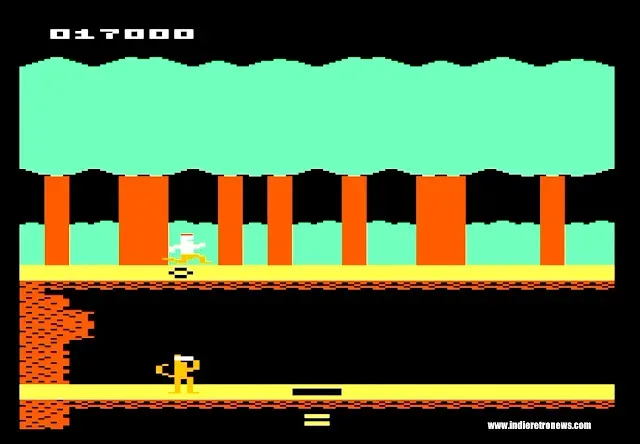
Pitfall II: Lost Caverns has received an ambitious new fan port for the Commodore VIC-20, targeting systems equipped with a 35K memory expansion. Created by programmer gekka and written entirely in 6502 Assembly, the 2026 homebrew project revisits Pitfall Harry's underground adventure on one of Commodore's most modest 8-bit machines.
The release is particularly notable for including Level 2 from the Atari 5200 version of Pitfall II. That area substantially enlarges the game's explorable subterranean world, and it was not present in many other editions of the classic adventure. For retro players who know the game through versions with a reduced environment, the VIC-20 adaptation aims to offer a broader expedition through tunnels, hazards, enemies, and treasure-filled caverns.
It is a technically striking fit for the VIC-20. The computer remains beloved for its early place in Commodore history, but its limited native memory means that expansive arcade-style worlds demand careful engineering. Requiring a 35K expansion gives this homebrew considerably more room to pursue its larger interpretation of Lost Caverns, while retaining compatibility with both PAL and NTSC VIC-20 hardware.
An Expanded Journey for Pitfall Harry
Pitfall II: Lost Caverns sends players back into the boots of Pitfall Harry for a dangerous trip beneath the surface. Rather than limiting the experience to a simple run through isolated screens, the adventure is built around an interconnected underground setting. Winding passages lead toward valuables and objectives, but the route is filled with lethal subterranean opposition and the ever-present risk of a poorly timed jump.
For useful background on this topic, read Mega Darkula Brings a Light-Smashing Vampire Adventure to Sega Mega Drive.
That structure is a major part of why Pitfall II remains memorable among early action-adventure games. Exploration is not merely decorative. Players must learn the cavern layout, recognize where hazards sit within individual screens, and decide how to safely advance through hostile territory. A missed jump or a collision can turn an apparently familiar route into a dangerous recovery attempt, especially when progress depends on reaching areas deeper in the cave network.
The inclusion of Atari 5200 Level 2 matters because it restores more of that sense of scale. Larger environments create more opportunities for discovery, but they also place a greater demand on navigation and player memory. The VIC-20 release gives its audience an opportunity to tackle that expanded space on hardware that originally operated under sharply constrained technical conditions.
For fans of vintage home computer games, this is more than a straightforward conversion. It is an example of how homebrew developers continue to revisit well-known games with an eye toward versions, features, or areas that earlier ports left behind. In this case, the focus is on bringing a more extensive Pitfall II experience to the VIC-20 configuration capable of supporting it.
For another perspective on this story, read Pitfall II: Lost Caverns Reaches the VIC-20 With a 35K Expansion.
Built Entirely in 6502 Assembly
Gekka coded the project entirely in 6502 Assembly, a detail that speaks to the kind of close hardware work involved in developing for the VIC-20. The 6502 processor family is foundational to a wide range of classic systems, but programming in Assembly means directly managing a machine's limited resources rather than relying on the abstractions common to modern game development tools.
That approach is especially relevant on the VIC-20. Memory, display considerations, game logic, animation, input handling, and level data all need to coexist within a tightly controlled technical environment. Expanding the game's world with the Atari 5200 version's Level 2 naturally increases the challenge, making the 35K memory requirement an essential part of this particular release rather than a minor optional enhancement.
The result also highlights the continuing vitality of the retro development community. Decades after the VIC-20's original era, creators are still producing software specifically designed around its strengths and restrictions. These projects are often as much exercises in technical craft as they are playable games: they require a detailed understanding of old hardware while addressing the expectations of players who may now encounter the system through original machines, modern storage solutions, or carefully assembled retro setups.
What Hardware Is Required?
Players will need a PAL or NTSC Commodore VIC-20 with a 35K memory expansion to run this version of Pitfall II: Lost Caverns. The stated support for both major video standards is useful for a hobbyist community spread across regions with different original hardware formats.
The game supports two control methods:
- Keyboard controls for players using the VIC-20's built-in input.
- Joystick controls for those seeking a more traditional action-game setup.
Supporting both options makes the project more approachable across different retro configurations. Keyboard play can be convenient for users working directly from a computer setup, while joystick input is likely to appeal to players pursuing an experience closer to the original home and console action-game feel. It also means owners can choose their preferred method without the port being limited to a single style of control.
Potential players should note that the memory expansion is not presented as optional. A standard, unexpanded VIC-20 does not meet the stated requirement for this homebrew release. The larger memory configuration is what enables the project's more ambitious scope, including the Level 2 content drawn from the Atari 5200 edition.
Why the Atari 5200 Content Stands Out
Classic games often have complicated port histories. Different releases may share the same title and central premise while varying in layout, audiovisual presentation, content, or overall scale. For a game as widely remembered as Pitfall II, those distinctions are important. Players who first encountered one edition may not have seen every area included in another.
By incorporating Level 2 from the Atari 5200 version, gekka's VIC-20 project is positioned as an expanded interpretation rather than simply a recreation of a smaller adaptation. The added environment offers a clear draw for longtime fans: it creates a reason to return even for those already familiar with Pitfall Harry's classic underground quest.
It is also the kind of preservation-minded detail that can make modern retro releases compelling. Homebrew work does not always have to be about creating entirely new characters or worlds. It can also investigate the history of an existing game, recognize where versions differed, and build a new release around content that deserves another chance to be played on a particular platform.
A New Reason to Revisit the VIC-20
The VIC-20 has long held a special place in retro computing because of its accessibility and historical importance, yet its specifications can make this kind of large-scale fan project feel unexpected. That contrast is central to the appeal of Pitfall II: Lost Caverns on the platform. A game associated with a sprawling underground setting has been reshaped for a machine with limited baseline resources, then extended through a substantial memory expansion.
For collectors with a compatible VIC-20 setup, the port offers a fresh reason to put the machine through its paces. For enthusiasts who follow current 8-bit development, it demonstrates that familiar properties can still inspire technically focused projects in 2026. And for players drawn to the history of Pitfall II itself, the Atari 5200 Level 2 inclusion makes this more than a nostalgia exercise.
There is no need to treat the release as a replacement for every prior version of the game. Its value lies in its own combination of hardware target, expanded content, and low-level development effort. The VIC-20 edition brings Pitfall Harry back to the caverns with keyboard and joystick support, PAL and NTSC compatibility, and a world larger than the one many players may remember.
Pitfall II: Lost Caverns is therefore a welcome addition to the VIC-20 homebrew scene: a fan-made, 6502 Assembly-driven project that embraces the limitations of classic hardware while pushing beyond them with a 35K expansion. For retro adventurers prepared to navigate dangerous tunnels in search of hidden treasure, the lost caverns are open once again.
Community
Discussion
Start the conversation.
No comments have been posted yet.