

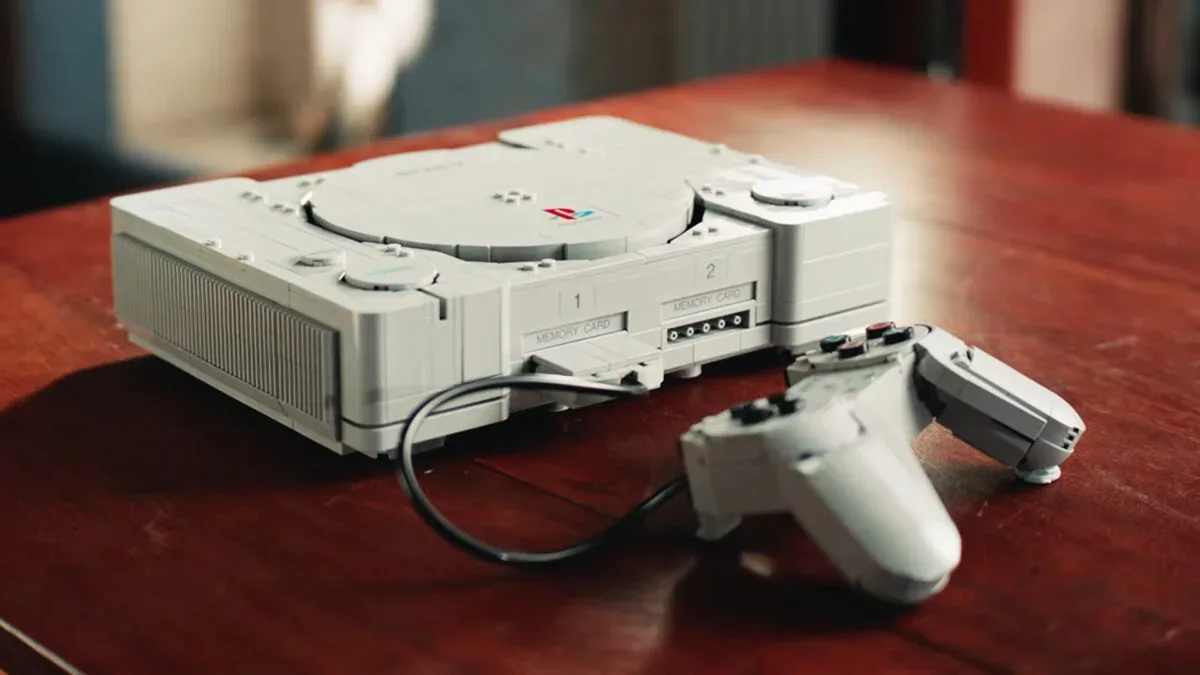
Sony and Lego have officially unveiled a new brick-built model of the original PlayStation console, turning one of gaming's most recognizable pieces of hardware into a 1,911-piece display set. The upcoming PlayStation Lego set recreates the gray 1994 console at near-scale and includes details designed to appeal to longtime fans, from its familiar panel layout to a matching controller and a disc compartment that can actually be opened.
It is a nostalgia-heavy release with a particularly notable mechanical feature: the console's top lid lifts up to reveal a modeled disc tray underneath. The set also includes a clickable power button, adding another interactive touch to what is primarily intended as a collectible display piece. Sony showed the set during its latest State of Play presentation on Thursday, following images and information that had surfaced earlier that day.
The set costs $180 USD. Orders will open directly through PlayStation on October 1, while Lego Insiders can also place orders through Lego's website that same day. Wider availability through Lego stores and the company's website begins October 4.
A PlayStation icon rebuilt in bricks
The original PlayStation is one of the defining game consoles of the 1990s, and Lego's design appears focused on preserving the machine's visual identity rather than radically reimagining it. The model uses the first PlayStation's signature gray exterior, broad rounded form, circular disc lid, front controller ports, and familiar button placement. The accompanying controller reinforces that early PlayStation look, making the package feel like a miniature hardware snapshot from the era that helped establish Sony as a major force in games.
For useful background on this topic, read PlayStation State of Play Chat Fills With Destiny 3 and Physical Media Protests.
For collectors, the appeal is similar to Lego's other gaming hardware recreations. The company has previously adapted systems including the Nintendo Entertainment System, Atari 2600, and Game Boy into brick sets built around recognizable design cues and smaller interactive flourishes. The PlayStation joins that growing category, although its design naturally places more attention on the physical media mechanism at the center of the console.
The newly revealed model does not merely suggest that the original PlayStation played discs. Its lid opens, and the disc tray is clearly visible. Sony's promotional footage even highlights the action of opening the console. That may seem like an obvious inclusion for a replica of the first PlayStation, but it has also made the timing of the reveal a major talking point among fans.
The disc drive has become the center of the conversation
Earlier this year, Sony announced that it will stop producing new physical PlayStation games beginning in 2028. The decision has generated a sustained negative response from some players, particularly those concerned about ownership, preservation, used-game access, and the practical limits of all-digital libraries.
Against that backdrop, a commemorative Lego PlayStation prominently featuring a working disc lid has drawn plenty of ironic reactions online. Fans have joked that Sony is delivering one more PlayStation console with a disc drive, albeit one made from plastic bricks. Others have focused on the functional tray as a pointed reminder of what physical media represented for earlier generations of PlayStation hardware.
The response has also extended to hopes for Sony's next major console. Some players are asking the company not to abandon disc-based options when the eventual PlayStation 6 arrives. No details about that hardware have been announced here, and the Lego model is strictly a recreation of the past, but its mechanical lid has become an unexpectedly visible symbol in the wider argument over PlayStation's digital direction.
The set celebrates the original console's design at a moment when the future of physical PlayStation releases is under intense debate.
That contrast is difficult to miss. The original PlayStation's optical drive was fundamental to its identity. Compact discs allowed Sony's first console to offer larger games, extensive audio, full-motion video, and a format that sharply distinguished it from cartridge-based competitors of the time. Opening the lid, placing a game disc inside, and closing it was part of the ordinary ritual of playing on the system. A Lego replica that preserves that action is therefore accurately recreating more than the hardware's silhouette; it is capturing a small part of how players interacted with it.
Physical media concerns remain unresolved
Sony's planned move away from producing new physical PlayStation games has prompted heavy criticism across its social channels and customer-support lines. Some fans have said they intend to avoid future PlayStation consoles, while others have continued pressing the company to reconsider the 2028 plan.
The volume and tone of some reactions have reportedly led Sony to introduce policies intended to protect support workers from toxic abuse. The dispute over physical releases has clearly become more than a routine disagreement over formats. For many players, discs represent the ability to lend games, resell them, build personal collections, shop across retailers, and access titles without relying entirely on digital storefronts and account systems.
Digital distribution offers its own conveniences, including instant purchases and downloads without changing discs, but the concerns voiced by physical-media supporters are longstanding. A digital purchase is tied to platforms, licensing terms, servers, and account access in ways that a boxed game is not. Preservation advocates have also argued that the industry needs stronger plans for ensuring older games remain available as storefronts and services evolve.
None of those broader issues will be solved by a Lego set, of course. Still, the model's release has created a strange cultural moment for PlayStation: the company is commemorating one of the most famous disc-based consoles ever made while preparing for a future in which it no longer produces new physical games.
Release details for collectors
The PlayStation Lego set contains 1,911 pieces and carries a $180 USD price tag. The first ordering window begins October 1 through PlayStation's direct storefront. Lego Insiders can buy it through Lego's website on the same date. General availability starts on October 4 at Lego stores and through Lego's website.
- Set: Original PlayStation console replica
- Piece count: 1,911 pieces
- Price: $180 USD
- PlayStation direct orders: October 1
- Lego Insiders orders: October 1
- General Lego availability: October 4
- Included features: Brick-built original PlayStation, controller, clickable power button, opening top lid, and functional disc tray detail
As with Lego's previous gaming-focused display sets, the audience is likely to include both dedicated Lego builders and players who grew up with the hardware being recreated. The original PlayStation has remained a powerful nostalgia object for decades, partly because of the library it hosted and partly because of its distinctly industrial design. Even people who have moved on to later PlayStation generations tend to recognize its shape immediately.
The $180 price positions it as a premium collectible rather than an impulse purchase, but the 1,911-piece count and working elements suggest the build is designed to feel substantial. Its appeal is not simply that it looks like a PlayStation from a distance. The small functional details are what connect it to the console's history, especially the click of a button and the opening of the lid over a disc tray.
A celebration with awkwardly perfect timing
There is no question that the Lego PlayStation is built to celebrate a foundational piece of gaming history. It takes a console associated with the transition to CD-based games and transforms it into a hands-on construction project. Yet that same choice has given the set a significance beyond nostalgia, at least in the immediate reaction from fans.
For supporters of physical games, the replica's conspicuous disc drive feels like a reminder of a feature they do not want to see disappear from PlayStation's future. For collectors, it is another detailed gaming artifact joining Lego's expanding lineup. And for Sony, it is an affectionate tribute to the machine that began the PlayStation era--even as debate continues around what that era's next chapter will look like.
Community
Discussion
Start the conversation.
No comments have been posted yet.