

Final Fantasy has built much of its identity on memorable beginnings. Whether it is a party of rebels leaping from a train, a lone figure approaching a city in snow-covered armor, or a theatrical kidnapping unfolding inside a royal castle, Square Enix's long-running RPG series understands the value of a first impression. Its best openings do more than introduce combat systems and characters. They establish a world, signal a tone, and give players a reason to keep pushing forward.
Few games in the series accomplish all of that as forcefully as Final Fantasy X. A quarter-century after its PlayStation 2 debut, the beginning remains astonishingly confident: loud, strange, melancholy, stylish, and deliberately difficult to explain. The HD remaster is also arriving on Switch 2 this week, providing another opportunity to revisit an opening that has lost remarkably little of its power.
There is a strong argument for Final Fantasy VII as the franchise's definitive introduction. Its camera move from the stars to Midgar, its immediate plunge into an anti-corporate bombing mission, and the sight of Cloud Strife jumping from a speeding train have become foundational images for video games. But Final Fantasy X reaches for something different. It is less interested in quickly defining the rules of its setting than in overwhelming the player with an event that feels impossible to comprehend.
That combination of spectacle and controlled uncertainty is why the Zanarkand sequence still stands above an unusually competitive field.
For useful background on this topic, read Ubisoft Statement Fuels September 10 Nintendo Direct Speculation.
The challenge of a great Final Fantasy introduction
Opening hours are a difficult balancing act for role-playing games. Developers need to teach basic mechanics, establish stakes, offer enough story context to make events meaningful, and avoid exhausting players before the journey has truly begun. Final Fantasy games have approached that task in radically different ways across generations.
Final Fantasy VI, for instance, opens with an image that was enormously evocative in the 16-bit era: Magitek Armor advancing through a blizzard toward Narshe. The scene's visual impact is naturally less startling now than it was on the Super Nintendo, but its atmosphere endures. The Empire's looming threat, Terra's condition under mind control, and the mysterious frozen Esper create immediate intrigue. Importantly, the game moves briskly from discovery to escape, rather than lingering on exposition.
It also gives players an unusual early advantage. Magic-powered armor easily eliminates enemies that would ordinarily pose a threat, a satisfying reversal of the vulnerable opening common to many RPGs. The sequence establishes a militarized world and a mystery surrounding Terra without wasting much time.
Final Fantasy IX excels for nearly opposite reasons. Its opening is playful, varied, and theatrical. Rather than beginning with another standard encounter against weak monsters, it lets players participate in a troupe's stage production while a kidnapping plot unfolds beneath the performance. Vivi's early exploration of Alexandria gives the game a gentler entry point, while Zidane and the Tantalus crew provide energy and mischief.
The structure is especially elegant. A short introduction to Alexandria leads into the play, then into the attempted escape, and eventually a crash landing outside the city. The changing perspectives, small exploration beats, and dramatic framing give the opening a satisfying rhythm. It is a particularly effective showcase for the original PlayStation's late-era cinematic craft, using pre-rendered sequences and character animation to evoke an older, more fairy-tale-like Final Fantasy sensibility.
Final Fantasy VII remains the closest rival
For pure efficiency, it is hard to beat Final Fantasy VII. Its introductory movie remains one of the most famous visual sequences in the medium. The camera begins in space, settles briefly on Aerith in a Midgar alley, pulls back to reveal the vast industrial city, and races toward the train carrying Avalanche. In only a few minutes, it presents a world defined by machinery, pollution, corporate control, and enormous scale.
Then it hands control to the player in the middle of a mission. Cloud arrives as a mercenary working alongside a resistance group that is already attacking Shinra's Mako Reactor 1. There is no lengthy prologue in a safe village and no slow tour through basic lore. The game trusts the urgency of the moment to carry the player into its systems and politics.
The early combat is simple but memorable in context. Cloud's magic, Barret's gun arm, and the 3D battle presentation were immediately striking in 1997. The opening climaxes with the Scorpion Sentinel, a boss encounter that feels appropriately enormous for that point in the adventure, followed by a countdown and a reactor explosion. It is a complete action sequence, not merely a tutorial.
If Final Fantasy VII is the series at its most direct and iconic, however, Final Fantasy X is the series at its most dreamlike.
Zanarkand begins as a celebration
Final Fantasy X does not initially look like a disaster story. Zanarkand is presented as a futuristic ocean city preparing for a major blitzball match. Tidus is a celebrity athlete, surrounded by fans, floodlights, massive architecture, and the expectation of spectacle. This is an effective choice because it makes the destruction that follows feel like an interruption of a life already in motion.
The opening's music is central to that effect. "Otherworld," featuring vocals by Till I Die's Bill Muir, is not the kind of track traditionally associated with a Final Fantasy introduction. Its aggressive metal sound lends the sequence an almost rebellious, early-2000s edge. Yet the game uses that intensity with surprising precision rather than simply blasting it over nonstop chaos.
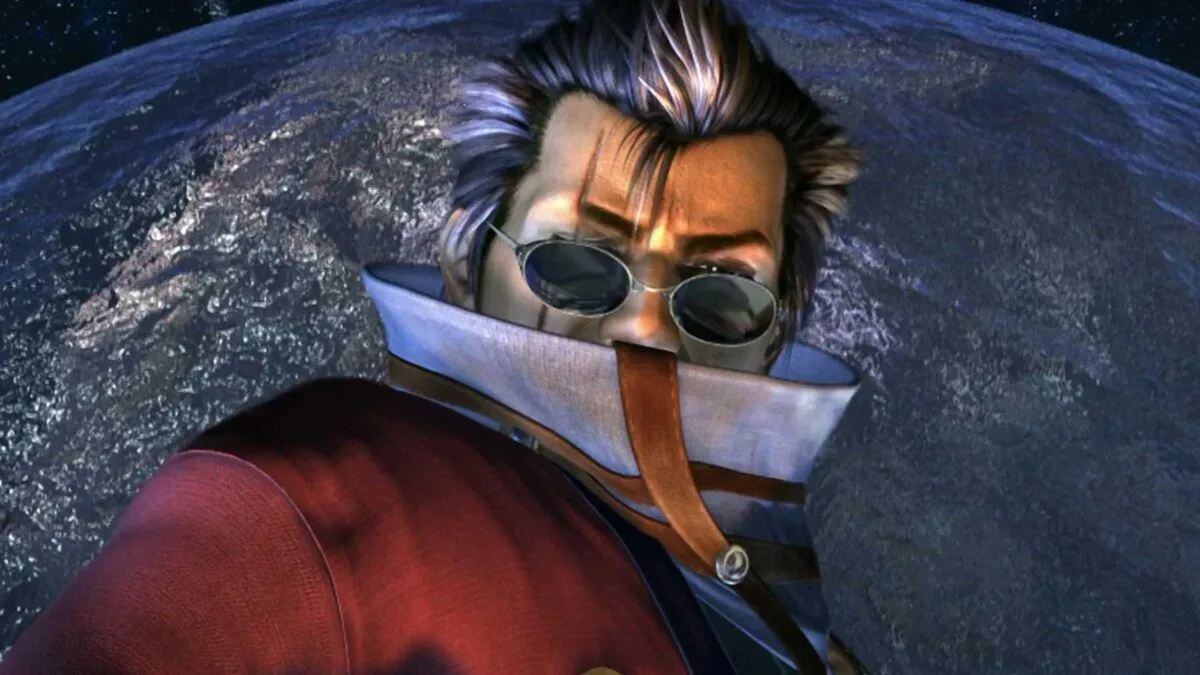
At the same time, Auron appears in a series of images that are as memorable as anything in the franchise. He moves along skyscraper ledges with his enormous sword, carrying himself with the calm of someone who knows exactly what is coming. His sake-spitting flourish is absurdly cool, but it also makes him an instant question mark: who is this man, why is he here, and why does he seem so prepared for the end of the world?
Then Sin arrives.
The sequence's strongest moments come from its editing and sound design. There is a lull as Auron's boot lands in a puddle. Water begins to behave unnaturally, splashing upward as if gravity has reversed. The city is swallowed by a colossal phenomenon that feels somewhere between a sea creature, a natural disaster, and a black hole made of water. The imagery has the heightened unreality of a nightmare, but it remains legible enough that players understand the essential fact: Zanarkand is being erased.
Mystery without total confusion
Many games attempt an opaque opening in hopes of creating mystery. The risk is that players can become detached if nothing makes emotional or practical sense. Final Fantasy X avoids that trap because, even when the larger context is hidden, the immediate situation is clear.
Tidus wants to survive. Auron is trying to lead him somewhere. A vast entity called Sin has attacked the city. The pair must escape through collapsing streets and wreckage. Those are simple, playable objectives, even if the player cannot yet know what Sin is, where Zanarkand fits into the world, or why Auron is involved.
The game's early battles are not its finest opening-combat showcase. Tidus and Auron spend much of the sequence cutting down relatively minor enemies, and the larger obstacles lack the memorable shape of the Scorpion Sentinel or some later Final Fantasy bosses. A tentacled structure and a mechanism that must be destroyed to trigger an escape do their job as interactive stakes, but neither becomes a lasting symbol of the game.
That weakness barely matters because the action supports the scene's momentum. Combat is not the star. It is a way to make the catastrophe feel navigable, giving players a role inside an event that is otherwise far bigger than them.
What the opening promises
By the time Tidus is consumed by Sin, Final Fantasy X has made a promise that few RPG introductions can match: this story is going somewhere players cannot yet predict. Tidus is not simply leaving home to become a hero. He appears to have been taken from one reality and thrown toward another. His fame, his strained relationship with his father, Auron's cryptic guidance, and the nature of Sin are all left hanging.
Those unanswered questions are powerful fuel, particularly because the game has first made Zanarkand feel tangible. It is not just a lore concept mentioned in a text box. Players have seen its crowds, its neon-lit skyline, its sports culture, and its destruction. The loss lands before the journey has even properly begun.
Later sections immediately after the opening can feel slower and more awkward by comparison, especially as the game starts laying out controls and placing Tidus in unfamiliar circumstances. But the force of the introduction carries it through. Players want answers, and the game has made them feel earned.
A standard few games can meet
Final Fantasy XIII deserves recognition as another visually spectacular start, particularly for its first major outing on PlayStation 3 and Xbox 360. Lightning's prison-transport escape arrives with lavish science-fantasy imagery, energetic ATB combat, and an urgent forward drive. Cocoon looks magnificent in the background, and the opening's relentless momentum helps disguise how much terminology and worldbuilding is initially being thrown at the player.
But its cinematic polish can feel like a promise the broader game struggles to sustain. Final Fantasy X, meanwhile, uses its grand opening to establish a mystery that remains directly tied to the emotional core of its story.
That is the difference. The best Final Fantasy openings do not merely look impressive; they give every image a purpose. Final Fantasy X uses a blitzball star, a grim swordsman, a metal song, a drowned city, and a monster called Sin to create a beginning that is both huge in scale and intensely personal. It is an opening built to make players ask questions, but it gives them enough feeling to care about the answers.
Twenty-five years later, Zanarkand's fall is still the series' most electrifying first act.
Community
Discussion
Start the conversation.
No comments have been posted yet.