


The approaching shutdown of Pokémon Bank has put renewed attention on one of the stranger and more emotional problems in Pokémon preservation: what happens when creatures stored on decades-old cartridges can no longer make the journey to modern games?
Pokémon Bank, the Nintendo 3DS-era storage application that has long served as a transfer bridge for older Pokémon titles, is scheduled to close on February 25, 2027. For players who have maintained collections across multiple handheld generations, that date represents more than the loss of an app. It threatens to sever a carefully maintained path connecting Game Boy Advance games to the current Pokémon ecosystem centered on Pokémon Home.
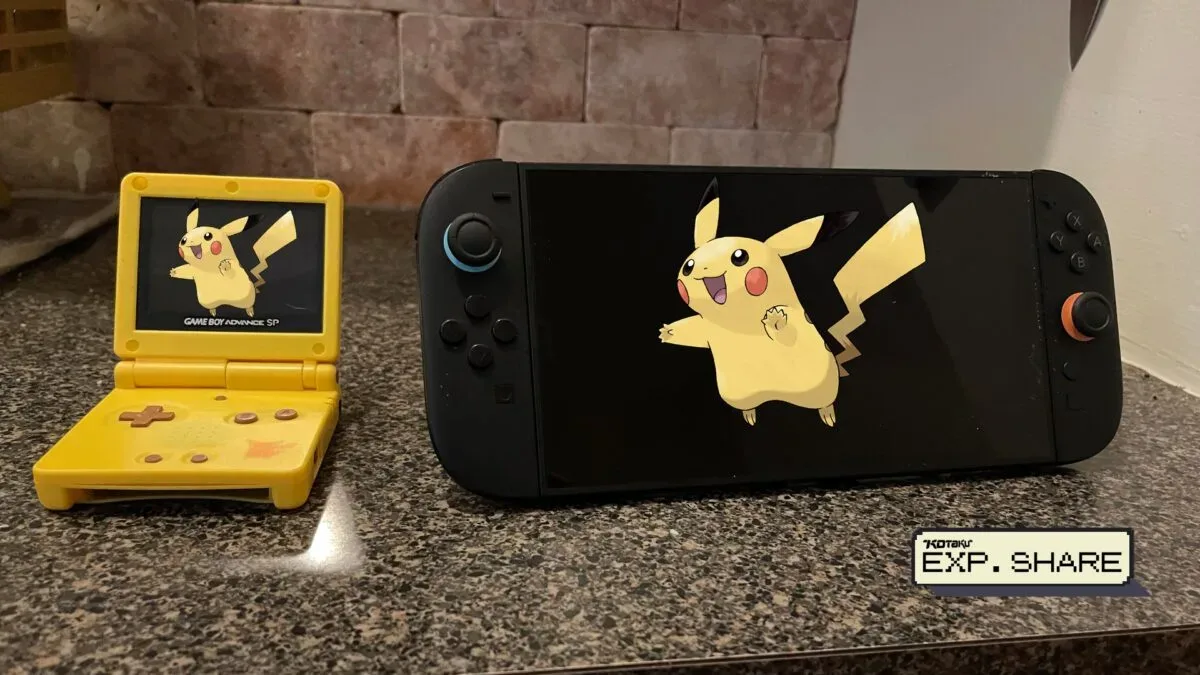
One independent developer, Andrew Henley, is attempting to build a new kind of bridge. Henley has shown a working prototype of an adapter designed to facilitate a trade between Pokémon FireRed and LeafGreen on original Game Boy Advance hardware and the Nintendo Switch version released earlier this year. The project remains early and is not yet a consumer product, but the demonstration points to a potentially remarkable possibility: legacy cartridges and a modern Nintendo console exchanging Pokémon directly.
Embedded X/Twitter post
A bridge between hardware generations
Under normal circumstances, a Game Boy Advance and a Nintendo Switch have no reason to understand one another. They were built roughly two decades apart, use vastly different connection technologies, and were never designed to participate in the same multiplayer session. The older handheld expects peripherals and communications systems from its own era, while Switch software operates through a completely separate framework.
For useful background on this topic, read Gabe Newell's Old Valve Lecture Finds New Life as Players Revisit the Case for Staying Private.
Henley's device is intended to sit in the middle of those two incompatible environments. Rather than altering the original cartridge or modifying the Switch game, the adapter acts as a translator. It receives the communications protocol expected by one side, converts it in real time, and presents it in a form the other side can use.
That distinction is important. A project that required patched ROMs, custom game code, or permanent alterations to a treasured cartridge would be difficult for many collectors to embrace. Henley's stated aim is for the original games to continue behaving as they ordinarily would. The hardware bridge handles the compatibility work instead of asking the software itself to know anything about systems that did not exist when it was made.
"I thought there was something compelling about being able to take a Pokémon that still exists on an original Game Boy Advance cartridge and let it interact with a modern system while still preserving that original hardware experience," Henley said of the project's origins.
The prototype began as a personal passion project, motivated by a desire to move Pokémon between original cartridge games and their Switch releases. From there, it evolved into a complicated technical undertaking involving synchronization, reliable real-time messaging, extensive debugging, and a great deal of trial and error.
Why Pokémon Bank matters so much to older collections
For years, moving a Pokémon from older games into a contemporary title has rarely been simple, but the franchise at least provided an official chain of tools. A Pokémon could travel from a Game Boy Advance game through later Nintendo DS titles, then onward through services and applications including Poké Transporter, Pokémon Bank, and ultimately Pokémon Home.
That route has always had restrictions. It requires specific compatible games and systems, a sequence of transfer steps, and enough working hardware to complete every stage. It is also generally a one-way trip: once a Pokémon reaches a newer generation, it typically cannot return to the older cartridge it came from. Still, the existence of the pathway allowed players to preserve long-running teams, event Pokémon, shinies, ribbons, and creatures associated with individual childhood save files.
Pokémon Home has become the franchise's broader, platform-agnostic storage center, but it does not erase the problem of getting data from the oldest supported games into that system. Bank's closure makes the remaining official route time-sensitive. Players hoping to move Pokémon from the Game Boy Advance era and related legacy games should not assume that future access will be available once the service goes offline.
That urgency helps explain why a direct Game Boy Advance-to-Switch connection has attracted interest. Even as a hobbyist technical project, it speaks to a concern shared by collectors and longtime fans: preserving a Pokémon does not just mean copying data somewhere safe. For many people, it means retaining a meaningful connection to the original hardware, save file, and game experience where that Pokémon was first caught.
Translation rather than game modification
Henley describes the adapter at a high level as hardware and software that translate communication between the two systems. Crucially, it generally does not need to interpret every piece of game-specific information being exchanged. Much of the traffic can be treated as opaque data, with the bridge focused on accurately carrying messages between different communication methods.
That approach could have advantages beyond the immediate Pokémon use case. If the adapter can faithfully relay compatible communications without rewriting the games on either end, it could become an example of how old and new game hardware might coexist while respecting the original devices. Henley has said the work is designed around interoperability, leaving open the possibility of applications outside Pokémon in the future.
That does not mean every old title could suddenly work with modern consoles. Each game and platform has its own assumptions, protocols, features, and technical limitations. Pokémon is a particularly compelling starting point because trading is a foundational part of the series, and because its individual creatures have value that follows players from game to game. A successful proof of concept in this space nevertheless suggests that connections once dismissed as impossible may be more achievable than they appear.
An unfinished project, not a replacement for Bank
Fans should keep expectations measured. Henley has made clear that there is still substantial work ahead before the adapter is ready for wider release. The eventual goal is a production-level, plug-and-play solution with minimal friction for players connecting a Game Boy Advance to a Switch, but a working prototype is not the same as a finalized peripheral.
There are practical challenges in turning a one-off demonstration into hardware that other people can use confidently. A consumer-ready device would need stable behavior across different consoles and cartridges, straightforward setup, clear documentation, dependable manufacturing, and a design that does not put valuable save data at risk. Pokémon players can be understandably cautious when a device interacts with collections that may have taken years to build.
The project is independent and has no official affiliation with or endorsement from Nintendo. Henley has received help from open-source work and research by Pokémon homebrew and console-communications specialists Yannik and Tornadus11. Interest from players looking for cross-generation trading options has encouraged continued development toward a more polished version.
Nintendo could theoretically create an official solution more easily, given access to its own platforms and software ecosystem. But a specialized peripheral for hardware that has been out of production for years would be an unusually niche product to prioritize. Henley has acknowledged that the company has an enormous range of games, services, and systems to support, while also leaving room for the possibility that Nintendo could pursue its own plans someday.
What players should do before February 2027
Anyone who wants to preserve Pokémon through the existing official transfer path should treat the Bank closure date as a real deadline rather than wait for an unofficial alternative to mature. A Game Boy Advance-to-Switch adapter may eventually offer an exciting new option, but there is no announced release date, no confirmation of public availability, and no guarantee that it will be ready before Pokémon Bank shuts down.
- Check older saves now: Identify cartridges and Nintendo DS or 3DS systems that may contain Pokémon you want to keep.
- Confirm your transfer chain: Older transfers can require several games, compatible hardware, and specific apps before a Pokémon reaches Pokémon Home.
- Do not leave transfers to the final days: The process can be complicated, and working through it early provides time to resolve account, hardware, or compatibility issues.
- Follow prototype development carefully: Treat demonstrations as promising technical progress, but wait for concrete details before assuming a retail-ready adapter exists.
The looming end of Pokémon Bank highlights an awkward truth about games built around long-term collections: digital infrastructure can disappear even when the cartridges, consoles, and memories remain. Henley's prototype cannot yet solve that problem for everyone, but it offers a fascinating vision of preservation through connection rather than replacement. If it reaches the plug-and-play stage its creator hopes for, a Pokémon caught on a Game Boy Advance cartridge could once again have a path to meet a modern world--while the original cart stays exactly what it has always been.

Community
Discussion
Start the conversation.
No comments have been posted yet.