

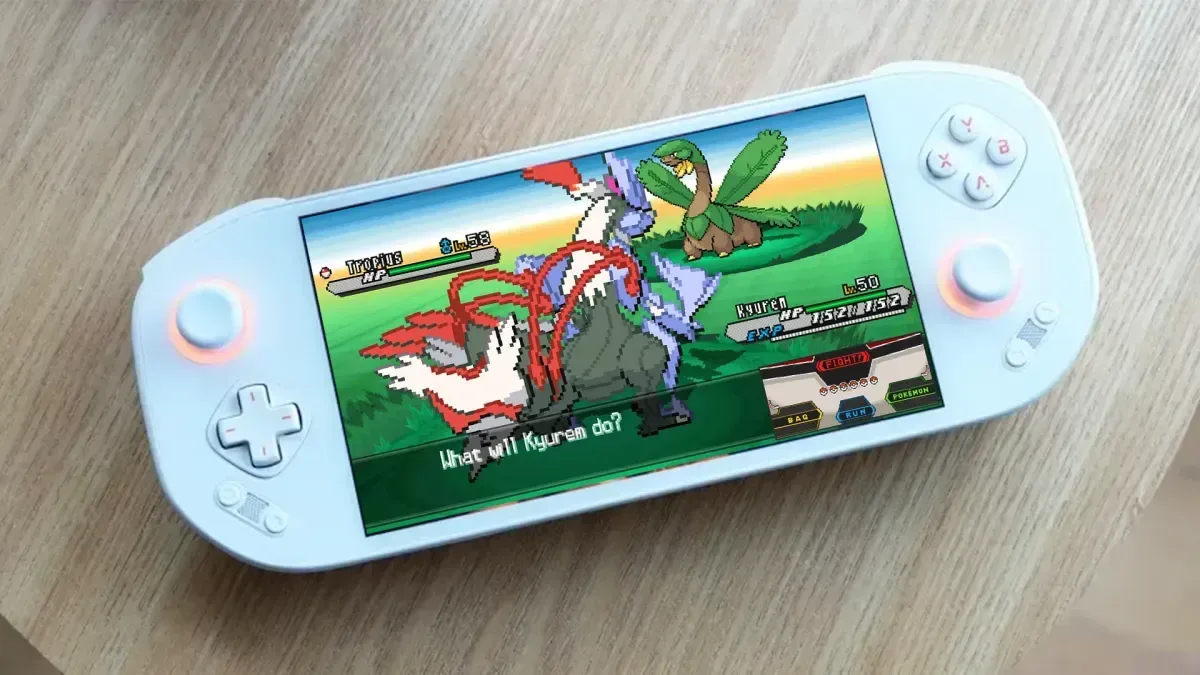
Pokémon games built for the Nintendo DS have always presented a small but persistent challenge for players returning to them on modern hardware. The original systems were defined by two displays: one largely dedicated to exploration and battles, and another that handled menus, maps, touchscreen controls, and a rotating collection of useful information. That design made perfect sense on a clamshell handheld. It can feel considerably less elegant on a television, a desktop monitor, or a wide handheld screen.
Pokémon FullDex, a new project from developer mamesj, is designed to address that issue by arranging supported Pokémon adventures into a single widescreen presentation. Rather than merely putting the DS screens beside one another or stacking them vertically, the application uses an added game-aware layer intended to determine what is happening in play and place the important material into one cohesive view.
The result is meant to make these games more comfortable to use on contemporary displays while retaining the original game experience. Pokémon FullDex is not a native remake or conversion of Nintendo's games. It runs users' own game files through included emulator technology, then changes how the information is displayed. The project advertises widescreen output, a 60fps presentation, and support for resolutions up to 4K.
A different answer to the dual-screen problem
Traditional Nintendo DS emulation generally asks players to compromise. They may use a vertical arrangement that imitates the shape of the original handheld, place both displays side by side, assign one screen to a hotkey, or shrink the secondary display so the main action can take priority. Every option works, but each can make menus harder to read or force a player's eyes to move constantly between different parts of a large display.
For useful background on this topic, read Lego Yoshi Teased for 2027 as Nintendo's Next Large Super Mario Build.
Pokémon FullDex takes a more tailored route. Its key feature is a layer that recognizes the game's current context, including whether a player is exploring, navigating menus, or in a battle. It then rearranges the relevant interface elements into a single widescreen image. In principle, that should allow the lower-screen functions that matter at a particular moment to remain accessible without permanently sacrificing a large part of the display to an always-visible second panel.
That focus makes the project especially relevant to the Pokémon entries whose systems became increasingly menu-heavy on DS. Party management, Pokétch features, bag organization, touch controls, battle selections, maps, and assorted utility screens all benefited from the original hardware's second display. A customized one-screen approach could make long sessions feel less awkward for people playing at a desk, on a TV, or on handheld PCs with wider screens.
Supported Pokémon games
The current listed support covers several major Pokémon releases from the DS era, plus a selection of Game Boy Advance games and one fan-made modification. The supported titles are:
- Pokémon Black
- Pokémon White
- Pokémon Black 2
- Pokémon White 2
- Pokémon HeartGold
- Pokémon SoulSilver
- Pokémon Platinum
- Pokémon Emerald
- Pokémon FireRed
- Pokémon LeafGreen
- Pokémon Ultra Violet, a FireRed hack
The DS games are the most obvious fit for the software's single-screen reorganization, since they were originally designed around two panels. However, inclusion of the Game Boy Advance-era games broadens the package beyond that particular problem. It also gives players a way to keep several generations of Pokémon adventures in a unified application and interface.
Pokémon Ultra Violet's appearance in the support list is also notable. As a modification based on FireRed, it suggests that FullDex may be of interest to the active Pokémon ROM-hack audience as well as players revisiting the official releases. That does not automatically mean every hack based on a supported game will behave correctly, and users should not assume unsupported projects are compatible. Still, the listed hack indicates that the software's ambitions extend beyond a strictly stock-game setup.
Built on familiar emulation cores
FullDex incorporates the melonDS emulator core for Nintendo DS software and the mGBA core for Game Boy Advance titles. The project's approach means those cores are built into the application, so users do not need to separately install another emulator before setting it up. The additional FullDex layer is what handles the specialized screen presentation.
That foundation also brings in features many retro players expect from a modern emulator environment. Pokémon FullDex includes cheat support and RetroAchievements support. Cheats can be useful for everything from experimentation to reducing repetitive grinding, though their use remains entirely optional and can affect the intended balance of a game. RetroAchievements, meanwhile, can add structured challenges and objectives for players who want an extra reason to revisit well-known regions and generations.
As with any emulator-based setup, compatibility, performance, control configuration, and display behavior can depend on the device being used. The advertised 60fps output and high-resolution options will be particularly appealing to players with capable PCs or newer handheld hardware, but it is sensible to treat performance expectations as hardware-dependent. The original games were made for much more modest devices, yet modern display enhancements and customized layouts still require a well-configured emulation environment.
Where Pokémon FullDex can be used
The project is listed for a broad range of devices. That includes PC, Linux, Mac, Steam Deck, other handheld PCs, Android handhelds, iPhone and iPod devices, and modified Nintendo Switch systems. Such coverage matters because the ideal way to play a long Pokémon RPG varies greatly from one person to another.
On a PC, the single-screen layout could be useful for players who want to enjoy an old Pokémon campaign on a large monitor without giving up a clean presentation. Steam Deck and similar handheld PCs are another natural match, combining portable play with screens that are far wider than the DS displays the games were designed around. Android handhelds may be particularly attractive for retro-focused players who already keep an emulation library on a compact device.
Support for modified Switch systems similarly puts the project in the hands of users who want a console-style setup, although modification carries its own technical, security, warranty, and policy considerations. The project is not presented as an official Nintendo product, and it should not be mistaken for a release through Nintendo's own stores or services.
Using personal game files remains essential
Pokémon FullDex does not supply commercial Pokémon games. Players are expected to use their own personal ROM files. That distinction is important: emulation software and game files are separate matters, and the project does not remove the need for users to ensure that the material they load is obtained and used lawfully in their region.
For players with legitimate dumps from their own collections, the software's appeal is straightforward. It offers a way to revisit Pokémon Black and White, the direct sequels, HeartGold and SoulSilver, Platinum, and older Game Boy Advance entries with a display philosophy built for current hardware instead of the physical limits of a 2000s-era handheld.
It could also be a compelling option for returning players who have delayed replaying DS Pokémon games specifically because they disliked conventional emulator layouts. The Pokémon series has no shortage of mechanics that draw a player into extended sessions: team building, breeding, item hunting, exploration, post-game battles, and repeated attempts at difficult encounters. Reducing the friction involved in handling two virtual screens may make those hours more inviting.
An AI-assisted project worth evaluating carefully
One additional point deserves attention before downloading or installing the application. Pokémon FullDex has been heavily assisted by AI, specifically Claude. That disclosure will mean different things to different players and developers. Some may focus on whether the program works well and is maintained responsibly, while others may prefer not to use software developed with substantial AI assistance.
Regardless of an individual's position on AI-assisted development, basic caution is appropriate with any new emulation tool. Users should review the project materials, check device compatibility, understand permissions and installation steps, and exercise normal security judgment before running software or moving game files onto a device. Players who rely on saves from other emulators should also back them up before experimenting with a new setup.
Pokémon FullDex's main idea is easy to understand: these games can still be excellent, but their original hardware assumptions are not always ideal for the screens people use now. By combining established emulation cores with a presentation layer tailored to Pokémon's menus and gameplay states, the project tries to make a two-screen legacy feel less like a compromise on one screen. For fans looking to replay supported generations on PC, portable handhelds, or mobile hardware, it is a technically interesting new option--provided they bring their own games and take the usual care with unofficial software.
Community
Discussion
Start the conversation.
No comments have been posted yet.