

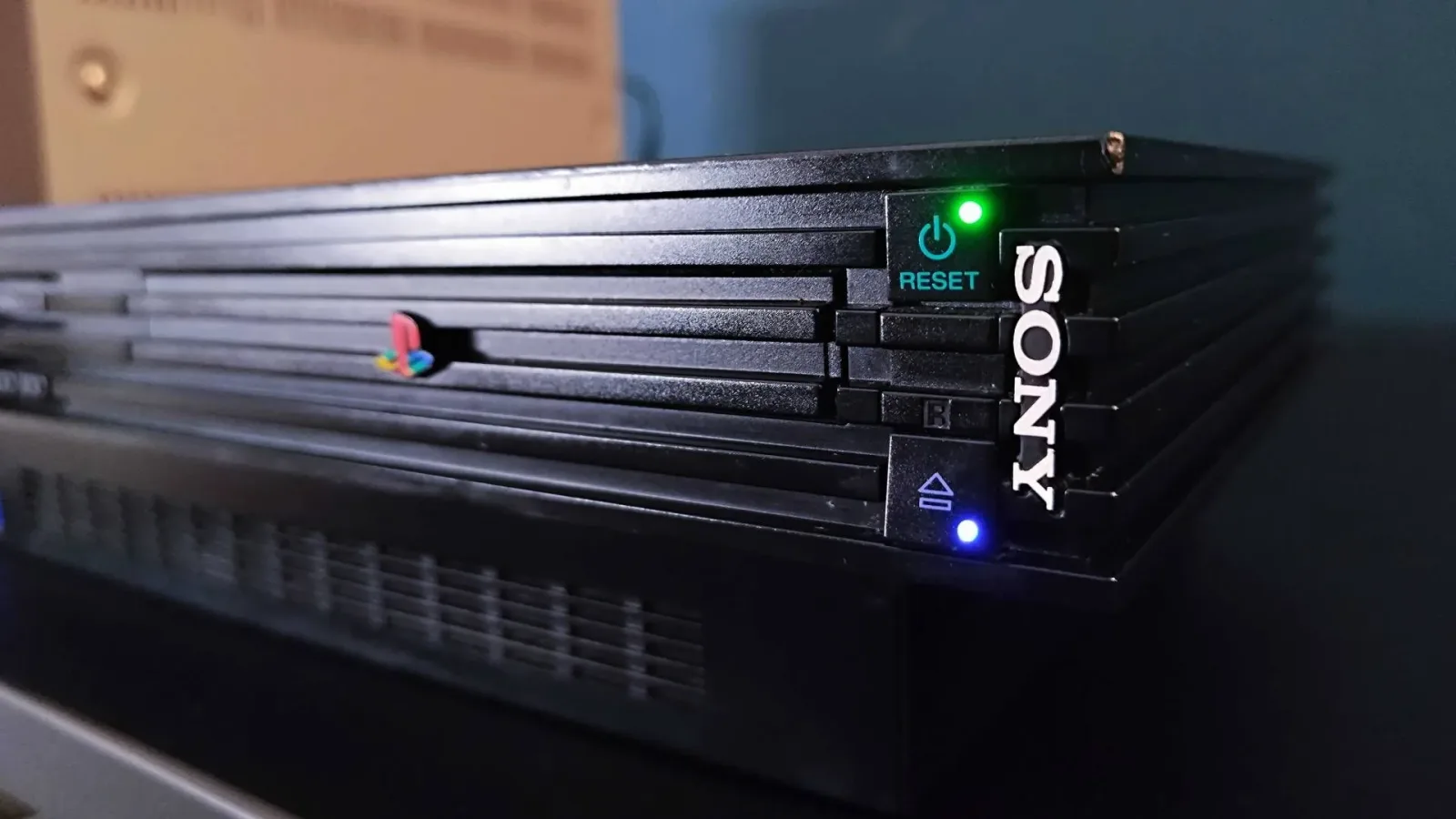
One of the PlayStation 2's most closely guarded hardware mysteries has reportedly been opened at last. The console's MechaCon chip, a component tied to disc-drive management and the system's anti-piracy protections, has been dumped after a four-year reverse-engineering effort. For a machine that first arrived more than two decades ago and remains a major target for retro enthusiasts, the result is an important milestone rather than merely a technical curiosity.
Developer DiscoStarslayer announced the breakthrough in a social-media post dated September 16, 2026, describing it as the end of a long process involving chip decapping, optical dumping, and, ultimately, a software-based solution. They also credited fellow modder Libby with finding the exploit from the optical dumps used during the project.
"After 4 years of effort, I'm happy to announce that one of the final secrets of the PS2 has been broken wide open," DiscoStarslayer wrote, calling the project a lengthy process before confirming that it had reached a software solution.
The achievement matters because the MechaCon is not simply another piece of PS2 hardware. It is a controller central to the way the console communicates with and manages its optical drive. It also sits within the chain of checks that helped Sony enforce the PS2's regional and anti-piracy measures. Understanding a component like that can give preservationists and hardware developers a much clearer picture of how original units behave, particularly in edge cases that can be difficult to replicate through observation alone.
For useful background on this topic, read The Transference Traps a Homegrown Mystery on Consoles This October.
What the MechaCon chip does in a PlayStation 2
The PlayStation 2 is often remembered for its enormous game library, DVD playback, distinctive Memory Cards, and multiple hardware revisions. Beneath that familiar exterior, though, it is a complex system built around several specialized components. The MechaCon, shorthand for Mechanical Controller, is associated with the console's disc mechanism and the security behavior surrounding it.
Disc-based consoles generally have to do much more than spin a disc and read data from it. They need to identify media, coordinate drive functions, handle errors, and perform validation checks expected by the rest of the system. On PS2 hardware, the MechaCon's role made it a consequential obstacle for anyone attempting to fully document the platform's security architecture.
For ordinary players, the chip has been effectively invisible. A retail PS2 inserts a disc, authenticates it, and launches a game with little indication of the work happening in the background. For repair specialists, modders, emulator developers, and people trying to keep aging systems functional, those invisible checks can become much more relevant. A dead or unreliable optical drive is one of the most common threats facing older disc consoles, while undocumented security behavior can make hardware replacements and accurate emulation more difficult.
Why dumping it is a preservation win
Dumping the chip means that its contents have been preserved and can now be examined by other developers. That does not automatically produce a polished consumer mod, a new emulator release, or a replacement drive. It does, however, provide material that previously had to be inferred, guessed at, or approached through more limited testing.
This kind of work is foundational. Retro development frequently progresses through many incremental discoveries rather than one final, all-purpose breakthrough. A chip dump can be analyzed to identify routines, communication behavior, safeguards, and implementation details. Those findings can then inform separate projects involving hardware restoration, diagnostics, firmware research, homebrew tools, and software emulation.
The value is especially clear for a console as historically significant as the PS2. Its massive installed base means there are still countless systems in circulation, but the hardware is aging. Laser assemblies wear down, motors fail, ribbon cables deteriorate, and donor parts become harder to obtain. Enthusiasts have developed a broad range of ways to run software without depending on an original game disc, yet deeper knowledge of the hardware can still improve the reliability and flexibility of future solutions.
There is also a difference between a workaround and a thorough technical understanding. Existing PS2 modifications may successfully avoid some limitations, but an archived and studied MechaCon image can help researchers understand the platform on its own terms. That distinction is valuable for long-term preservation, where the aim is not only to make something function today but also to record how it worked in the first place.
An optical drive emulator is a major possibility
One of the most intriguing possibilities raised by the MechaCon breakthrough is a more complete optical drive emulator, commonly shortened to ODE, for PlayStation 2. An ODE is hardware designed to stand in for a console's original disc drive. Instead of relying on a physical disc and aging laser mechanism, it can present game data to the system from alternative storage.
ODE-style solutions are established in the retro-hardware space. They are appealing because they can reduce wear on scarce original components and offer a practical route for keeping a system usable when the disc drive is no longer dependable. Depending on the implementation, they can also make testing, maintenance, and library management easier for owners who use legally created backups of games they own.
The PS2 already has numerous routes for loading games without a disc, and the new dump does not make those existing options obsolete. The platform's modding community has long worked with memory cards, network methods, internal storage arrangements on compatible models, and other approaches. Still, the prospect of an ODE that understands the console's original drive and security interactions more fully is compelling. More choices can mean better compatibility, fewer hardware compromises, and solutions suited to different PS2 revisions.
It is important to keep expectations measured. No finished PS2 ODE was announced alongside the dump, and no timetable for one has been established. Turning a successful reverse-engineering result into a widely usable piece of hardware takes additional engineering, testing, manufacturing, and support across the console's many model variations. The discovery expands what may be possible; it does not guarantee that every potential application will arrive quickly.
Potential benefits for emulation and homebrew
Emulation is another area that could benefit over time. Accurate console emulation relies on more than reproducing the behavior of a CPU or graphics processor. It also depends on how individual subsystems interact, including peripheral controllers and security-related components. When developers have better documentation and preserved firmware data, they can investigate behavior that was previously unclear.
That does not mean an immediate transformation for PS2 emulators. Mature emulation projects already run a substantial amount of the PS2 catalog, and many challenges lie outside a single controller chip. But each newly understood part of original hardware reduces uncertainty. It can help developers verify assumptions, improve handling of unusual software behavior, and create more faithful models of real systems.
Homebrew development could see a similar long-term benefit. The PS2 has maintained an active enthusiast scene because it is accessible, plentiful, and still capable of interesting projects. Developers make tools for system setup, diagnostics, game loading, media playback, and original software. A deeper view into the console's low-level design can give that community a stronger technical base for future work.
There is also a preservation angle beyond gaming itself. The PS2 was a defining consumer electronics device of its era, and its hardware design represents a particular moment in the evolution of optical media, console security, and mass-market entertainment systems. Archiving the contents of key chips helps ensure that knowledge is not lost as functioning units become rarer and proprietary documentation remains unavailable.
A collaborative result after years of work
DiscoStarslayer described the MechaCon effort as a personal "white whale," an apt description for a project that lasted four years and required several demanding techniques. Decapping involves removing a chip's outer package to access its internal structure. Optical dumping refers to extracting information by examining the chip through imaging and analysis methods. The final exploit identified with Libby's contribution appears to have been the piece that enabled a software solution.
That sequence highlights how console reverse engineering is often collaborative. One researcher may build equipment or collect raw data, another may spot an exploitable pattern, and others may later turn those findings into tools that a wider community can use. The eventual public breakthrough can look sudden, but it usually rests on extensive experimentation, failed attempts, and shared specialist knowledge.
For PS2 owners, nothing changes overnight: their consoles will not suddenly gain a new feature simply because the MechaCon contents are now available for research. Yet the significance of the news lies in what it removes from the list of unknowns. A security-related component that had resisted full access for roughly 26 years is now preserved for closer study.
In retro gaming, that is a meaningful victory. The best preservation work does not only save games; it helps preserve the conditions needed to understand and maintain the machines that ran them. With the PS2 MechaCon no longer an unopened black box, developers have another important piece of the console's technical history to investigate.
Community
Discussion
Start the conversation.
No comments have been posted yet.