

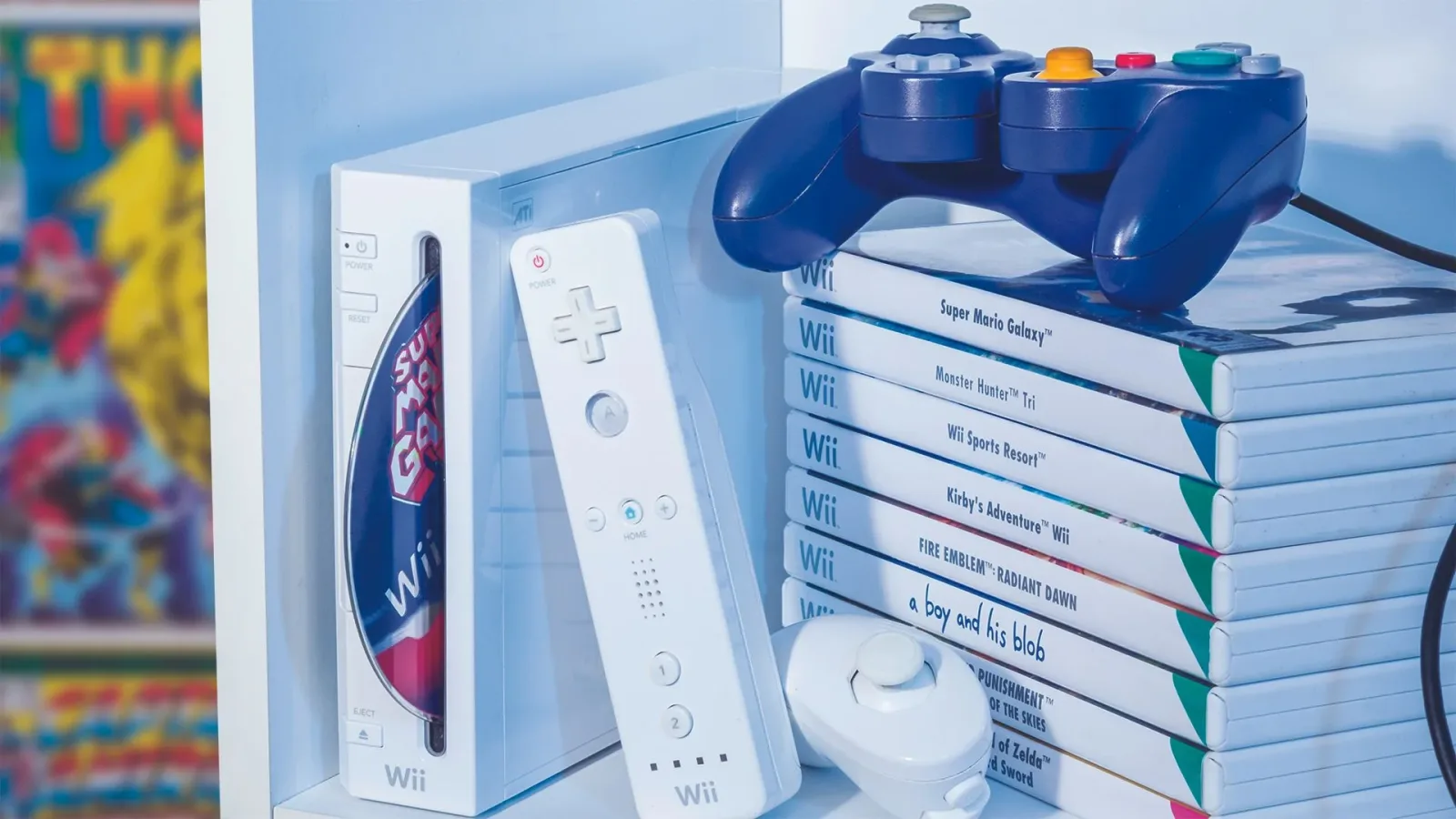
For a generation of players, calling the PlayStation 3 and Nintendo Wii "retro" can still feel strangely premature. They are systems associated with motion controls, HD displays, achievement lists, downloadable content, online multiplayer, system updates, and the beginning of an always-connected console culture. Yet the calendar has a way of changing the meaning of familiar hardware. The Wii arrived in 2006, while the PlayStation 3 began its life in the same year, meaning both machines are now approaching the two-decade threshold that many enthusiasts use to define retro gaming.
That question recently took center stage on GameCenter CX, the enduring Japanese television program in which comedian Shinya Arino takes on difficult games, often with spectacularly stubborn results. The show began in 2003 and has produced more than 400 episodes over 23 years. Its identity has long been built around older games, particularly titles from the 1980s and 1990s. But as time passes, the boundaries of that catalogue naturally move forward too.
During an August YouTube stream, the production put a direct question to viewers: should Wii and PS3 games be considered eligible for a program centered on retro gaming? The initial audience response was decisively favorable, with 71% backing the inclusion of the two systems. After Arino played a selection of Wii and PS3 games, the show held the vote again. Around 17,000 viewers ultimately voted yes, reinforcing the view that these machines have earned a place in the retro family.
The result does not settle the argument for every player, of course. Retro is one of gaming's most personal labels. It can refer to a console's age, the design conventions of its games, the technology it used, the period someone grew up in, or simply the sense of distance created by changing habits. Still, the strong response from GameCenter CX viewers is an interesting sign that the definition is evolving beyond the cartridge-focused eras that have traditionally dominated retro discussion.
For useful background on this topic, read Street Fighter movie's Chun-Li Training Was So Intense Her Stunt Double Needed Padding to Match Her Physique.
A show built on revisiting gaming history
GameCenter CX is uniquely suited to test the mood around retro games. The series has spent decades turning the challenge of revisiting old software into entertainment. Arino's attempts to complete games are central to the format, and the appeal is not solely about clearing a final boss. Failures, surprise discoveries, obscure mechanics, and the camaraderie of the production team are all part of the experience.
For much of its run, the show's idea of retro has leaned toward games from the 1980s and 1990s. Its trips into the 2000s have been less common. There has never been an entirely rigid rule, either. Early episodes featured Super Nintendo games that, at the time, were only around a decade old. That history matters because it shows that "retro" has always been a moving target rather than a permanently fixed category.
One broad guideline associated with the program has been the idea that a game becomes retro after about 20 years. It is an understandable benchmark: two decades is enough time for hardware to leave active retail shelves, for services to disappear, for accessories to become collector items, and for a younger audience to discover a library as history rather than as the latest release calendar. By that measure, Wii and PS3 software is now entering exactly the space once occupied by 1990s and early-2000s favorites.
Why the Wii and PS3 still feel modern to many players
The resistance to calling these consoles retro is easy to understand. The Wii and PS3 generation sits close to the foundation of today's console ecosystem. The PS3 helped normalize downloadable games, patches, digital storefronts, expanded online services, and post-launch content on a major scale. It was also part of an era defined by HD development, cinematic presentation, and increasingly large games built around networked features.
Nintendo's Wii was different in approach but equally influential. Its motion-control interface reached far beyond the traditional enthusiast audience, and games such as Wii Sports became cultural touchstones. It was a system many households owned even if they did not regularly follow game releases. That widespread presence can make the machine feel less distant than older hardware, because so many people still remember using one at family gatherings, schools, retirement homes, and living rooms.
For players in North America and elsewhere, the Xbox 360 belongs to the same conversation. Although the viewer poll focused on the Wii and PS3, the 360 shared the same general generation and many of the same shifts in how console games were bought, updated, and played online. The trio is often viewed as a dividing line: systems before them seem unambiguously retro, while systems from their era can still feel like the beginning of modern gaming.
But that dividing line is becoming harder to maintain. Features that once seemed transformative are now historical artifacts in their own right. Early online storefront interfaces, limited hard-drive space, the first wave of console downloadable content, and the evolving culture around patches all belong to a specific period. Even the systems' online infrastructures and digital preservation challenges have become part of retro gaming's larger concerns.
The irony of Wii's Virtual Console legacy
There is a particularly fitting irony in the Wii becoming a retro platform. Nintendo's Wii Virtual Console played a major role in making classic games widely available in the 2000s. It offered a legal, convenient way for players to revisit older libraries on then-current hardware, and it helped establish the expectation that console makers could curate their own histories digitally.
When the Wii Virtual Console launched in 2006, Super Mario 64 was one of its key games. At that point, Nintendo 64's landmark 3D platformer was roughly 10 years old. Today, the Wii itself is far older than Super Mario 64 was when it appeared on that service. The comparison makes the speed of gaming history feel especially clear. A machine that once served as a gateway to retro libraries has now become a piece of retro hardware itself.
This does not make the Wii or PS3 less significant; if anything, it provides another reason to revisit them. Both systems captured a transitional stage in the industry. The Wii represented an unusual design philosophy built around accessibility and physical play, while the PS3 reflected the push toward high-definition audiovisual ambition and a more digitally connected console future. Their libraries also include games whose original contexts are increasingly difficult to replicate through newer hardware.
Retro is about preservation as much as nostalgia
The discussion is larger than terminology. Once a platform is accepted as retro, audiences often become more attentive to preserving its games, controllers, accessories, manuals, regional variants, and online history. That can mean renewed interest in physical collections, repair knowledge, original display technology, archival documentation, and games that have not been reissued.
The PS3 and Wii libraries present different preservation questions. Wii games may depend heavily on motion controls and sensor-bar setups that are integral to how they were designed. PS3 games can be tied to that system's architecture, hard-drive installations, downloadable updates, and online functions. In both cases, simply having the disc is not always the entire historical experience.
Those complications are familiar to longtime retro fans. Every generation eventually develops its own form of fragility. Cartridge batteries fail, disc drives wear down, controllers become scarce, proprietary cables disappear, and online components shut off. The Wii and PS3 are old enough now that these concerns are no longer theoretical for collectors and preservation-minded players.
A generational label will keep changing
No audience vote can create a universal rule for what retro means. Some players will reserve the term for arcade boards, 8-bit machines, and cartridge consoles. Others will use it for anything no longer current. Many will simply measure from their own memories: the first console they bought with their own money may never feel old, while a system from childhood can seem like ancient history.
Still, the response from GameCenter CX viewers offers a useful snapshot. There is broad enthusiasm for bringing Wii and PS3 games into a classic-gaming setting, rather than treating them as too recent for historical appreciation. With both platforms nearing 20 years old, that position is less radical than it initially sounds.
The Wii and PS3 generation may have introduced many habits that remain central to current gaming, from digital distribution to frequent system connectivity. Yet it also belongs to a past era with its own design trends, technical limitations, landmark exclusives, unusual peripherals, and distinct cultural identity. Retro gaming has always expanded as the years pass. For Wii and PS3 fans, it may be time to accept that their favorite consoles are no longer merely old enough to remember. They are old enough to revisit as history.
Community
Discussion
Start the conversation.
No comments have been posted yet.