

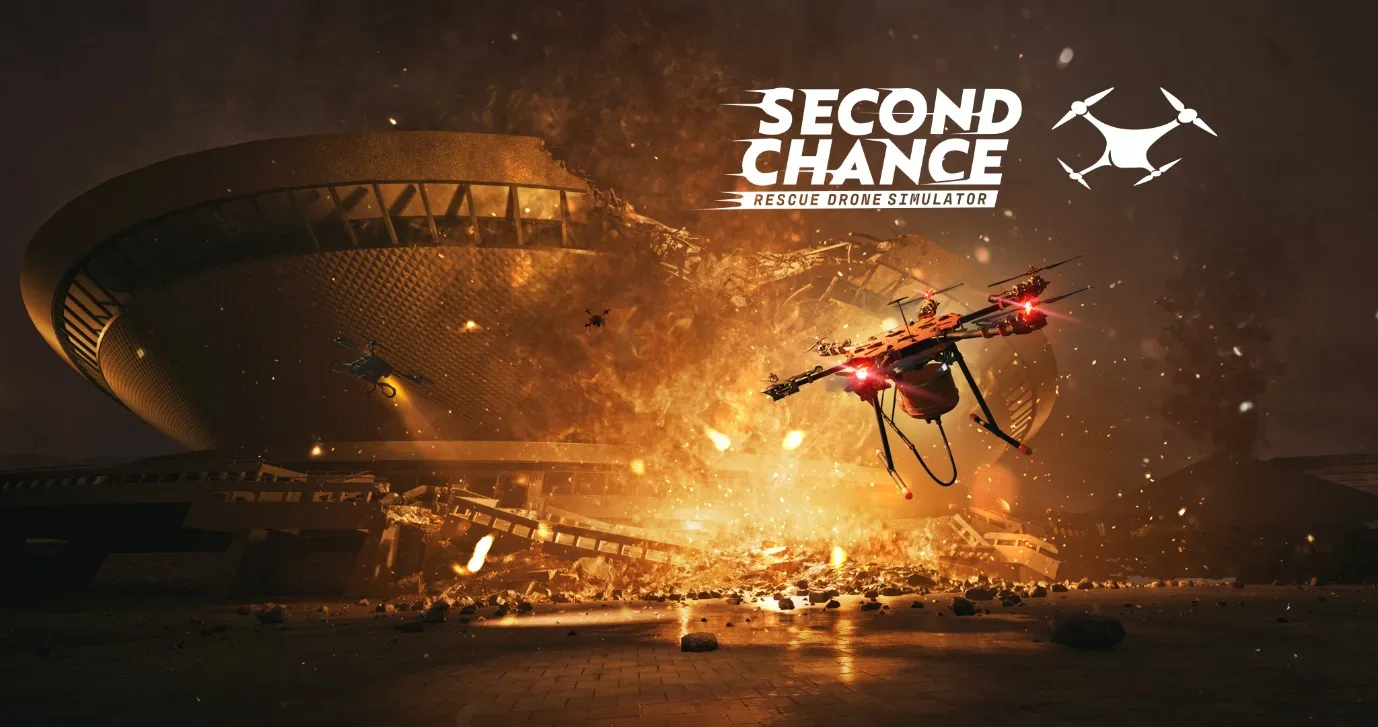
Rescue Drone Simulator: Second Chance has received its first gameplay trailer, offering a clearer picture of how its emergency-response missions will play when it arrives in Q1 2027. Developed by Anraga Studios and The Farm 51, the game puts players behind the controls of specialized rescue drones during volatile operations shaped by fire, smoke, difficult weather and urgent communication from teams on the ground.
The newly shown footage frames the experience as more than an aerial sightseeing simulator. Its opening sequence drops into an active blaze on the Katowice map, where the drone's camera becomes the player's viewpoint amid dense smoke, flames and radio traffic. From there, the trailer moves rapidly between locations and incidents, using fragmented transmissions to establish the pressure surrounding each callout.
That presentation points toward a game built around operating machinery reliably when visibility, maneuverability and time are all working against the player. The central appeal is not simply taking flight, but learning to use a tool designed for dangerous situations where a mistake can have consequences for a broader rescue operation.
Two specialist drones, one rescue effort
The gameplay footage highlights cooperative play through two distinct drone roles: the Firefighting Drone and the Medical Drone. Although the full extent of each role's equipment and mission objectives has not yet been detailed, the trailer establishes that the drones are intended to operate alongside one another rather than function as interchangeable vehicles.
For useful background on this topic, read Nyra and the Garden of Moros Revealed as a Choice-Driven Climbing Adventure.
The Firefighting Drone is positioned as an active part of containing an emergency, flying close to burning structures and areas obstructed by smoke. In a scenario where ground crews may struggle to reach a particular angle or where the air itself is becoming hazardous, an unmanned aircraft can provide another way to get response equipment into the scene. The trailer's focus on a burning Katowice operation gives this role an immediate, practical identity.
The Medical Drone, meanwhile, suggests a support role centered on helping casualties or assisting the wider team while the incident remains in progress. Pairing it with a fire-focused machine creates a co-op structure where players may need to divide their attention between controlling the disaster and responding to people affected by it. That division has the potential to make communication and coordination as important as an individual pilot's handling skills.
Cooperative emergency games often depend on clearly defined responsibilities, and Rescue Drone Simulator: Second Chance appears to be using drone specialization to create those responsibilities from the start. One player may be handling the most immediate threat, while another must navigate the same unstable environment to provide a different form of support. A successful response may therefore require teams to think about positioning, timing and safe routes, rather than simply rushing every objective at once.
For another perspective on this story, read Rescue Drone Simulator: Second Chance Shows Firefighting and Medical Drone Gameplay.
Flight conditions are part of the challenge
The trailer makes a point of showing that a drone will not behave like a frictionless camera floating above the action. Wind, smoke and payload weight will affect how the machines handle, adding simulation-driven complications to every mission.
Wind can force pilots to compensate while moving through narrow or exposed spaces. Smoke can limit sightlines and make it harder to identify landmarks, hazards or the exact position of another responder. Payload weight adds another variable, likely making a loaded drone feel different from one that is traveling light. Together, those factors suggest that players will need to understand their equipment and adjust to conditions rather than rely on a single, predictable flight model.
This emphasis is significant for the game's tone. Rescue Drone Simulator: Second Chance is presenting drones as working machines, not effortless superpowers. A drone may provide access to a location that is too dangerous or impractical for a person, but it remains subject to physical pressures. The player's job is to master that machine while responding to a situation that is changing around them.
That approach could also make the co-op element more compelling. If poor conditions make one player's route difficult, a teammate may need to alter their own plan to compensate. A medical drone carrying important supplies could need cover, direction or a safer approach. A firefighting drone may need to prioritize an area before another player can proceed. The trailer does not spell out every possible interaction, but its footage and role setup establish a foundation for those kinds of decisions.
Katowice provides a dramatic first look
The first extended gameplay glimpse takes place on the Katowice map during a large firefighting and rescue operation. Fire dominates the scene, while the drone-camera perspective places the player close enough to the incident for the danger to feel immediate. It is an effective setting for demonstrating why remote aircraft can matter in an emergency: the pilot can enter spaces that are visually chaotic and potentially unsafe while keeping the person operating it outside the immediate hazard zone.
The fast montage that follows indicates that Katowice will not be the only environment featured in the game. The trailer moves between additional locations, though it does not provide a full list of maps or explain how missions will be structured across them. Still, the edit communicates variety in both scenery and incident intensity, implying that the campaign will move beyond a single type of emergency.
Audio is also central to the trailer's atmosphere. Radio chatter, broken transmissions and clipped voices accompany the action rather than merely serving as background noise. In an emergency setting, communication is a tool as important as a drone's controls. It can signal where help is needed, reveal a sudden change in conditions or create tension when information is incomplete. The footage uses that idea well, keeping the operation feeling busy and unsettled.
A campaign with a more ominous signal
Beyond its rescue-simulation mechanics, Rescue Drone Simulator: Second Chance is also introducing a narrative thread. The voices communicating with the team during the campaign are not the only voices present on the radio frequency, and the game warns that some of the people players encounter will not be friendly.
That detail adds an unusual layer to the premise. Emergency-response gameplay naturally has tension because there is pressure to act quickly and accurately, but an uncertain presence on the airwaves can turn that tension into a mystery. Players may be asked to consider not only how to complete an operation, but also who is transmitting information and whether that information can be trusted.
For now, the developers have kept the specifics of that story element under wraps. There is no confirmed explanation of who the hostile voices belong to, how directly they will affect missions, or whether the campaign will branch based on player actions. The trailer's message is simply that the radio channel contains more than a conventional rescue crew, giving the game a darker edge beneath its technical simulation focus.
It is a promising contrast: a game about precise equipment and coordinated emergency procedures that may also ask players to deal with uncertainty, interference and potential threats. If the campaign connects those ideas effectively, the drones could become more than tools for mission objectives. They could be the means through which players investigate what is happening around the rescue teams.
Release window and platforms
Rescue Drone Simulator: Second Chance is planned for a Q1 2027 release. Anraga Studios intends to launch the game simultaneously on PC via Steam, PlayStation 5 and Xbox Series X|S. The Steam page is already available for players who want to add the game to their wishlist.
No exact launch date has been announced. Details such as the number of maps, the full range of available drones, the maximum co-op player count and the campaign's overall length also remain to be confirmed. The first trailer is therefore a focused introduction rather than a complete systems breakdown.
Even so, it establishes a distinct direction. Rescue Drone Simulator: Second Chance combines the careful operation of specialized aircraft with high-stakes emergency scenes, and it places co-op roles at the heart of that concept. The added emphasis on wind, smoke and weight suggests a demanding flight experience, while the strange radio presence offers a narrative question that extends beyond the immediate task of putting out fires or delivering aid.
With its Q1 2027 window still ahead, there is plenty of room for the developers to reveal more about mission design and campaign structure. For now, the Katowice footage offers an early answer to the key question behind the project: this is a rescue game where reaching the scene is only the beginning, and controlling the drone under pressure may be the most important rescue skill of all.
Community
Discussion
Start the conversation.
No comments have been posted yet.