

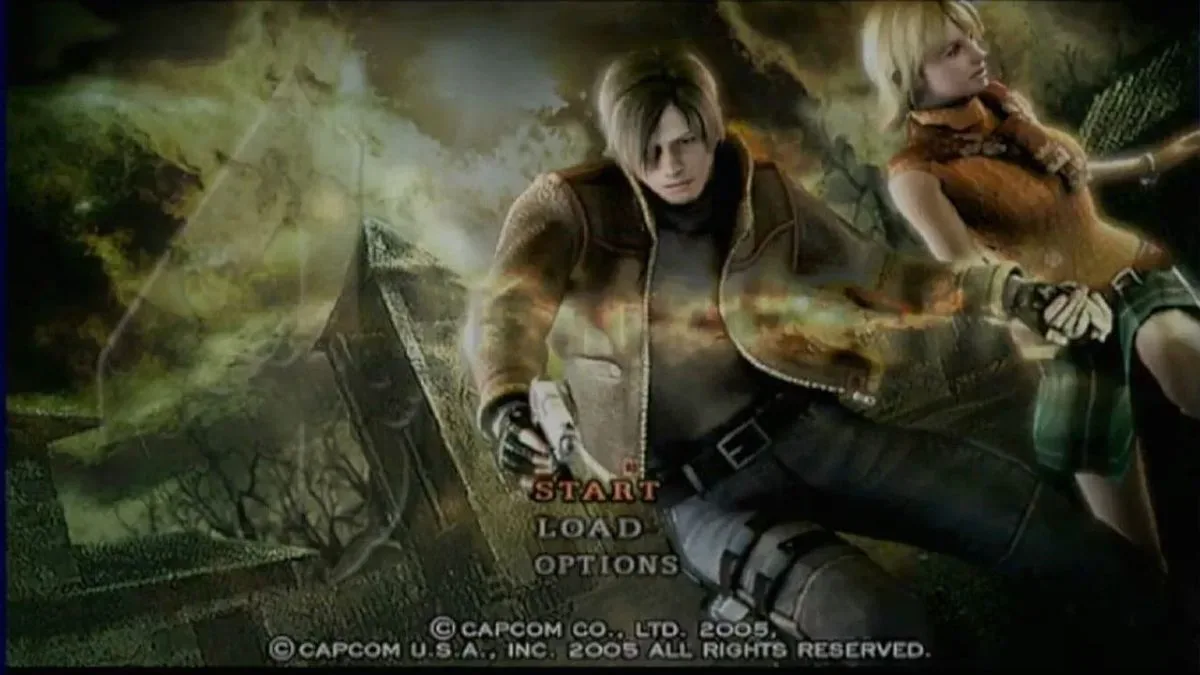
The PS Vita homebrew scene may be years removed from the handheld's commercial peak, but it continues to produce projects that would have seemed wildly unlikely during Sony's own support for the system. The latest example comes from developer Alessio Tosto, better known online as Rinnegatamante, who is working on two separate Resident Evil projects for the Vita: an adaptation of the GameCube version of Resident Evil 4 and a native recompilation of Game Boy Advance spin-off Resident Evil Gaiden.
Of the two, Resident Evil 4 is clearly the larger technical undertaking. A short teaser has shown the project running on Vita hardware, though the work remains early and should not yet be mistaken for a finished release. Tosto has said the immediate priority is making the game functional before moving on to visual bug fixes and performance optimization. The build being used also contains debugging material that may need to be removed, potentially reducing overhead and helping the game reach its intended speed.
That is an important caveat for a project of this scale. Seeing a game boot and render on a target system is a major milestone, but a polished handheld experience depends on much more: stable frame pacing, reliable controls, audio behavior, memory management, save functionality, interface readability, and the removal of graphical issues that may emerge across a full campaign. Still, the prospect of the original GameCube-era Resident Evil 4 running natively on Vita is an exciting one for fans of both Capcom's survival-horror classic and Sony's underappreciated handheld.
Embedded X/Twitter post
Embedded X/Twitter post
A difficult game to bring to a smaller handheld
Originally released for Nintendo GameCube in 2005, Resident Evil 4 was a turning point for the franchise and action games more broadly. It moved the series away from the fixed camera angles and pre-rendered environments associated with earlier entries, placing Leon S. Kennedy in an over-the-shoulder third-person perspective. Its aiming system, enemy behavior, pacing, set pieces, upgrade loop, and cinematic presentation went on to influence a huge range of games.
For useful background on this topic, read Turok: Origins Is Using Co-Op, Boss Fights, and Classic Weapons to Reach a New Generation.
The GameCube release is especially notable because it was the original version of this reinvention. Later editions expanded or altered the package in various ways, and the game has appeared on a remarkable number of systems over the years. Yet the GameCube build remains a significant technical and historical target. It was designed around hardware substantially different from the PS Vita, and adapting it for a portable machine is not simply a matter of placing an existing PC release onto a smaller screen.
The Vita has a capable mobile-oriented architecture, a sharp OLED or LCD display depending on model, dual analog sticks, and enough controls to make it a natural fit for a third-person action game. But it also has finite processing power and memory, meaning an unofficial adaptation must make smart compromises while preserving the feel of the original. If Tosto can deliver stable performance while addressing graphical flaws, the result could become one of the more remarkable technical showcases in the Vita homebrew library.
There is no announced completion date, and no detailed compatibility list has been presented. That means fans should keep expectations measured until the project progresses beyond its current debug-stage footage. It is also too early to say exactly how visual quality, cutscenes, controls, or game-specific features will compare with the GameCube original. For now, the headline is the project's existence and the evidence that it is running, rather than a promise of an imminent public launch.
For another perspective on this story, read Resident Evil 4 GameCube Port Is Being Worked On for PS Vita, Alongside Resident Evil Gaiden.
Resident Evil Gaiden brings a very different kind of Vita project
The second Resident Evil effort is less demanding visually but no less interesting from a preservation and usability standpoint. Resident Evil Gaiden, released for Game Boy Color in 2001 rather than GBA as is sometimes casually assumed, is being brought to Vita through a native recompilation project. Unlike the high-profile console-style action of Resident Evil 4, Gaiden is an unusual handheld branch of the franchise, set aboard a passenger ship and built around exploration, item management, and a distinctive combat system.
Its perspective and mechanics make it one of the stranger Resident Evil releases, but it has long held curiosity value for series historians. A native Vita version could give it a more comfortable presentation than playing through a conventional emulator alone, particularly if the announced quality-of-life additions are implemented as described.
The project's feature list includes widescreen support, enhanced item sparkles, an ambient flashlight effect, save states, cheat functionality, and packs for textures and music. Those additions suggest that this is intended as more than a bare conversion. Widescreen can make a retro game feel better suited to the Vita's display, while improved environmental cues and optional audiovisual packs may offer players ways to tailor the experience without abandoning the original game's identity.
Save states are particularly welcome for a portable system. Resident Evil Gaiden was designed for short handheld play sessions, but instant suspend-like flexibility remains useful for modern players. The Vita itself has always been a strong fit for quick, on-the-go gaming, and features such as save states reinforce that advantage. Cheats, meanwhile, can help players experiment with an obscure and occasionally challenging title, though purists can simply avoid using them.
What "native recomp" and an unofficial port mean
Neither Resident Evil project is an official Capcom or Sony product. They are community-developed efforts for hardware whose official software support has long since ended. As with other fan-made ports and recompilation projects, players should pay attention to the eventual installation instructions, legal requirements, and any need to supply original game data themselves. Those details have not been fully outlined for the Resident Evil 4 effort, so it would be premature to make assumptions about distribution or setup.
Native recompilation generally refers to translating or rebuilding game code so that it can execute on a different platform's architecture, rather than emulating the original console in full. The practical benefit can be improved performance and the chance to add platform-specific features such as widescreen support, revised controls, higher-resolution assets, or quality-of-life tools. It is also extremely demanding work, especially when dealing with games that were never intended to run on the new hardware.
That distinction matters to Vita owners. Emulation has already made a substantial amount of classic software playable on the device, but native projects can potentially provide a more tailored experience. They can use the Vita's inputs and screen more directly, reduce the overhead associated with emulating another platform, and introduce carefully chosen enhancements. The trade-off is that compatibility work and bug fixing can take a long time, especially for a complex 3D game such as Resident Evil 4.
AI assistance has become part of the conversation
The announcement has also prompted discussion around the methods used in these projects. Tosto's own project information indicates that AI assistance has been used in some of his work, although the precise extent of that assistance on these particular Resident Evil projects has not been fully detailed. Other entries distinguish between projects made without AI and ones described as "vibecoded," making it clear that the developer's workflow can vary from release to release.
That leaves room for legitimate questions rather than simple conclusions. AI assistance can mean a wide variety of things, from help with repetitive coding tasks or debugging ideas to more extensive automated code generation. Without a clear technical breakdown, it is not possible to determine which parts of either Resident Evil project involved such tools. What is clear is that AI use is increasingly being discussed within modding and homebrew circles, where individual developers often take on jobs that would traditionally require larger teams and long development timelines.
For some players, the primary concern will be whether the finished software is stable, respectful of the original material, and responsibly distributed. Others will be more focused on the development process and how much automated assistance was involved. Both viewpoints are likely to remain part of the conversation as community projects become more technically ambitious. The Vita scene, in particular, has benefited from persistent developers willing to push a discontinued system beyond its official catalog, but the tools and practices behind that work are changing.
Another sign of life for PS Vita homebrew
Tosto's recent activity has already attracted attention following work on bringing Crash Team Racing to Vita. Adding two Resident Evil projects to that momentum underlines just how active the handheld's community remains. The Vita was never given the long-term first-party support many owners hoped for, yet its combination of portable design, dual sticks, touchscreen features, and enthusiast interest has allowed it to endure as a homebrew platform.
There is a particular appeal to seeing games associated with Nintendo hardware and older portable systems find a new home on Sony's handheld. Resident Evil 4 began life as a GameCube exclusive, while Resident Evil Gaiden was designed for Nintendo's compact Game Boy Color. Their arrival on Vita through unofficial development would connect three very different eras of portable and console gaming.
At present, the Resident Evil 4 project is best viewed as a promising technical work in progress, not a completed product. The footage and comments point to a difficult optimization phase still ahead. Resident Evil Gaiden appears further defined in terms of planned features, but players should likewise wait for final release information before treating its feature set as locked. Even so, both efforts are worth watching. They represent the mix of preservation, experimentation, and hardware enthusiasm that continues to keep the PS Vita relevant long after its retail life ended.
Community
Discussion
Start the conversation.
No comments have been posted yet.