

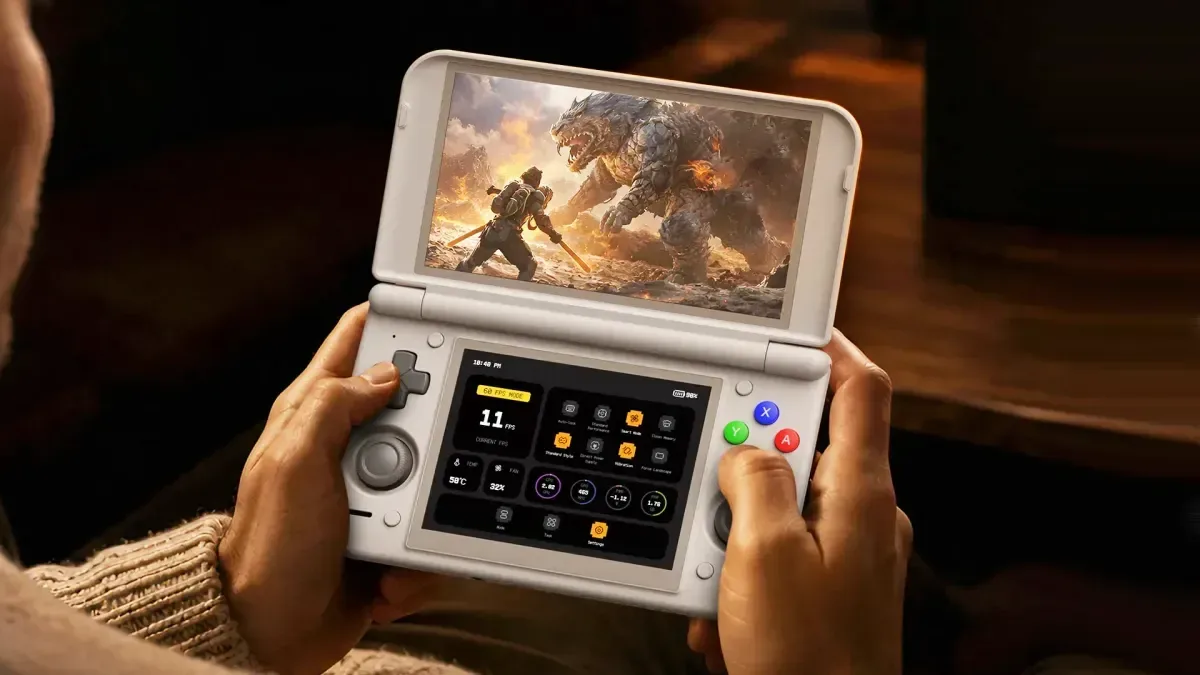
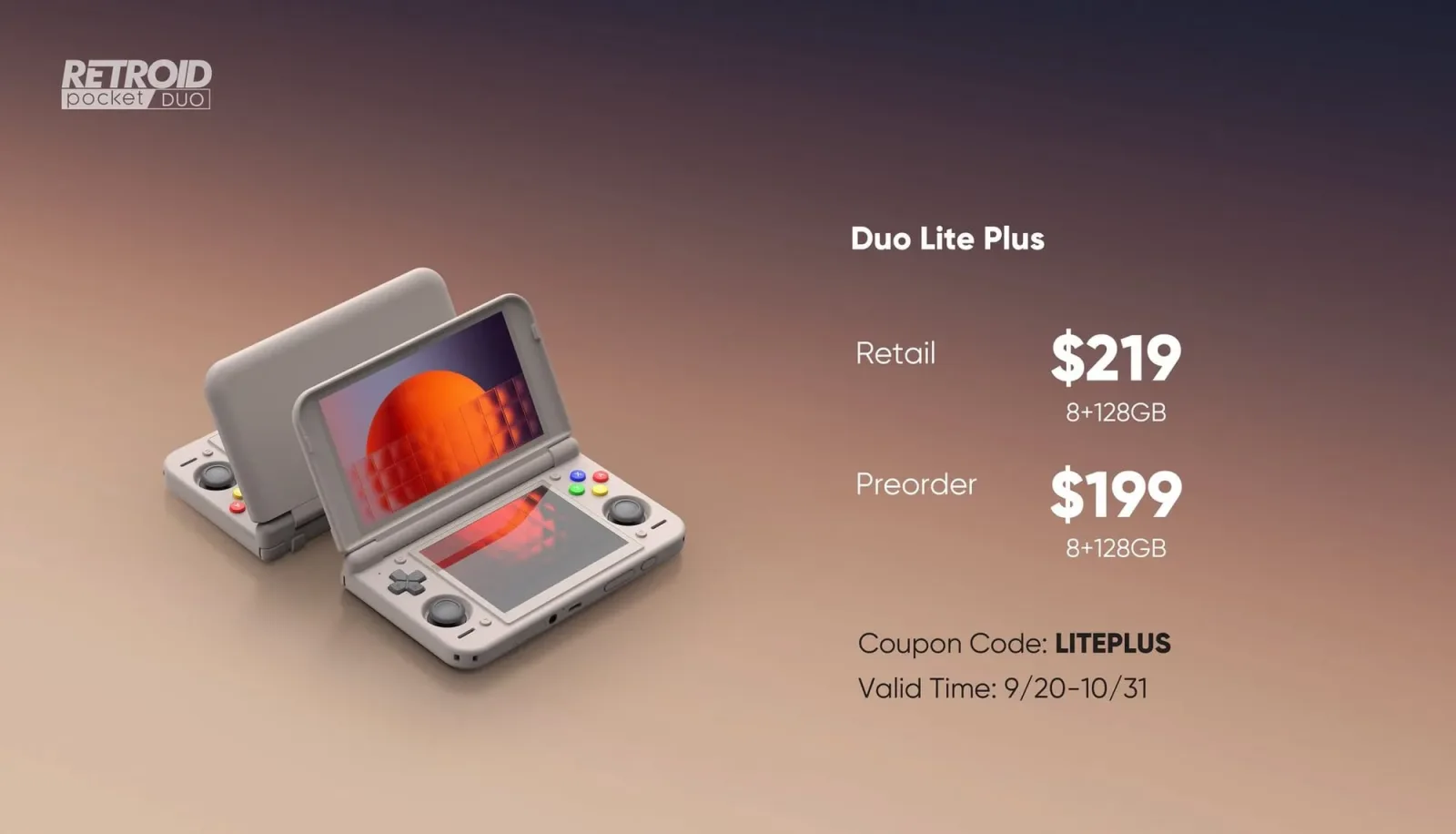
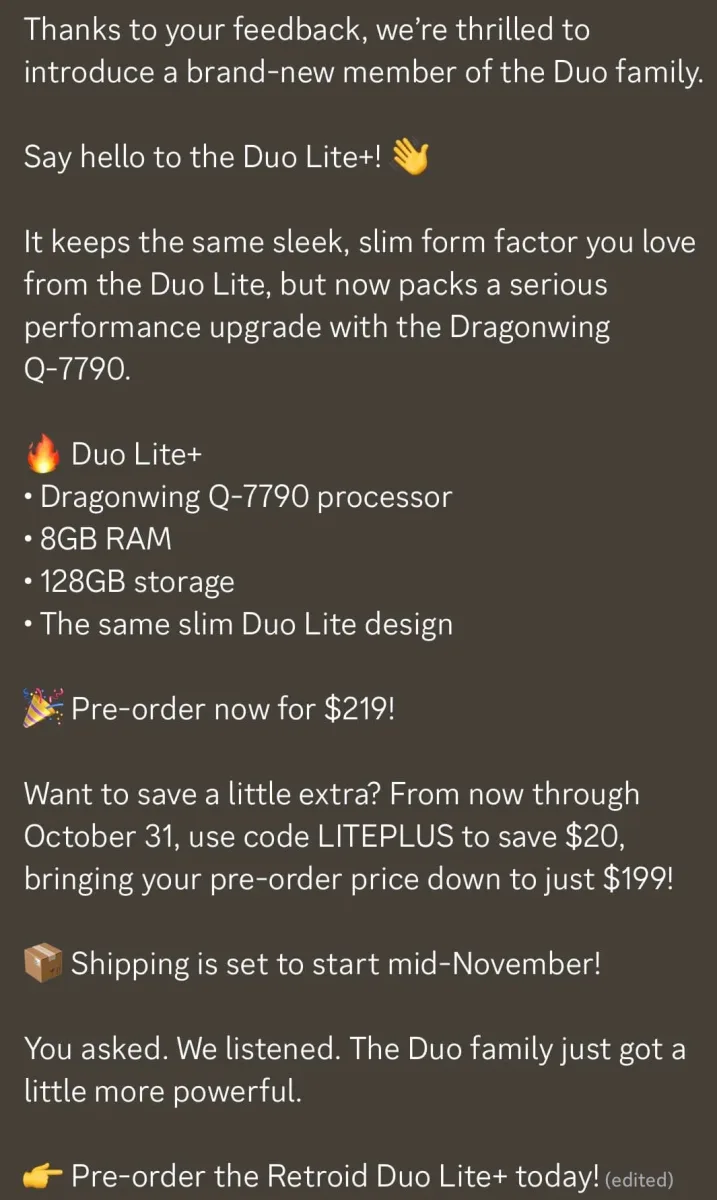
Retroid has added a third configuration to its upcoming Duo Lite handheld range, introducing the Duo Lite+ with 8GB of RAM and 128GB of internal storage. The new dual-screen device is listed at $199 during the official pre-order period and is expected to cost $219 at retail. Retroid says the model was created in response to community feedback, but the reveal has also prompted fresh criticism from customers who had already committed to one of the previously announced Duo Lite versions.
The timing is the central issue. Retroid's Duo family had only recently entered its pre-order phase, with the Duo Lite positioned as the slimmer and lower-powered alternative to the standard Duo. Buyers originally had two Duo Lite choices: a 4GB RAM model with 64GB of storage and a 6GB RAM model with 128GB. Now, before the broader rollout of the family is complete, the Duo Lite+ gives prospective buyers a considerably roomier memory specification in the same general design.
For new customers, the Lite+ is simply another option. For people who already placed orders, however, the announcement creates the familiar fear that choosing early may mean missing a more desirable revision announced soon afterward. That reaction has become a recurring part of the conversation around Retroid hardware launches, particularly when a revised layout, upgraded specification, or adjacent model emerges close to an initial product announcement.
What the Duo Lite+ adds
The Duo Lite+ retains the fundamental design and processor of the existing Duo Lite. It uses the Dragonwin Q-7790 chip, includes 8GB of RAM, and carries 128GB of onboard storage. Retroid has not presented it as an entirely new generation of hardware, nor as a replacement for the higher-end Duo. Instead, it occupies a middle position: it keeps the Lite chassis and its more compact shoulder-button arrangement while raising its memory capacity above the two configurations announced first.
For useful background on this topic, read Satoru Iwata's Nintendo Vision Put Reinvention Ahead of Endless Sequels.
That memory increase may matter to the audience Retroid is targeting. Android-based handhelds are used across a broad mix of emulation, streaming, native Android games, launcher software, and multitasking. More RAM can provide useful headroom when users are running demanding software or switching between apps, while 128GB of internal space is a more comfortable starting point than 64GB for players maintaining larger libraries, disc-based game images, texture packs, save backups, and media files.
Still, the Duo Lite+ does not alter several of the distinctions between the Lite line and the regular Duo. The Duo Lite has a 4.2-inch TFT secondary display, while the standard Duo is described as having a larger 4.5-inch AMOLED secondary screen. The Lite design also uses its own compact shoulder controls. Those choices leave the regular Duo as the more feature-focused version of the concept, even if the new Lite+ narrows the gap in memory.
Retroid says the Duo Lite+ is scheduled to begin shipping in mid-November. That places it behind the previously announced Duo and Duo Lite models in the delivery sequence. Some customers on social media have suggested their Duo Lite units may already have shipped, although the exact status of individual orders is not clear. In either case, the Lite+ has been unveiled at a point when early purchasers are already watching fulfillment closely.
For another perspective on this story, read Retroid's Duo Lite+ Adds 8GB RAM, but Its Timing Raises Familiar Buyer-Trust Questions.
A price that invites comparison with the regular Duo
At $199 during pre-orders, the Duo Lite+ appears designed to appeal to buyers who want more memory without abandoning the Lite's compact style. Its $219 retail price, however, makes the purchasing decision less straightforward. The standard Duo is only $50 more at that point, while offering dual AMOLED displays and flared shoulder buttons.
That does not automatically make the standard model a better fit for everyone. Hardware preferences are rarely dictated by a specification list alone. Some players may prefer a slimmer shell, smaller secondary panel, or a control layout that better matches their hands and use cases. A purchaser interested primarily in retro emulation may value the Lite's form factor more than a display upgrade. Others may see the Lite+ as the sensible compromise because it avoids the lowest RAM tier while remaining below the flagship model's price.
But the close pricing makes the Lite+ difficult to view in isolation. The question is no longer just whether 8GB of RAM is worth paying more than the original Duo Lite configurations. Buyers also have to ask whether a $50 saving outweighs the standard Duo's display technology, larger secondary screen, and different shoulder-button design. Retroid's expanding lineup supplies more choice, but it also asks shoppers to make increasingly fine distinctions between devices that may arrive only months or weeks apart.
Why existing customers are frustrated
The concern expressed by parts of the handheld community is not necessarily that a company should never introduce an improved configuration. More choice can be a positive outcome, especially in a product category where users have widely different priorities. The frustration is about transparency and launch planning: customers who order early want confidence that the product lineup has been clearly defined before deposits and purchases are encouraged.
Retroid has faced similar reactions in the past over hardware decisions and revisions. Discussions around the company have included control-layout rearrangements and new versions arriving not long after shipping began. In that context, the Duo Lite+ reveal is being interpreted by some buyers not as a single isolated expansion, but as another example of a pattern that makes it harder to know when a product family is settled.
For early adopters, the practical concern is simple: if a more appealing version can appear after pre-orders are underway, it becomes harder to judge whether ordering immediately is the best move.
That uncertainty can be especially damaging in the enthusiast handheld market. These devices are often purchased by people who closely compare processors, screen panels, analog controls, memory capacities, operating-system support, and dimensions. They are not merely buying a generic gadget; many are selecting a specific machine to handle a personal emulation library, streaming setup, or travel use case. A late specification option can make a buyer feel that the decision was made with incomplete information.
There is also a difference between a surprise upgrade that arrives long after a device has established itself and one that appears while pre-orders are active. The latter can create an immediate dilemma for customers: keep the original order, seek a cancellation or change if those options are available, or wait longer for the revised unit. Retroid's decision to position the Lite+ shipping window in mid-November adds another trade-off, since shoppers may be comparing better specifications against a later delivery.
The Duo range now has a clearer, but more crowded, ladder
On paper, the expanded lineup creates a fairly understandable hierarchy. The entry Duo Lite configuration offers 4GB of RAM and 64GB of storage. The next version raises that to 6GB and 128GB. The new Lite+ keeps 128GB but moves to 8GB of RAM. Above those sits the standard Duo, which differentiates itself through its display setup and physical design rather than merely a memory number.
- Duo Lite base model: 4GB RAM and 64GB storage.
- Duo Lite higher configuration: 6GB RAM and 128GB storage.
- Duo Lite+: Dragonwin Q-7790, 8GB RAM, 128GB storage, $199 during pre-orders and $219 at retail.
- Standard Duo: a 4.5-inch AMOLED secondary screen and flared shoulder buttons, compared with the Lite's 4.2-inch TFT secondary display and compact shoulder controls.
The lineup makes sense for a company trying to cover more budgets and preferences without creating a wholly separate product. Yet clarity on a chart does not necessarily eliminate buyer hesitation. The closer models are in price, the more carefully customers will scrutinize every compromise. That is particularly true for a dual-screen handheld, where screen quality and ergonomics can be as important as internal memory.
What comes next for Retroid buyers
The Duo Lite+ may ultimately find an audience among people who were waiting for a stronger Lite specification, or who prefer the Lite body but do not want to settle for 4GB or 6GB of RAM. It could also attract buyers who have not yet placed any order and can now evaluate the full range at once. For those shoppers, the additional configuration is a benefit rather than a disruption.
For Retroid, the bigger challenge is trust in the rollout process. The company has an opportunity to explain where the Lite+ sits within its long-term Duo plans and to make customers feel confident that they are not about to see another materially improved version appear immediately after their device arrives. Clear communication about configurations, fulfillment order, and any available options for existing pre-order customers would go a long way toward reducing that uncertainty.
As it stands, the Duo Lite+ is a potentially appealing handheld on its own terms: 8GB of RAM, 128GB of storage, the Dragonwin Q-7790 processor, and a compact dual-screen design at a pre-order price of $199. Whether it becomes the preferred Lite model will depend not only on performance and ergonomics, but also on how buyers weigh its close proximity to the standard Duo--and how much confidence they have that the model they choose will remain the right one once shipping begins.

Community
Discussion
Start the conversation.
No comments have been posted yet.