

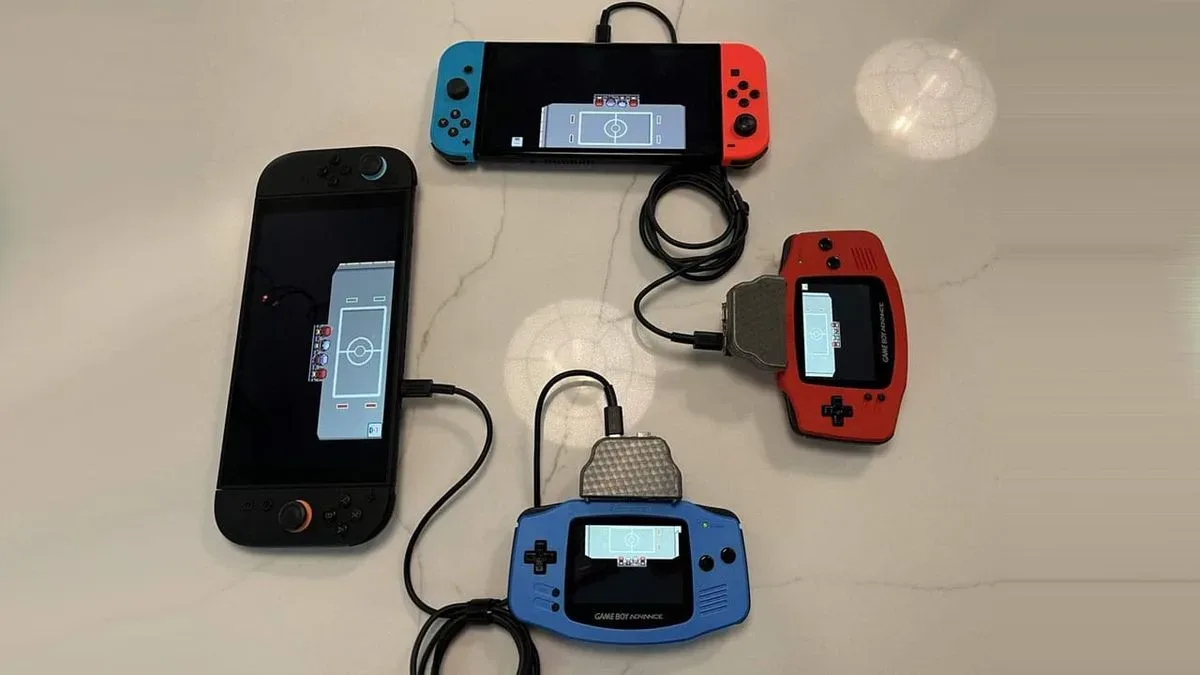
A new accessory called RetroSync is expected to arrive in early December, promising a notably unusual bridge between Nintendo generations: a way to connect a Game Boy Advance or Game Boy Advance SP to a Nintendo Switch family console for selected Pokémon link activities. Developed by DrewWorks, the adapter has moved from an early prototype to a much more finished-looking device in a short period, with compatibility currently focused on supported versions of Pokémon FireRed, Pokémon LeafGreen, and Pokémon Emerald.
The planned price is £39. While an exact on-sale date has not yet been given, an interest list is available for people who want to be notified when sales begin. The current target is early December, following an announcement made on September 30, 2026.
A modern connection for Game Boy Advance link play
For many players, trading and battling are inseparable from the experience of the Game Boy Advance-era Pokémon games. The original games used the Game Link Cable and, depending on the activity and hardware involved, accessories such as the Wireless Adapter. Those systems were designed around Game Boy Advance hardware, not contemporary consoles with USB-C ports. RetroSync is designed to make a specific kind of cross-generation connection possible while keeping the original GBA game cartridge and handheld at the center of the experience.
Embedded X/Twitter post
Embedded X/Twitter post
The adapter attaches to a Game Boy Advance and uses a USB-C cable to connect onward to a Nintendo Switch. DrewWorks has shown the unit working with both the original Game Boy Advance and the clamshell Game Boy Advance SP. It has also been demonstrated with both the original Nintendo Switch and Nintendo Switch 2.
For useful background on this topic, read Mario Kart Tour Has Officially Reached the Finish Line.
That combination is what makes RetroSync especially interesting to collectors and active players of older Pokémon games. Rather than being a software re-release or a conventional reproduction cable, it is a device intended to let original handheld cartridges participate in supported multiplayer-style functions through newer Nintendo hardware. It is a niche use case, but it addresses a longstanding practical problem for players who still maintain Game Boy Advance libraries and hardware.
Current supported games and activities
At launch, RetroSync is stated to work with compatible versions of three Game Boy Advance Pokémon titles:
- Pokémon FireRed
- Pokémon LeafGreen
- Pokémon Emerald
The wording around compatibility is important. Support is currently limited to compatible versions of those games, and no broader list of supported Pokémon cartridges has been confirmed. Players should therefore avoid assuming that other GBA Pokémon releases, including every regional edition or revision, will necessarily function with the adapter at launch.
For another perspective on this story, read RetroSync GBA-to-Switch Adapter Targets December Release for Pokémon Trading and Battles.
RetroSync currently supports joining only in the following modes:
- Trading
- Single Battles
- Double Battles
- Multi Battles
- Berry Crush
- Pokémon Jump
- Dodrio Berry Picking
The joining-only limitation means prospective buyers should keep their expectations specific. The adapter is not being presented as a complete replacement for every original link arrangement or every feature connected to these games. Instead, its initial goal is participation from the connected Game Boy Advance side in a defined group of Pokémon activities.
Even with that limitation, the supported list covers many of the social features most associated with the generation. Trading remains a major reason to revisit FireRed, LeafGreen, and Emerald, whether players are completing a Pokédex, moving version-specific creatures between friends, or simply recreating the experience of building a team alongside other players. The available battle options also include the principal formats that made local Pokémon sessions so flexible on Game Boy Advance hardware.
From exposed prototype hardware to a compact accessory
RetroSync's development has progressed rapidly. Earlier work on the project had the appearance expected of an in-development hardware concept: boards, soldered components, and several cables visible as the connection method was being tested. The latest version is far closer to a consumer-facing accessory, with a compact adapter form factor and a USB-C connection for linking it to a Switch console.
That transition matters for more than presentation. Handheld accessories are often used in cramped spaces, carried between homes, or connected and disconnected regularly. A smaller, cleaner unit should be easier to accommodate than a bench-style prototype with multiple loose parts. The demonstrated support for both Game Boy Advance models also gives the project wider appeal, since many enthusiasts favor the SP's folding design and illuminated-screen variants while others prefer the original system's shape and controls.
At present, the most clearly established hardware pairing is a GBA or GBA SP connected through RetroSync to an original Switch or Switch 2. No additional console families are confirmed, and the accessory should be understood as a Nintendo-focused solution. It is also not described as an alternative way to run GBA games on Switch. The GBA remains the machine running the original cartridge; RetroSync is designed around link functionality between the old and new devices.
Firmware updates leave room for expansion
One of RetroSync's more encouraging technical details is that it supports firmware updates. DrewWorks has indicated that updates are intended to enable future improvements and expanded compatibility. That does not guarantee any particular game, feature, or platform will be added, but it means the launch configuration is not necessarily the project's final form.
For a product attempting to interface with hardware separated by several console generations, update capability is valuable. Compatibility work can uncover edge cases involving game revisions, regional variations, console behavior, cables, or multiplayer modes. Firmware support gives the developer a route to refine performance after release instead of treating the initial shipping version as permanently fixed.
It also makes the current feature list easier to view in context. The confirmed functionality is substantial enough to make the adapter useful to a defined audience, while the update path signals an ambition to improve it over time. Still, buyers should base a purchase decision on the modes and games explicitly supported at launch, rather than on possible additions that have not been announced.
Plug-and-play design is central to the appeal
RetroSync is described as plug-and-play, requiring no setup before use. That simplicity could be crucial for the audience most likely to be interested in it. Retro gaming projects can sometimes involve adapters, drivers, custom firmware, complicated instructions, or a chain of specialized cables. A device that can be connected directly to a GBA, linked by USB-C, and used without an involved configuration process is considerably more approachable.
The £39 price point also places it below the kind of cost often associated with bespoke enthusiast hardware. That does not make it an impulse purchase for everyone, particularly when a player may also need compatible original cartridges and maintained handheld hardware. But for players already invested in Game Boy Advance Pokémon collecting, it is a relatively accessible way to explore a new form of connectivity.
There are still sensible questions for interested buyers to keep in mind. The device's joining-only status will matter depending on how someone intends to organize a session. Compatibility remains narrowly confirmed, and firmware expansion is a future-facing possibility rather than a detailed roadmap. As with any accessory made for legacy hardware, the condition of the Game Boy Advance, cartridge contacts, USB-C cable, and connected console may all be relevant to day-to-day use.
A preservation-minded idea with practical appeal
RetroSync arrives at a time when the relationship between retro games and modern hardware is receiving more attention than ever. Older Pokémon cartridges remain widely played, but their original social functions can be difficult to recreate as hardware ages and original accessories become less convenient to find. Devices that preserve use of the original games while offering new ways to connect them can help keep those experiences active rather than merely collectible.
The project is particularly notable because it is not simply about displaying or backing up an older game. Its focus is interaction: trades, battles, minigames, and the shared activities that gave these Pokémon releases much of their lasting character. By targeting both original Switch hardware and Switch 2, it also attempts to place that GBA interaction alongside the current Nintendo ecosystem without requiring players to abandon their original cartridges.
For now, the key details are straightforward. RetroSync is planned for an early December release at £39, works with Game Boy Advance and GBA SP hardware, and has been shown connecting to the original Nintendo Switch and Nintendo Switch 2. Compatible versions of Pokémon FireRed, Pokémon LeafGreen, and Pokémon Emerald are the confirmed software focus, with joining-only support for trading, multiple battle formats, and several multiplayer minigames. Firmware updates are planned to support improvements and potentially broaden compatibility later.
It remains a specialized accessory with clearly defined launch limits, but it is also a compelling example of modern hardware design being used to extend the social life of classic handheld games. Players interested in using original GBA Pokémon cartridges for supported Switch-connected activities will want to watch for the early December sales announcement.
Community
Discussion
Start the conversation.
No comments have been posted yet.