

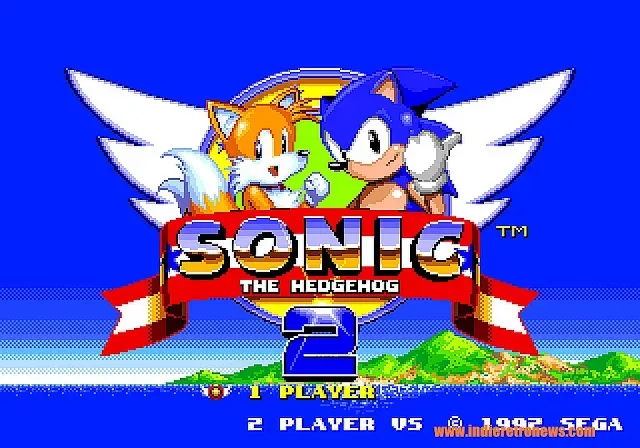
Sonic the Hedgehog 2 has received an ambitious new conversion for Commodore Amiga AGA machines. Created by EAB moderator Cody Jarrett, the project aims to bring the complete Mega Drive original to enhanced Amiga hardware, from the familiar opening presentation through to the ending credits. It is currently described as a test release, but its feature list is substantial: all 11 zones are included, Tails can accompany Sonic under computer control or a second player's command, the competitive two-player mode is present, and the rotating special stages have made the jump as well.
What makes this particular port stand out is not only the hardware it targets, but the method used to produce it. Jarrett used Anthropic's Claude AI as part of a workflow that translated original Motorola 68000 logic from the Sonic Retro community's s2disasm disassembly into C. The resulting implementation was then checked against the original game code by running both side by side through the Unicorn engine, with the goal of confirming that they generated matching results.
That combination of old hardware, reverse-engineered game logic, modern compilation tools and AI assistance makes the conversion an intriguing technical experiment. It also arrives at a time when retro-development communities are actively debating where AI tools fit in projects involving classic games and historic systems.
A complete Sonic 2 package for AGA Amigas
The scope of the port is important. This is not presented as a single-level demo, a proof-of-concept physics test, or an early attempt limited to Sonic running through Emerald Hill Zone. The conversion covers the entire journey through Sonic the Hedgehog 2's 11 zones. That includes the game's full progression, its recognizable stages and its final credits sequence.
For useful background on this topic, read Epic Announces 2026 AI MegaJam With $65,000 in Prizes and Grants Up to $50,000.
It also retains the ways players can experience the game beyond the standard solo campaign. Tails can be used as an AI-controlled companion, closely reflecting the behavior familiar from the original release. A second player can instead take direct control of Tails for cooperative play. The dedicated 2-Player VS mode is included too, as are the special stages associated with collecting Chaos Emeralds.
Those inclusions matter because Sonic the Hedgehog 2 is built around much more than its headline speed. Its co-op option, split competitive play and special-stage challenges all rely on systems beyond the main platforming levels. Bringing them across means the project is pursuing a far broader recreation of the original package rather than simply reproducing its most visible elements.
How AI entered the development process
The core technical work began with s2disasm, a community disassembly of the original game. Disassemblies are valuable in preservation and homebrew circles because they make it possible to study software originally written in low-level machine-oriented code. In this case, the original 68000 logic was used as the basis for translation into C, a language better suited to building a new version for the Amiga environment.
For another perspective on this story, read Sonic the Hedgehog 2 Rebuilt for Amiga AGA With AI-Assisted Code Translation.
Claude was used to assist with that translation. This is a notable contrast with a more traditional porting process, where a programmer or team manually interprets assembly-language routines, recreates them in a different language, and repeatedly tests behavior while resolving discrepancies. AI assistance can accelerate parts of that process, but it does not automatically guarantee that a translated program behaves correctly on new hardware.
To address that challenge, the project used the Unicorn engine to execute the original code and the translated version in parallel. The intention was to compare their outputs and identify whether their behavior remained identical. That validation step is particularly relevant for a game as tightly tuned as Sonic the Hedgehog 2, where small differences in movement, object interactions, collision behavior or level scripting can quickly become visible to experienced players.
The port therefore represents more than an AI prompt producing a finished retro game. It is an AI-assisted translation and verification workflow built around existing disassembly work, software testing, C compilation and platform-specific Amiga engineering. The use of AI will still be controversial for some enthusiasts, especially in communities that value hand-coded technical craftsmanship, but the project offers a clear example of the tool being incorporated into a structured development pipeline.
Why the Amiga version needs more memory
Sonic the Hedgehog 2 originally shipped in a 1MB Mega Drive cartridge ROM, but an Amiga AGA version has very different memory requirements. The Mega Drive and the Amiga do not handle graphics and audio in the same way, and the conversion has to account for those differences rather than simply move a ROM image from one machine to another.
The Amiga build uses pre-drawn graphical data and sampled sound, while the Mega Drive version benefits from its native tile-oriented video hardware and hardware-synthesized music. As a result, the Amiga conversion requires considerably more storage in memory. The test release calls for 4MB of Fast RAM. Of that allocation, the program itself takes around 2MB, while each act needs approximately 3.9MB.
The system's 2MB of Chip RAM is used for the AGA dual-playfield screens, hardware sprites and audio samples. That division reflects a defining trait of classic Amiga architecture: Chip RAM is shared with the machine's custom chips, making it essential for graphical and audio work, while Fast RAM is generally reserved for processor-accessible code and data.
For players accustomed to thinking of Sonic 2 as a compact cartridge game, these figures underline how much of a port depends on the target platform's design. The same game assets and gameplay rules can demand a radically different technical layout when moved from Sega's console to Commodore's computer hardware.
Using the Amiga's custom hardware
The conversion takes advantage of several hallmark Amiga features. The Copper, one of the machine's custom co-processors, is used for per-line background scrolling and water effects. This is a particularly fitting use of the hardware, as the Copper can alter display behavior during the drawing of a frame, enabling visual tricks that were central to the Amiga's reputation in the late 1980s and early 1990s.
Objects are handled with the blitter, another celebrated custom component designed to quickly move and manipulate blocks of graphical data. Meanwhile, the Paula audio chip is responsible for the soundtrack. Rather than using the Mega Drive's original hardware sound generation directly, the music has been converted into four-channel ProTracker modules.
That means the Amiga edition is not merely emulating the Mega Drive sound hardware. It is adapting the game's audio to the character and limitations of Paula-based playback. ProTracker music is deeply associated with the Amiga scene, so its use gives the project a distinctly machine-specific identity even as it seeks to preserve a famous console game.
The build was created with tools including Bartman's Amiga GCC toolchain and the Shrinkler packer. Together with the C translation, memory layout and custom-chip work, those tools form the practical foundation that lets a modern development effort target an early-1990s computer configuration.
Required hardware and current testing status
The test release is intended for AGA-equipped Amiga systems, specifically machines such as the Amiga 1200 or Amiga 4000. It requires a 68020 processor or better, Kickstart 3.0 or later, 2MB of Chip RAM and 4MB of Fast RAM. The release has been tested with Kickstart 3.1. Players will also need roughly 20MB of hard-disk space for either the LHA or HDF version.
- Compatible class of machine: AGA Amiga, including A1200 or A4000
- Processor: 68020 or better
- Kickstart: 3.0 or later, with 3.1 tested
- Chip RAM: 2MB
- Fast RAM: 4MB required
- Storage: Approximately 20MB for LHA or HDF versions
Testing has included a real Amiga 1200 equipped with a Blizzard 030 accelerator. However, 040 and 060 accelerator cards have not been tested, and configurations with less than 4MB of Fast RAM are also untested. As with any test release on varied vintage hardware, users encountering problems are encouraged to report them alongside details of their CPU, memory setup and Kickstart version.
An alternative route for Amiga Sonic projects
Amiga fans have more than one Sonic-related project to watch. This Sonic the Hedgehog 2 conversion takes an explicitly AI-assisted route, while another anticipated Sonic the Hedgehog 1 Amiga port by reassembler is being developed through a purely human-coded approach. The two projects illustrate different philosophies rather than a simple contest over which game is more significant.
For preservation-minded players, the essential question will likely be how accurately and smoothly each project plays on intended hardware. For developers, the more interesting question may be whether carefully constrained AI assistance, backed by direct comparison and rigorous testing, can become a useful tool for translating old software without replacing the engineering knowledge needed to finish a stable port.
For now, Sonic the Hedgehog 2 AGA is a technical test release with an unusually broad feature set and demanding but attainable Amiga requirements. Its full campaign, multiplayer options, special stages, Amiga-specific graphics handling and ProTracker audio make it a substantial effort for owners of properly expanded AGA machines. Just as importantly, it gives the retro scene a real, playable case study in how modern AI tools can intersect with classic-platform development.
Community
Discussion
Start the conversation.
No comments have been posted yet.