

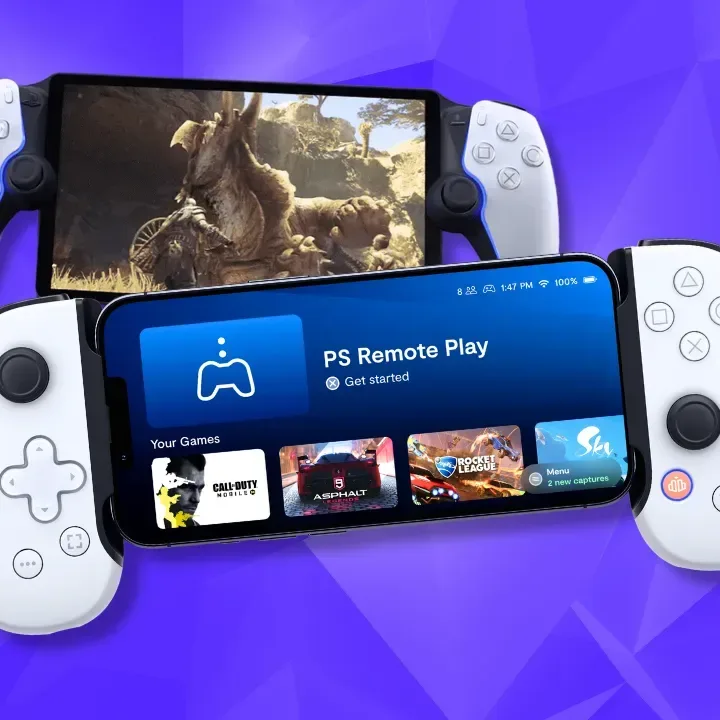
Sony's long-rumored next-generation PlayStation handheld may be positioned around a substantial graphics advantage if a new claim about AMD's hardware roadmap proves accurate. During a Digital Foundry discussion, technology analyst Richard Leadbetter said there has been behind-the-scenes talk suggesting Sony could hold an exclusivity arrangement of some kind for AMD's RDNA 5 graphics architecture in handheld hardware.
It is an intriguing possibility for a market that has become intensely competitive. Dedicated PC gaming handhelds have grown from a specialist category into a major part of the broader hardware conversation, while Nintendo's Switch family has continued to demonstrate the appeal of portable systems that can also connect to a TV. Sony, meanwhile, has not formally revealed a successor to its earlier dedicated portable consoles. The company's PlayStation Portal is a Remote Play device rather than a standalone games machine, but recurring reports and executive comments have kept speculation alive around a more traditional PlayStation portable.
At this stage, the most important point is that neither Sony nor AMD has confirmed a new PlayStation handheld, an RDNA 5-powered portable chip, or any exclusive agreement. The claim should therefore be treated as an informed industry discussion rather than an announcement. Still, the existing technical partnership between Sony and AMD gives the idea a degree of context that goes beyond a simple wishlist.
What the RDNA 5 claim could mean
Leadbetter's comments centered on the possibility that Sony has an "exclusive of sorts" with AMD concerning RDNA 5 for handheld use. He also noted that the other AMD handheld-oriented chip he was aware of in production is expected to be called the Z3, and suggested it is unlikely to use RDNA 5 graphics.
For useful background on this topic, read Mass Effect: Universe's Timeline System Could Have Connected Player Saves Into Parallel Realities.
That wording leaves considerable room for interpretation. An exclusivity deal could be limited by time, by product class, by configuration, or by access to specific features rather than preventing every other manufacturer from ever using the architecture. In other words, even if Sony has secured preferred or early access, that would not necessarily mean RDNA 5 will be permanently absent from future PC handhelds or competing devices.
For a PlayStation portable, early access to newer GPU technology could matter enormously. Handheld design always requires compromise between performance, battery life, thermal limits, physical size, memory bandwidth, and price. A newer architecture can potentially improve performance per watt, enabling either more demanding games in a similar power envelope or better battery behavior at comparable performance. It could also bring modern rendering features that help a compact machine present games more convincingly on its own display or on a larger television while docked.
None of that guarantees that a theoretical Sony handheld would match the output of a full home console. A portable system has fundamentally different constraints. But an advanced graphics architecture, combined with platform-specific software support and upscaling technology, could help narrow the gap in selected scenarios.
Project Amethyst gives Sony and AMD a shared foundation
Sony and AMD have been working together through an initiative called Project Amethyst. That collaboration has already fed into technology associated with PlayStation and other platforms, including PSSR 2 on PlayStation 5 Pro and FSR 4.1 for PC and Xbox.
The significance of that work is not simply that the companies are familiar partners. Sony has long used AMD technology in its PlayStation consoles. Project Amethyst suggests a deeper effort focused on graphical techniques and machine-learning-assisted rendering at a time when image reconstruction is becoming increasingly central to modern game performance.
For a handheld, advanced upscaling could be especially valuable. Rather than attempting to render every game at a very high native resolution, a system could render at a lower internal resolution and use reconstruction methods to create a cleaner final image. The approach is already important on home hardware and PC, but portable hardware may benefit even more because lower power draw and reduced heat are so important.
That does not mean a rumored device would necessarily use the exact same implementation found on PlayStation 5 Pro. Hardware features, software tools, and developer targets can all differ from platform to platform. Nevertheless, Sony's continuing work with AMD gives it potential building blocks for a handheld designed around contemporary rendering methods rather than relying solely on raw graphical horsepower.
The portable market is changing quickly
The discussion arrives as the handheld PC sector faces a transitional period. AMD's Ryzen Z2 Extreme uses an RDNA 3.5 GPU, a design that was already based on an older graphics direction when it launched. Intel, meanwhile, introduced its Panther Lake handheld chip at Computex 2026. Its Arc G3 graphics hardware uses technology related to the GPU architecture in Intel's contemporary laptop chips, although with some CPU cores disabled in the handheld configuration.
The pace of improvement has raised expectations for portable performance. Players increasingly want handheld systems capable of running current large-scale games, but they also expect those devices to remain reasonably compact and provide enough battery life to be useful away from a charger. Meeting all of those goals at once remains difficult, especially as component costs fluctuate.
Memory pricing is another concern for the category. Higher-end portable hardware is already expensive, and continued pressure on RAM costs could make it harder for manufacturers to produce broadly affordable systems with generous memory configurations. If those costs remain elevated, some companies may decide that launching ambitious, premium handhelds is too risky.
That environment could make Sony's potential role unusual. A platform holder with a major software ecosystem may be more willing than smaller hardware companies to make a large investment in a bespoke portable design. If Sony were able to secure an early RDNA 5 advantage, it could potentially turn that technology into a differentiator at a moment when many competitors are balancing performance targets against increasingly difficult cost decisions.
Competition may include Microsoft as well
Microsoft is also widely expected to have broader handheld ambitions. Reports have described an initiative called Project Helix as covering a range of devices, with a handheld potentially arriving first. One report has indicated that Microsoft could target the 2027 holiday period for its portable hardware, followed by a next-generation console in 2028.
Those plans remain unconfirmed, including the precise silicon that would power any eventual Xbox handheld. However, AMD has indicated that FSR Diamond is planned to launch alongside Project Helix, and the technology is likely associated with RDNA 5. That detail complicates the idea of total Sony exclusivity, since a future Xbox portable could also plausibly be built around AMD's next graphics generation.
There is no contradiction if Sony's arrangement is narrow or temporary. It could apply to a certain handheld implementation, a tailored chip design, a launch window, or a particular set of capabilities. It is also possible that the current understanding of AMD's product plans is incomplete. Until the companies outline actual products and specifications, the precise relationship between RDNA 5, Sony, and Microsoft remains uncertain.
A dockable PlayStation portable has been rumored before
This is not the first suggestion that Sony could return to dedicated portable hardware. A report last year described an unannounced PS6 handheld that would support docking and backwards compatibility with PlayStation 4 and PlayStation 5 games. The same report briefly mentioned a possible "PS6 S," characterized as a lower-cost counterpart to the main PS6 concept.
Those claims have not been verified by Sony, and backwards compatibility across two existing console generations would be a particularly significant promise. Compatibility is affected by far more than processor architecture: game testing, system software, performance targets, storage behavior, and publisher support can all shape what works and how well. A dockable format also raises questions about whether games would receive separate portable and television profiles, or whether a system would depend heavily on dynamic resolution and reconstruction technology.
Still, the concept fits the direction of the market. Nintendo has proven the commercial power of a hybrid form factor, while PC handhelds have familiarized a larger audience with the idea of carrying a substantial game library between a desk, sofa, commute, and television. Sony Interactive Entertainment CEO Hideaki Nishino said in June that PlayStation could move toward more hybrid, Switch-like console concepts in response to how players now engage with games while on the move.
What remains unknown
The rumor leaves nearly every major practical question unanswered. There is no confirmed product name, no launch window, no price, no display specification, no battery estimate, and no indication of whether the machine would be a fully independent console or require some connection to a PlayStation home system for certain experiences.
There is also no confirmed information about its software strategy. A standalone PlayStation handheld could pursue native versions of games, rely on scalable cross-generation development, use cloud streaming in some capacity, or combine several approaches. Sony's eventual choices would determine whether the device is best understood as a companion product, a hybrid console, or a distinct part of the next PlayStation generation.
For now, the RDNA 5 discussion is most useful as a sign of where the technological stakes may be heading. Sony and AMD's collaboration is real, handheld competition is accelerating, and platform holders are looking closely at the demand for high-quality gaming beyond the living room. Whether Sony has secured a meaningful early edge in AMD's next graphics architecture is still unproven, but it is a claim worth watching as the next wave of portable hardware takes shape.
Community
Discussion
Start the conversation.
No comments have been posted yet.