

Star Wars: Galactic Racer is not being built around the idea that every player should immediately feel like the best pilot on the track. Fuse Games CEO Matt Webster, whose team includes many developers with experience on the Burnout series, says the Star Wars racer is deliberately asking more of players than those earlier arcade racing games did.
That does not simply mean higher speeds, though speed is clearly central to the game's identity. The racing is built around intense competition, aggressive opponents and punishing consequences for mistakes. Racers can try to force one another off the course, a moment of hesitation can send a vehicle into a barrier, and crashes are not an unlimited inconvenience. Players have a finite number available before they must forfeit. The intended effect is a game where surviving, improving and even taking a modest finishing position can feel meaningful.
Webster's view is straightforward: games should challenge players. In his estimation, an experience that delivers reward after reward without enough contrast eventually risks losing its impact. The objective for Galactic Racer is not to deny players satisfaction, but to make that satisfaction carry more weight.
A different kind of arcade-racing pressure
The team's history makes the approach especially notable. Burnout became closely associated with immediate, high-energy arcade spectacle: blazing speed, destructive crashes and a constant sense of momentum. Webster said the older games frequently gave players rewards in rapid succession, from new cars to repeated positive feedback. That approach can be exhilarating, but he argued that an uninterrupted chain of "dopamine hits" becomes less effective when it is the only emotional note a game plays.
For useful background on this topic, read Star Wars: Galactic Racer Aims to Restore Risk and Consequence to Arcade Racing.
Star Wars: Galactic Racer is aiming for a more demanding balance. Webster has said that Fuse Games is asking substantially more of its audience this time, in part because modern players can handle a greater cognitive load. That phrase is important in the context of a racing game. It suggests that success will involve more than simply holding a racing line at extreme velocity.
Players will need to read the track, react to hazards, manage the presence of hostile competitors and decide when to commit to a dangerous manoeuvre. A corner taken too cautiously may cost position, yet uncertainty at the wrong moment can lead to a collision and an explosion. With only a limited number of crashes permitted, each failure has the potential to change the rest of a run.
That structure gives every placement more room to matter. Webster specifically pointed to the intended appeal of a hard-fought fifth-place finish. In a game calibrated around this philosophy, fifth is not automatically a disappointing result or a prompt to chase the next cosmetic unlock. It can be proof that a player endured a difficult race, found a way through the chaos and earned a result that might have felt out of reach minutes earlier.
Why friction can make rewards stronger
There is a persistent challenge in designing accessible racing games: how to preserve the immediate appeal of arcade action while leaving room for genuine skill, tension and improvement. Too much punishment can turn a race into frustration. Too little resistance can make the action blur together, especially when the game continually showers the player with upgrades, praise or unlocks.
Webster's comments place Galactic Racer on the side of deliberate friction. The game is not presenting high difficulty as a badge of exclusivity. Rather, its developers appear to see challenge as essential to emotional pacing. If a player has to stay alert, protect a limited supply of crashes and fight through a crowded field, then the eventual payoff has context.
That is also a useful distinction from the idea that arcade games must be shallow. Fast, approachable controls and spectacular crashes do not prevent a racer from having demanding decision-making. In fact, the faster the game moves, the more significant its moment-to-moment choices can become. At high velocity, a line through a corner, the timing of an evasive move or a split-second response to another racer may determine the entire outcome.
The description of Galactic Racer suggests that Fuse Games wants those choices to be felt immediately. The game's aggressive competitors are not just visual background for a Star Wars race. They are an active source of pressure, capable of ramming players off course. This turns the contest into more than a time trial against track geometry. Positioning among other racers matters, and players may have to account for threats coming from every direction.
Limited crashes raise the stakes
The finite crash system is one of the clearest signals of the game's intended intensity. In many arcade racers, wrecking is an entertaining interruption before the player quickly returns to the action. Here, crashes appear to be a resource that must be managed. Too many will force a forfeit, making every explosion consequential.
That could make the earliest races a substantial hurdle for some players. Webster indicated that it may take a significant amount of time before certain players even reach the game's second act. The statement does not establish exactly how progression will work or how long that journey will be, but it does underline the team's expectations. Advancement is not being treated as something that should happen automatically after a handful of low-risk events.
For racing-game fans, that prospect may be appealing precisely because it restores jeopardy to the genre. A close finish is more exciting when a damaged run, a mistake on a late turn or an opponent's shove can genuinely undo it. The pressure can turn otherwise familiar racing fundamentals into a more memorable contest: staying composed while the screen is moving at extraordinary speed, identifying the safer route when rivals are closing in, and deciding whether a risky overtake is worth the possible cost.
Of course, challenge depends heavily on how fairly the systems communicate their demands. Players are far more likely to embrace a punishing crash limit if they understand why a collision happened and believe they could avoid it next time. The available comments focus on the design intent rather than the specific assists, difficulty options or progression systems that may accompany it. Those details will matter in showing how broadly the game can welcome players while retaining the tension Webster describes.
Intensity needs contrast
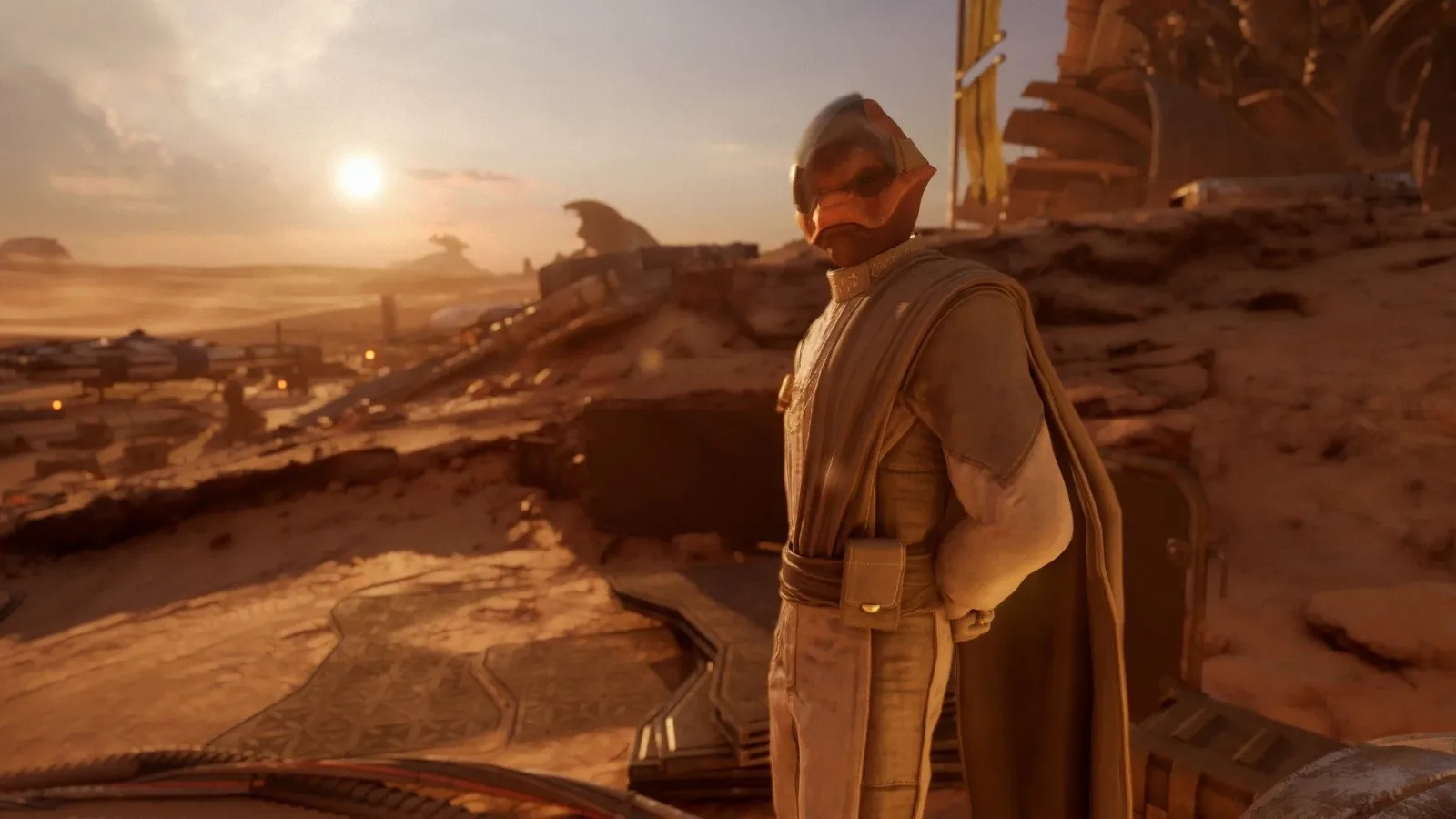
Fuse Games is not planning to keep players at maximum racing intensity without interruption, however. Webster described the need for "light and shade" in the experience. The contrast comes through sections in which players control Shade after arriving on a new planet.
These sequences are intended to offer a lower-intensity form of immersion within the Star Wars setting, creating breathing room between the most demanding races. The idea is not that the game abandons its high-speed identity, but that it gives the action a different rhythm. After a punishing contest filled with collisions and split-second turns, slowing down enough to take in a new world can make the next burst of racing feel sharper.
That pacing serves the same broader philosophy as the game's approach to rewards. Constant excitement can become background noise if it never changes shape. By alternating the pressure of competition with calmer planet-based moments, Galactic Racer is attempting to make both sides of the experience more distinct. The quieter sections may strengthen the sense of place, while the races gain impact because players are not permanently locked into one level of sensory and mechanical intensity.
It is also a natural fit for Star Wars. The setting has long supported both kinetic chases and quieter travel between distinctive worlds. In this case, the slower material is being positioned as part of the game's immersion rather than simply a menu between events. Exactly what players will do as Shade on each planet has not been detailed, but the role is being framed as an important part of the overall structure.
Earned success is the central promise
Webster's comments make the direction of Star Wars: Galactic Racer clear. The game is pursuing speed and spectacle, but it does not want those elements to come without stakes. Its developers believe players can manage a more complex, more demanding racer, and they want the highs of victory or progress to emerge from difficulty rather than replace it.
That means the game may stand apart from racers built primarily around effortless forward momentum. Finishing first will presumably still be a thrill, but the design is also trying to validate persistence: the recovery after a near-disaster, the narrow survival of a hostile pack, or the fifth-place result that once seemed impossible.
For a team with deep Burnout roots, it is a notable evolution rather than a rejection of arcade racing. The speed, crashes and physical aggression remain. What changes is the purpose behind them. In Star Wars: Galactic Racer, the chaos is meant to test players, and the game's creators hope that test will make every hard-won result feel more satisfying.
Community
Discussion
Start the conversation.
No comments have been posted yet.