

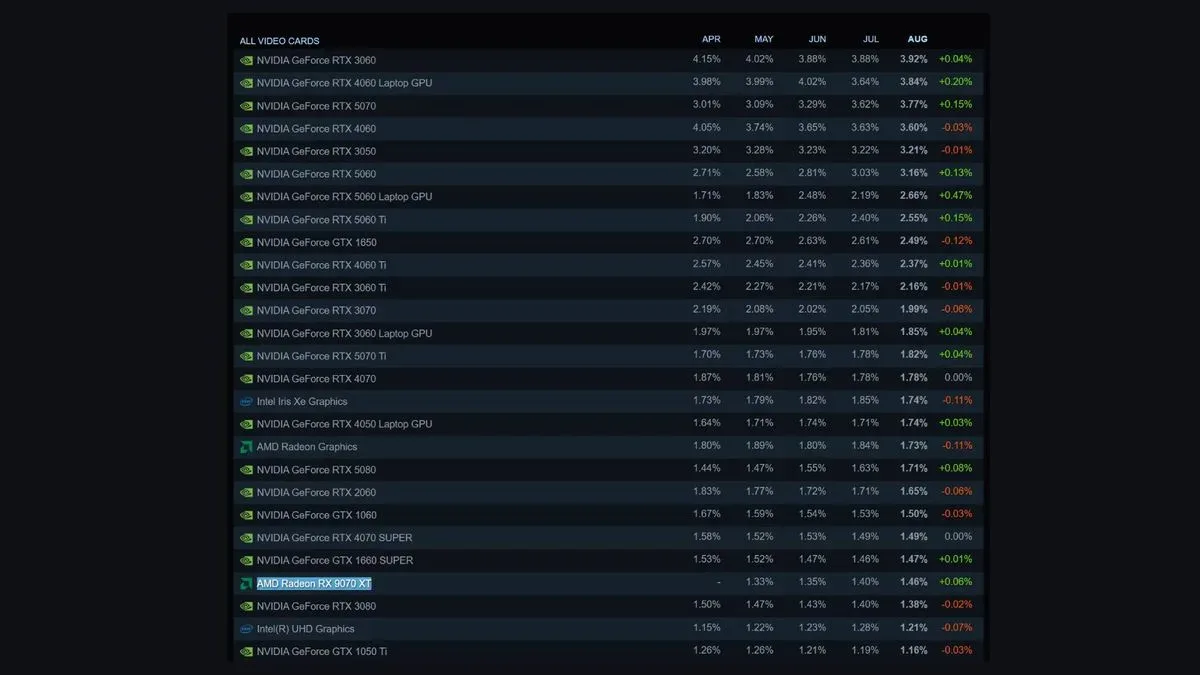
The Radeon RX 9070 XT has become the most widely represented AMD graphics card in Valve's latest Steam Hardware Survey results, a notable milestone for the upper-mid-range GPU as it continues to establish itself among PC players. In the August survey, the Radeon RX 9070 XT holds a 1.46% share of the participating systems, placing it 24th in the overall graphics-card rankings and ahead of every other Radeon model listed individually.
That result does not mean AMD has overturned Nvidia's long-standing lead among Steam users. Far from it: GeForce hardware still makes up the overwhelming majority of the most popular entries, and the RTX 3060 remains at the top of the chart with a 3.92% share. Nvidia's newer RTX 5070 is also significantly ahead of AMD's RX 9070 XT, landing in third place at 3.77%.
Still, the RX 9070 XT's position is meaningful. It now ranks above the standard Radeon RX 9070, older Radeon generations, and even Nvidia's GeForce RTX 3080 within the survey. For AMD, which has often seen its individual desktop GPUs sit further down Steam's monthly lists than their real-world performance might suggest, becoming the company's highest-placed card is a clear sign that the RX 9070 XT is finding an audience.
A Small Monthly Increase, but an Important AMD Lead
The RX 9070 XT's August share represents an increase of 0.06 percentage points from the prior month. That is a modest movement, and Steam Hardware Survey changes should always be interpreted with caution. The survey is based on a subset of Steam participants rather than a complete census of every account and every active PC. Individual month-to-month shifts can be influenced by participation, regional sampling, new hardware launches, and the way Valve categorizes devices.
For useful background on this topic, read Exterminauts Turns Galactic Pest Control Into a Chaotic Co-Op Shooter.
Nevertheless, the survey remains one of the most visible public indicators of the hardware being used by active PC players. It is especially useful for observing broader trends over time: which GPUs persist for years, which newer products rise quickly, and which price segments command the largest installed base.
From that perspective, the RX 9070 XT is in an interesting position. It is not competing for mass adoption in the way a low-cost entry-level graphics card might. Instead, it sits in a more performance-focused tier, aimed at players who want a substantial upgrade for modern games. Its 1.46% showing suggests that the card has reached enough systems to stand above AMD's other current and previous individual GPU entries, even if it remains well outside the leading group of GeForce models.
Valve's GPU Categories Have Recently Been Corrected
There is an important detail behind the newest Radeon figures. Valve previously had an issue in which several AMD GPU models were grouped together in the survey data. The Radeon RX 9070, RX 9070 XT, and RX 9060 were among the cards affected by that categorization problem, making it difficult to judge the popularity of each product on its own.
That problem has since been addressed, meaning the latest figures offer a cleaner look at the RX 9070 XT as a distinct piece of hardware. The corrected listing makes its status as AMD's leading individual GPU in the survey more useful as a data point, though the normal limitations of a voluntary hardware sample still apply.
It also means comparisons with previous months need some context. A change in reported share can reflect genuine adoption, but it can also be affected when the underlying reporting categories are refined. The 0.06% gain shown for the RX 9070 XT is still positive, yet it is best treated as one part of a developing trend rather than definitive proof of a major market shift.
The RTX 3060 Continues to Show the Value of Installed Base
The Steam chart's leader provides a useful reminder that popularity is not simply a contest between the newest GPUs. Nvidia's RTX 3060, an Ampere-generation card, continues to occupy first place with 3.92% of surveyed systems. That lead illustrates how long a capable, broadly available graphics card can remain relevant after its initial release window.
For many PC players, upgrading is not an annual event. A graphics card that delivers satisfactory performance across a large library can stay in a system for years, particularly when the cost of moving to a newer tier is high. The RTX 3060 benefits from that dynamic, with a substantial installed base built over time rather than a sudden surge tied to one month.
The presence of a newer 12GB RTX 3060 model may also help preserve the name's visibility, although many of the systems recorded by Steam are likely to be using older versions already purchased and installed. Either way, the RTX 3060's continued lead shows why a new product such as the RX 9070 XT has a steep climb ahead if it is to approach the top of the list.
Meanwhile, the RTX 5070's 3.77% share in third place demonstrates that Nvidia's newer hardware can also gain ground quickly. Its much stronger placement than the RX 9070 XT reinforces the broader imbalance visible throughout the survey: Nvidia remains dominant not merely through legacy cards, but across a number of current GPU categories as well.
Pricing Could Limit the RX 9070 XT's Next Step
One potential obstacle for the Radeon RX 9070 XT is its current retail pricing. Although it launched with a more favorable price position, the lowest identified price was a Gigabyte model at $749, while an ASRock Steel version was listed at $769.99 and included a copy of Onimusha: Way of the Sword. Those prices place the card close to the $800 mark, which can make a purchase decision more difficult for players trying to maximize value.
Bundled games can improve the proposition for a buyer who already planned to pick up that title, but they do not change the upfront cost of the hardware. For shoppers comparing multiple upgrade routes, the final price of the GPU often matters more than its launch MSRP or its position in a performance chart.
That is particularly relevant in a market where older cards remain attractive. A player who is satisfied with a lower performance tier may decide to seek out a second-hand GPU such as an RTX 3070 rather than spend substantially more on a new RX 9070 XT. Others may retain an existing RTX 3060 or similar card until a larger price drop makes a next-generation replacement feel more compelling.
As a result, the RX 9070 XT's Steam presence is likely to depend not just on its technical capabilities, but on availability and sustained street pricing. If more models begin appearing at lower prices, the card could become a more appealing upgrade for a wider set of PC gamers. If pricing stays elevated, adoption may remain gradual even as the card continues to outperform other Radeon entries in Valve's rankings.
What the Survey Does--and Does Not--Tell PC Gamers
Steam's hardware data should not be read as a straightforward recommendation list. The most common GPU is not automatically the best purchase for every buyer, nor does a lower-ranked card necessarily offer worse gaming performance. The survey primarily reflects what people already own and use, which is shaped by years of sales, regional pricing, prebuilt systems, used hardware, and the pace at which people upgrade.
For AMD, though, the RX 9070 XT's result is still encouraging. It has moved into the company's top spot within one of the PC gaming ecosystem's most closely watched public datasets. It has also done so after Valve corrected the Radeon reporting issue, giving the card a clearer individual identity in the results.
The bigger picture remains unchanged for now. Nvidia hardware occupies most of the highest positions, the RTX 3060 continues to lead at 3.92%, and the RTX 5070 is comfortably ahead of the RX 9070 XT at 3.77%. AMD's 1.46% share is a promising foothold rather than a challenge to that leadership.
Future survey updates will show whether the RX 9070 XT can continue its slow ascent. A broader drop in retail pricing, stronger stock availability, or an active seasonal upgrade period could help it reach more systems. Until then, August's numbers give AMD a concrete success to point to: the Radeon RX 9070 XT is now the company's most popular individually listed graphics card among the Steam Hardware Survey sample.
Community
Discussion
Start the conversation.
No comments have been posted yet.