

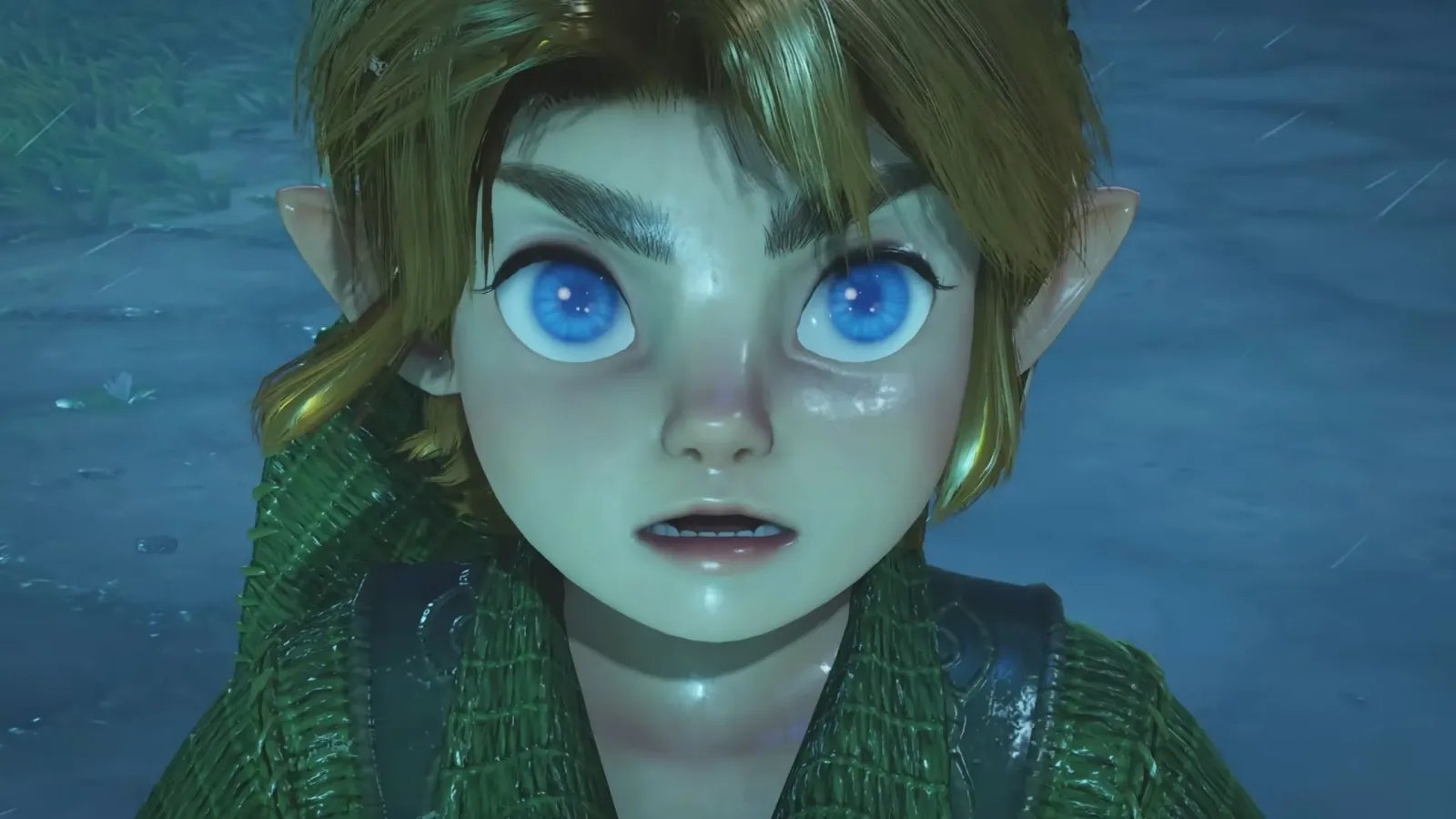
Nintendo's newly showcased The Legend of Zelda: Ocarina of Time remake has given Zelda fans plenty to examine, but one detail has rapidly become the center of the conversation: Young Link's face. The hero of time has received many visual interpretations across decades of games, art, animation, and promotional material. This latest version, however, is proving unusually divisive among even the series' most committed players.
The issue is not that Young Link has been redesigned at all. A remake naturally invites a fresh look at familiar characters, especially when the original Ocarina of Time was built around the visual limitations of its era. Instead, the reaction has focused on the particular choices made for the child version of Link: very round eyes, especially full cheeks, and a soft, doll-like facial structure that some fans feel has crossed from stylized into unsettling.
Online reactions have been swift and often merciless. The broad consensus among critics of the model is that the remake's Young Link lands in an awkward uncanny-valley space. He is recognizably Link, with the green clothing, blond hair, pointed ears, and overall silhouette players expect, yet his proportions have made the character feel less like an adventurous Kokiri boy and more like an unnervingly lifelike toy.
Embedded X/Twitter post
Embedded X/Twitter post
A Hero of Time With an Uncomfortable New Look
Young Link was never designed to be intimidating. In the original game, he is a small child thrown into an enormous adventure, beginning in Kokiri Forest before being sent out into Hyrule with the fate of the kingdom on his shoulders. His relative simplicity was part of that appeal. The original model had an expressive, readable face, but the technology of the time kept it abstract enough that players could easily project personality onto him.
For useful background on this topic, read Crisis Core Reunion Launches Digitally on Nintendo Switch 2 Today.
The remake's interpretation appears to take the opposite route. Rather than leaving much to the imagination, it gives Link an extremely rounded, youthful face. For some players, that makes him look appropriately childlike. For many others, the combination of enlarged eyes and chubby cheeks has generated an immediate sense that something is slightly off.
That distinction matters because Link is such an unusually flexible protagonist. He is traditionally silent, and while each incarnation has recognizable traits, his reserved presentation lets players inhabit the role. A face that becomes too conspicuous can work against that quality. When a character model attracts more attention than the adventure around it, players may find themselves studying its oddities rather than connecting with its emotions.
In this case, the concern is less about graphical fidelity than character identity. Fans are not simply saying the model is too detailed. They are responding to a specific version of detail that makes Young Link appear oddly artificial. The effect is intensified by the eyes, which have become the subject of repeated jokes and edited images across social media.
Memes Arrive Almost Immediately
It did not take long for the comparisons to begin. One particularly popular reaction placed the remake's Young Link alongside Renesmee, the infamous animatronic baby from the Twilight film series. The comparison is harsh, but it illustrates why the redesign has taken off as a meme. Both images evoke the uneasy feeling produced when a face is meant to be cute and realistic but ends up looking a little too fixed, a little too polished, and a little too unlike a natural human expression.
Other fan edits have pushed that idea further, emphasizing the blank intensity of Link's new stare. The humor has ranged from light teasing to considerably darker exaggeration, including a widely shared post imagining a much rougher reception for the young hero in another era. The joke is obviously hyperbolic, but the engagement around it suggests the response is not isolated. Plenty of viewers see the same strange quality in the new model.
Another comparison has sent longtime Zelda players back to The Legend of Zelda: Twilight Princess. Fans have noted a resemblance to Malo, the very young-looking Ordon resident whose wide-eyed appearance has long been a source of community jokes. That connection is especially amusing because it turns the discussion into an internal Zelda callback: for some players, Nintendo has inadvertently given its most famous hero the visual energy of one of the franchise's stranger child character designs.
One fan's succinct verdict, that Nintendo "did him dirty," neatly captures the prevailing tone. This is not necessarily rage over a beloved game being changed beyond recognition. It is disbelief that a company known for some of gaming's most iconic character art could give Young Link a look that so many viewers find distracting.
Why Young Link Is a Particularly Sensitive Redesign
Redesigning Link always carries risk because there is no single definitive version of him. The character has appeared as a bright, cartoon-like adventurer in The Wind Waker, a more realistically proportioned young man in Twilight Princess, and a weathered open-world survivor in Breath of the Wild and Tears of the Kingdom. The franchise has repeatedly shown that Link can be reinterpreted successfully.
Young Link from Ocarina of Time occupies a particularly important place in that history, though. For many players, he is the image most closely associated with the transition of Zelda into 3D. He is the Link who first rode across Hyrule Field, entered the Temple of Time, met Princess Zelda, and moved between childhood and adulthood as the game's central structure transformed the world around him.
That legacy gives every small visual decision extra weight. Players are likely to accept a remake changing textures, lighting, environments, and animation because those updates are expected. A face, however, is where nostalgia becomes personal. Even when fans cannot precisely define what has changed, they know when a character no longer matches the impression they carried for years.
There is also an irony in the response: Young Link's original design was technologically crude by modern standards, but that restraint may have protected its charm. The old model did not attempt to convincingly simulate a real child's face. It communicated the idea of a child adventurer through clear shapes and expressive animation. By making the new version more elaborate, the remake has opened the door to scrutiny that the original could never have faced.
Voiced Cutscenes Mark a Much Bigger Change
Young Link's appearance may be dominating social feeds, but the remake includes another change that could have broader implications for how players experience Ocarina of Time: its cutscenes are fully voice acted. That is a substantial shift for a game originally defined by text boxes, musical cues, brief vocal sounds, and player interpretation.
Giving the cast spoken dialogue has the potential to reshape familiar scenes throughout the adventure. Characters such as Zelda, Navi, Saria, Ganondorf, Impa, Rauru, and the people Link encounters across Hyrule have long existed primarily through written dialogue and memorable visual moments. Full performances can add emotion, timing, and personality that players previously supplied themselves.
At the same time, the remake retains one of the series' oldest traditions: Link himself is not receiving full spoken dialogue. The hero remains silent even as the characters around him speak in voiced scenes. That choice preserves a core part of Link's identity and avoids forcing a specific vocal personality onto a protagonist players have historically inhabited rather than merely watched.
It also creates an interesting contrast with the Young Link debate. Players may be willing to accept extensive new voices for the supporting cast while being far more protective of the hero's visual presentation. Link can remain silent because that feels familiar. But if his face stops feeling like Link, silence alone will not protect the audience's connection to the character.
The Debate Is Part of Remake Culture
Strong reactions to character changes have become a standard part of major remakes. Modern technology allows developers to revisit older games with richer geometry, facial animation, cinematic presentation, and far more detailed expressions. But every improvement introduces interpretation. A developer is no longer just increasing resolution; it is deciding what a remembered character was supposed to look like all along.
That is an especially difficult task for Nintendo's older 3D games. Their visual styles often relied on bold colors, simplified shapes, and expressive exaggeration. Translating those elements directly into a newer rendering style can produce unexpected results. Smooth surfaces may become too plastic. Larger eyes can look vacant rather than charming. A face intended to read clearly from a distance can feel exaggerated in a close-up cinematic shot.
The conversation around Young Link shows how quickly players notice those tensions. Some may ultimately warm to the new design once they see it moving through full scenes and environments. Others may continue to find the face distracting regardless of context. For now, the model has achieved something few redesigns manage: it has become a story in its own right.
Whether Nintendo adjusts anything or simply lets the debate run its course remains to be seen. The remake's showcase has made clear that it is not treating Ocarina of Time as a purely cosmetic update. Fully voiced cutscenes and reworked character models indicate a more ambitious reinterpretation. That can be exciting, but it also means every cherished detail will be examined closely.
For the moment, the Hero of Time has saved Hyrule many times over, but he may have a harder battle ahead: convincing fans that those wide, baby-faced eyes are not staring straight out of the uncanny valley.
Community
Discussion
Start the conversation.
No comments have been posted yet.