

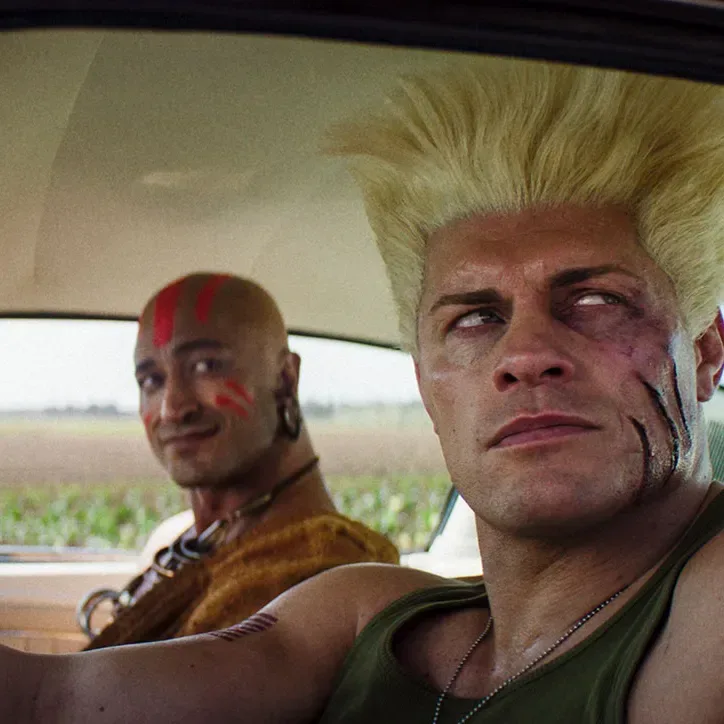
Street Fighter may be leading the North American box office, but its deliberately goofy tone has become one of the biggest points of conversation around the new video game adaptation. While some viewers hoped for a darker and more grounded approach to Capcom's iconic fighting-game world, director and writer Kitao Sakurai has made it clear that such a version was never really part of the plan.
Sakurai has said the project was conceived with a very different kind of energy in mind: heightened, chaotic, comic, and sometimes intentionally ridiculous. In his view, that approach is not a departure from Street Fighter's identity. It is central to it.
The filmmaker explained that he would not have been hired to make the movie if his pitch had been a grim, realism-focused reinvention in the mold of Batman Begins. Instead, the creative assignment reflected the stranger, more colorful, and more spiritually heightened qualities of Street Fighter's characters and universe. Legendary producer Cale Boyter was described as a major supporter of that vision, advocating for a film with a distinctly gonzo sensibility.
A Fighting Game World Built for Big Personalities
Street Fighter has always occupied an unusual space in video games. Its fundamental premise is straightforward: warriors from around the world face one another in martial-arts bouts. But the series has rarely been interested in presenting that premise as ordinary reality. Its cast includes globe-trotting martial artists, military operatives, wrestlers, secret organizations, mystics, experimental soldiers, and villains whose ambitions are frequently as outsized as their costumes.
For useful background on this topic, read Unmatched: Cobble & Fog Turns Victorian Horror Into a Brilliant Battle of Wits.
That mix has helped Street Fighter remain recognizable for decades. The games can deliver tense competitive matches at the highest level, but their world is also filled with dramatic rivalries, impossible special moves, eccentric stage designs, boastful introductions, and characters who feel as if they have stepped out of entirely different genres. One fighter may be grounded in traditional martial arts, while another channels supernatural energy or arrives with an exaggerated gimmick that would seem at home in a comic book.
Sakurai's comments suggest the movie was built around the belief that sanding down those qualities would have risked losing what makes Street Fighter distinctive. A grounded action drama can work for many game adaptations, but that does not automatically make it the right framework for every franchise. In this case, the production chose to meet the material on its own heightened terms.
The director's prior work also makes that creative fit easier to understand. Sakurai is associated with projects including The Eric Andre Show and Bad Trip, productions that thrive on discomfort, surprise, escalation, and situations that can become hilariously strange without warning. Street Fighter's film version appears to bring some of that sensibility to a blockbuster setting, embracing a world where conventional realism is not always the primary goal.
Not Everything Needs to Be Conventional to Be Engaging
One of Sakurai's key ideas is that a scene does not always need to function with strict realism or even perfect narrative logic to hold an audience's attention. The overall feeling, momentum, and personality of the film can sometimes matter as much as whether every individual beat could exist in a more conventional drama.
That philosophy does not mean story is irrelevant. Rather, it frames Street Fighter as a movie aiming for a specific form of entertainment: one based on velocity, enthusiasm, unpredictability, and an affectionate willingness to go big. The film's choices are meant to form part of a shared energy, even when individual moments might be intentionally outlandish.
It is a fitting perspective for a franchise that has long asked players to accept extraordinary things as normal. Street Fighter is not a series defined solely by tournament brackets and punches. It is also a universe where signature attacks can be named, shouted, and launched with impossible force; where rivalries carry melodramatic weight; and where each new challenger has room for a distinctive visual and thematic identity.
For some fans, that heightened quality is precisely why the new movie works. The adaptation is not attempting to convince viewers that Street Fighter could happen in the real world. It is inviting them into a stylized version of reality where the franchise's inherent absurdity is a feature, not an obstacle to overcome.
Critical Response and Audience Reaction Have Split
The response to Street Fighter illustrates the risks and potential rewards of that strategy. Critics have been less enthusiastic overall, with the film holding a 41% score on Rotten Tomatoes' Tomatometer. Audience reaction has been considerably warmer, however, as reflected by its 78% Popcornmeter score.
That divide is especially notable because it aligns closely with the debate surrounding the film's tone. Viewers looking for a tightly structured, serious-minded action story may find the movie's anarchic impulses distracting. Others may see those same impulses as a welcome alternative to the polished but interchangeable style that can affect large franchise releases.
The film has been praised for the commitment and enthusiasm of its cast, as well as for its wild spirit. At the same time, one of the recurring criticisms is that all of its energy is not always shaped into a focused story. That is an understandable tension for a movie trying to preserve the feeling of a game series with a vast roster, decades of lore, and a tendency toward larger-than-life spectacle.
For an adaptation like Street Fighter, the question is not simply whether it is faithful in a literal checklist sense. It is also whether it captures a recognizable feeling. A movie can reproduce costumes, moves, names, and locations yet still feel disconnected from the source if it misses the spirit that made the game memorable. Sakurai's approach clearly prioritizes the latter, pursuing the sensation of an unruly Street Fighter world rather than remaking it as something more restrained.
Box Office Momentum Could Shape What Comes Next
With Street Fighter currently sitting at number one in North America, the conversation will inevitably turn toward a possible sequel. The film leaves room for more story, including teases that could point toward future developments. That does not mean a follow-up has been formally set, however.
Sakurai has said there is interest in continuing the story and that the cast had an excellent experience making the film. He would like the opportunity to explore more of this version of Street Fighter, but he stressed that no concrete plans are in place and that nothing has been finalized.
That cautious position is typical for a major franchise film in its early release period. Strong box office performance is an important factor, but studios will also weigh audience reception, long-term interest, production costs, scheduling, and the creative direction for any continuation. Street Fighter's opening leaves the door open, but it is too early to treat a sequel as a certainty.
If another film does happen, Sakurai's remarks offer a strong indication of what audiences should expect. A continuation would likely not pivot suddenly into a grim and grounded reinterpretation. The existing movie's identity is rooted in its big swings, comic strangeness, and willingness to treat the franchise's most exaggerated qualities as part of the appeal.
Street Fighter's Longstanding Adaptation Challenge
Video game movies often face pressure to prove that their source material can be taken seriously. That pressure can lead filmmakers toward darker visual palettes, heavier dramatic stakes, and more conventional action-thriller structures. Sometimes that is appropriate. But seriousness and fidelity are not the same thing, and a game franchise does not need to abandon its humor or oddity to earn a place on the big screen.
Street Fighter presents a particularly clear example of that challenge. The games are competitive, skill-driven, and beloved by dedicated communities, yet they are also theatrical and playful. Their intensity comes from confrontations between extremely bold personalities, not merely from realism. The new film's creative team has chosen to treat that theatricality as an asset.
Whether viewers embrace that choice will remain a matter of taste. The critical and audience-score gap shows that Street Fighter is unlikely to become a universally agreed-upon adaptation. But its box office position and stronger audience response indicate that there is a substantial appetite for its particular brand of chaos.
For Sakurai, the central point appears uncomplicated: the movie was not designed to be a sober, grounded reimagining of Street Fighter. It was designed to be energetic, silly, strange, and committed to the outrageous spirit that has always been woven into Capcom's legendary fighting franchise. For fans who want Street Fighter to feel loud, colorful, and a little unhinged, that may be exactly the point.
Community
Discussion
Start the conversation.
No comments have been posted yet.