

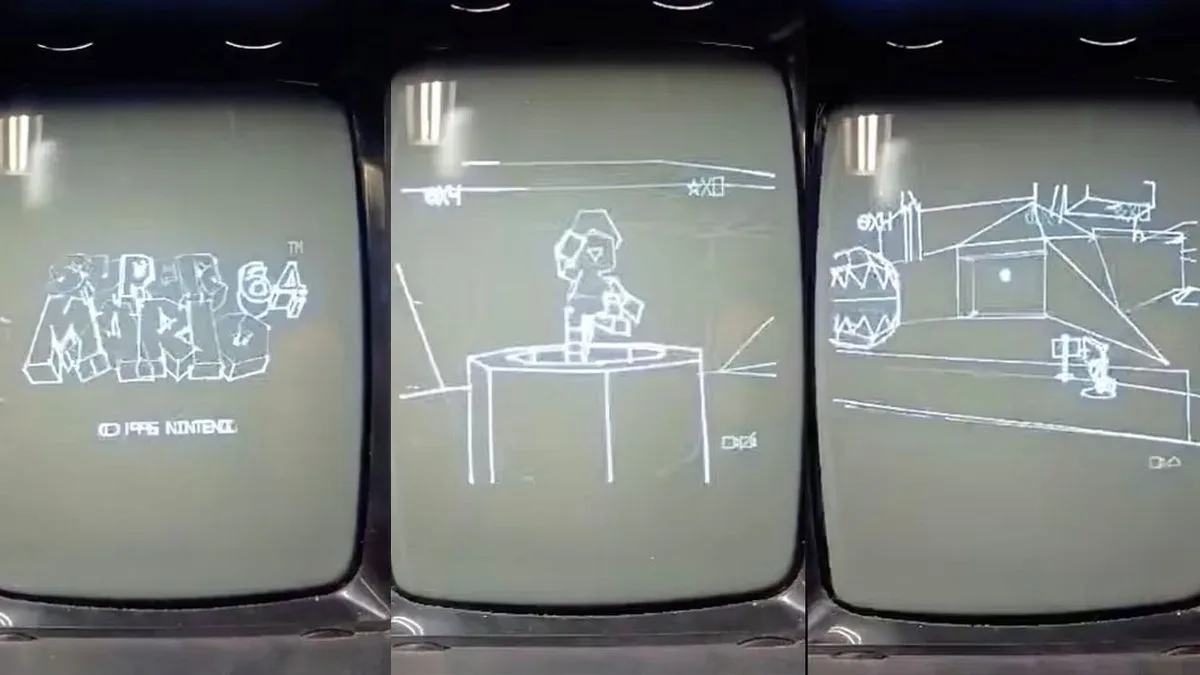
Few gaming combinations sound less likely than Super Mario 64 and the Vectrex. Nintendo's landmark 3D platformer was built for the Nintendo 64 in 1996, while the Vectrex is a much older machine released in 1982, remembered for its distinctive built-in vector monitor and its compact all-in-one arcade presentation. Yet an ambitious homebrew project has brought a recognizable version of Mario's first 3D adventure to the vintage hardware's ecosystem.
The result is not a conventional, feature-complete conversion of Super Mario 64. It is a simplified, wireframe-style interpretation, and it is nowhere near the visual density, breadth, or polish of the Nintendo 64 original. Even so, the footage is immediately compelling because the basic identity of the game comes through: a 3D Mario-like character moves through a geometric environment on hardware from an era far removed from the polygonal console generation.
For retro enthusiasts, that contrast is the point. Seeing an adventure associated with the start of Nintendo's 3D platforming era rendered through the glowing lines of a vector display is an unusual collision of technologies, aesthetics, and game-design history.
A Mario 64 Demake Unlike Most Others
Demakes and homebrew ports are common fixtures of the retro scene. Developers regularly reinterpret major games for older systems, often redesigning them around 8-bit or 16-bit limitations. Those projects can be technically impressive, but they usually involve platforms with relatively familiar libraries, well-established tools, and a broad audience of hobbyist developers.
For useful background on this topic, read Govee Smart TV Light Bars Drop to $50 for 45-70-Inch Displays.
The Vectrex is a very different proposition. The machine occupies a distinctive corner of game history because it does not draw visuals in the same way as conventional raster-display consoles. Instead, its integrated monochrome screen produces vector graphics: crisp lines and shapes that lend games an arcade-like, oscilloscopic look. That makes the system especially suited to abstract visuals, space shooters, and geometric displays, but it also makes a recognizable 3D platform game adaptation a particularly unusual fit.
Rather than trying to reproduce Super Mario 64's colorful worlds, textures, detailed characters, and camera work, this experiment embraces a visual language the Vectrex can communicate. Characters and scenery appear as lines and wireframe forms. The presentation is radically stripped down, but that reduction is what makes the project such a fascinating technical showcase. It turns a game normally associated with bright, textured 3D environments into something resembling a playable vector demonstration.
That approach also underlines the challenge of translating a game like Super Mario 64. The original relies on a large number of elements working together: responsive analog movement, animation, 3D collision, a flexible camera, varied stages, enemies, collectibles, sound effects, and music. A Vectrex interpretation does not need to duplicate every one of those pieces to make an impact. Establishing recognizable movement and a sense of depth on the system is already an achievement.
Dani Ferrer's Work Gains Added Sound
The project has been linked to work by Dani Ferrer, with Arcade Jason adding sound to the original build. That makes this less of a single-person curiosity and more of a collaborative retro development effort, with separate contributions helping shape the version seen in footage.
Sound is an important addition even in an early or incomplete technical showcase. Super Mario 64 is remembered not only for Mario's movement and the freedom of its levels, but also for its instantly recognizable audio feedback. Jumps, interactions, music cues, and Mario's vocalizations all contributed to the game's personality. A minimalist Vectrex adaptation cannot be expected to recreate every aspect of that soundscape, but audio helps the wireframe visuals feel more game-like rather than simply functioning as a graphical experiment.
The collaboration also reflects one of the strengths of the homebrew scene. Projects for obscure or technically demanding machines often evolve through shared tools, code, testing, art, music, and hardware knowledge. A developer may establish a prototype, while another contributor improves presentation or handles a specialized component. For consoles with smaller communities than the NES, Mega Drive, or PlayStation, that cooperative spirit can be especially vital.
Why the Vectrex Makes This So Remarkable
Released in 1982, the Vectrex has always stood apart. Its self-contained display meant players did not need a separate television, and its vector screen gave its software a sharply defined visual identity. It remains beloved by collectors and dedicated developers, although it is far more niche than many of the major home consoles frequently represented in retro homebrew discussions.
That niche status has not stopped enthusiasts from exploring the machine's capabilities. If anything, it has encouraged a community focused on seeing how much can still be achieved with a platform that many players may only know from photographs, collector showcases, or arcade-history conversations. Modern interest in the Vectrex has also been helped by renewed attention surrounding the Vectrex Mini, but developing for the original platform remains a specialist pursuit.
A Super Mario 64 experiment is particularly effective at demonstrating the gap between eras. The original N64 game arrived roughly 14 years after the Vectrex and represented a major leap in home-console design. It helped establish expectations for analog movement and 3D platformer controls that still influence games today. The Vectrex, by comparison, belongs to an earlier generation with dramatically different technical assumptions.
Putting the two together creates an intentionally improbable spectacle. The project is not trying to argue that the Vectrex can natively become an N64. Instead, it shows how far creative reinterpretation, supplemental hardware, and modern hobbyist development can stretch an old platform's identity.
There May Be More Than the Original Hardware at Work
It is important to frame the project carefully. The Vectrex would not be expected to run a direct, untouched version of Super Mario 64 entirely by itself. The version on display is heavily simplified, and there are indications that additional assistance may be involved.
One possible explanation is the use of an SDK or cartridge solution such as the UVMC2, a Vectrex cartridge described as essentially functioning like a small PC. This has not been confirmed as the precise setup behind the project, so it should be treated as a plausible technical theory rather than a definitive breakdown. Still, the apparent complexity of the demonstration strongly suggests that the original console hardware is receiving help beyond what a standard period cartridge alone would ordinarily provide.
That does not lessen the appeal of the experiment. Hardware-assisted retro projects are a meaningful part of preservation and enthusiast development. They can enable developers to use original displays, controllers, and system architecture in new ways while also testing what kinds of experiences can be presented through vintage machines. In this case, the key attraction is the fusion of a recognizable Super Mario 64 concept with the unmistakable look of a Vectrex screen.
It also raises interesting questions about what people mean when they call something a port. In the strictest sense, this is not a one-to-one transfer of Nintendo's game. It is better understood as a Vectrex-focused reinterpretation or proof of concept inspired by Super Mario 64, translated into a radically different technical and visual format. That distinction matters, but it does not make the achievement any less fun to watch.
An Incomplete Project With an Open Future
For now, the project's future appears uncertain. Arcade Jason has indicated a desire to move on to another project, which means this Super Mario 64 adaptation may never become a finished release. As it stands, it can be appreciated as an impressive demonstration of what has been achieved rather than a promise of a complete Vectrex campaign through every familiar Mario 64 location.
There is still a path for the idea to continue. Jason has said that people interested in finishing the project should get in touch. That invitation leaves the door open for another developer, programmer, or Vectrex specialist to pick up the work and expand it. Whether that happens will likely depend on finding someone with both the technical expertise and the time to tackle a demanding niche project.
Completing it would be a substantial undertaking. Beyond building out more environments, a finished game would need to address gameplay systems, performance, visual readability, controls, sound, and the many compromises required by vector hardware. The goal would not necessarily be to reproduce Super Mario 64 wholesale. A more realistic endpoint might be a compact Vectrex game that captures selected ideas from Mario's 3D debut in a form tailored to the machine.
Even if it remains unfinished, the work has already succeeded at something valuable: it has made people look again at the Vectrex. Projects like this keep older systems active in the public imagination not by pretending their limitations do not exist, but by treating those limitations as creative prompts. The wireframe style is not merely a fallback; it becomes the defining visual hook of the whole experiment.
A Celebration of Retro Ambition
Super Mario 64 on Vectrex is the kind of project that thrives on improbability. It takes a game synonymous with the Nintendo 64's 3D breakthrough and filters it through a console known for glowing vector lines and early-1980s arcade sensibilities. The resulting experience may be sparse compared with the original, but it is immediately recognizable and unusually memorable.
That is why unfinished technical experiments deserve attention alongside completed fan games and commercial releases. They reveal the curiosity that keeps retro hardware communities moving forward. Developers continue to build tools, test unconventional ideas, collaborate across specialties, and find fresh uses for machines that have been out of mainstream production for decades.
Whether Dani Ferrer and Arcade Jason's work receives further development or remains a striking proof of concept, it is an excellent reminder that old hardware still has stories left to tell. The Vectrex may not be the place anyone would expect to encounter Super Mario 64, which is exactly what makes this wireframe Mario adventure so captivating.
Community
Discussion
Start the conversation.
No comments have been posted yet.