

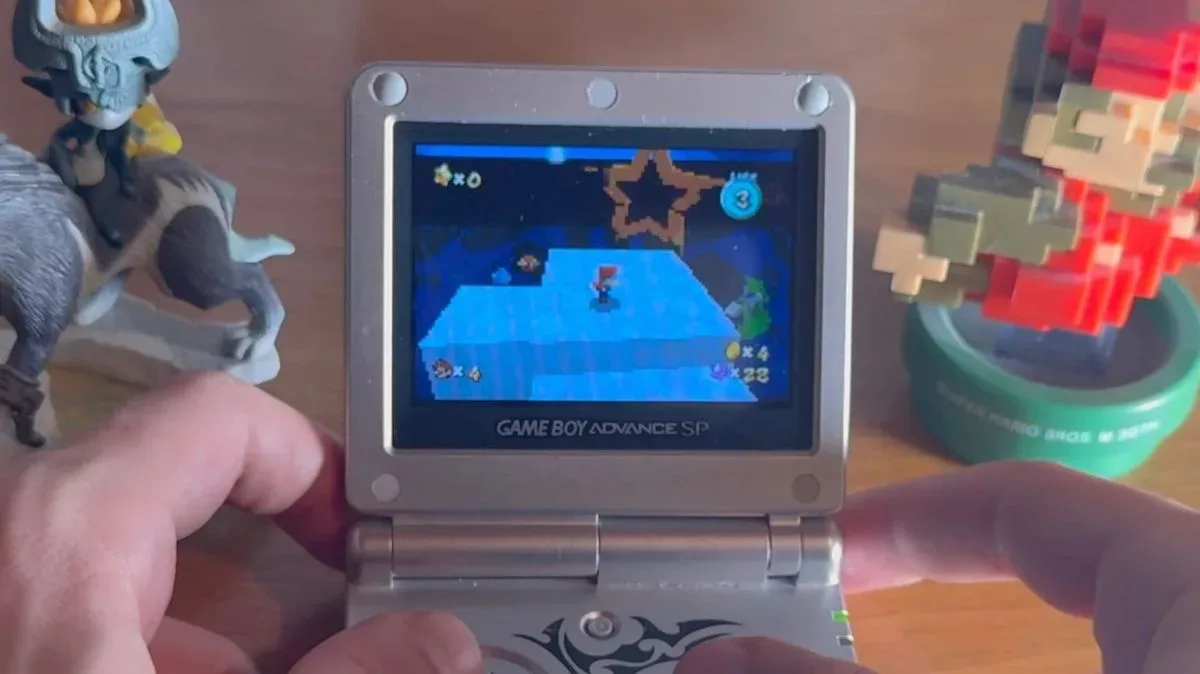
Super Mario Galaxy, one of the defining 3D platformers of the Wii generation, is being reimagined for a machine that predates the Wii by years. Developer Tobias Friedly, known online as Game of Tobi, has unveiled a work-in-progress Game Boy Advance version of the cosmic Mario adventure, turning an idea that sounds technically impossible into a playable handheld project.
The result is naturally a radically different visual experience from Nintendo's original 2007 release. The Game Boy Advance cannot reproduce the Wii game's detailed 3D worlds, sweeping orchestral presentation, or hardware-intensive gravity effects at anything close to their original fidelity. Yet the project's early showing demonstrates recognizable environments, characters, movement, music, and platforming translated into a much more compact form.
It is not a conventional retail port, nor is it presented as an attempt to replace the Wii original. Instead, it is an ambitious fan backport built around the limitations and strengths of Nintendo's 32-bit handheld. For retro enthusiasts, homebrew followers, and Mario fans, that contrast is the entire appeal: a game designed for the Wii running on hardware from the Game Boy Advance era.
A Wii-scale idea on a GBA cartridge
Super Mario Galaxy was built around concepts that were especially striking at the time: tiny planets with their own gravitational pull, expansive space-themed stages, 3D camera work, and elaborate animated set pieces. Bringing any version of that experience to Game Boy Advance hardware requires substantial reinterpretation rather than a simple conversion.
For useful background on this topic, read Pokémon Emerald Color Aims to Bring Hoenn to Game Boy Color Hardware.
Friedly's version is consequently blockier and more stripped back than the Wii release, as expected. Geometry, presentation, and effects must all be adjusted to fit the enormous gap between the two systems. Even so, the project is being shown as a genuinely playable game rather than merely a proof-of-concept scene or a visual mock-up.
That distinction matters. Fan demakes often focus on a single level, a short technical demonstration, or an approximation of a game's artwork. This project is attempting to establish a functional version of Galaxy's gameplay framework on a handheld that was never intended to run an adventure of this scale. The visual compromises are apparent, but they also make the technical work easier to appreciate.
The Game Boy Advance launched long before the Wii, and its capabilities place strict boundaries around memory, processing power, storage, sound, and rendering. Translating a 3D Wii platformer to it means solving problems beyond making models look smaller. Movement, collisions, animation, camera behavior, level data, audio, and controls all have to be made practical within a dramatically tighter hardware budget.
Built from a personal copy of the original game
The project's construction process is designed around users supplying their own legally acquired US version of Super Mario Galaxy as an ISO file. Rather than distributing Nintendo's game data as part of a ready-to-play download, the build process extracts and creates the required assets from the user's own copy while the project is compiled.
Friedly has explained that the models, animations, textures, sounds, music, and text are constructed on the user's computer from their copy of the original game. This approach means a user needs the appropriate game dump before they can produce the Game Boy Advance build.
The required file is identified as the US version of the game and needs to be placed in the project directory under the name baserom_us.iso. During an initial build, the tools unpack the disc data and verify that the files required by the project match the expected original game data before creating the assets used by the GBA version.
That setup also underscores the unusual nature of the release. This is not a cartridge being sold with a complete copy of Super Mario Galaxy embedded within it. It is a fan development project that depends on the user having access to a legally obtained copy of the original game and following the technical setup process themselves.
Open code and familiar community tools
Transparency is a major part of the project. The engine code and game code have been made available for others to inspect, allowing interested users to study how the conversion works, contribute to it, or simply better understand the technical choices behind it.
That openness is particularly notable for a project of this kind. A GBA reinterpretation of a Wii game inevitably prompts questions about how its assets are processed, how its systems are rebuilt, and how much of the original game can be represented on older hardware. Making the code accessible gives the wider homebrew and preservation community a chance to examine those answers directly.
The work draws on an engine created by Joshua Barettos, along with the recent decompilation work surrounding Super Mario Galaxy. Decompilation projects can make it easier for developers to understand and recreate the behavior of older games, though they still do not erase the technical difficulty involved in adapting that knowledge to a very different platform.
In this case, the challenge is heightened by the fact that Game Boy Advance development has its own toolchain and platform-specific demands. The project documentation provides routes for building on macOS, Windows, and Linux systems. macOS users are directed to install Apple's developer tools and devkitPro, while Linux users can prepare the required tools through a terminal environment.
Windows support is handled through Windows Subsystem for Linux, or WSL. The setup involves installing an Ubuntu environment and the relevant development packages before building the project there. The instructions also note that working from the Linux home directory is preferable to building directly from the Windows C: drive, where the process may run more slowly.
An ambitious continuation of Mario backport work
Friedly has become known for experimenting with Mario projects on unexpected hardware, including work connected to bringing Super Mario 64 to Game Boy Advance. The Galaxy project continues that interest in asking how far classic handheld hardware can be pushed when paired with modern development knowledge and a willingness to redesign complex games for new constraints.
There is a long tradition of impressive technical conversions in the retro scene. Some are commercial-era ports made under severe deadlines, while others are modern homebrew projects that benefit from contemporary tools, documentation, and community collaboration. A Wii-to-GBA Galaxy reinterpretation belongs firmly in the latter camp, but it still reflects the same fascination: seeing a familiar game transformed to fit a system it was never meant to reach.
For Mario fans, the appeal is not that this version can rival the original game's Wii presentation. It cannot, and it does not need to. The attraction comes from watching a recognizable form of Galaxy emerge from such limited hardware, with its worlds and systems reshaped into something that feels at home on a Game Boy Advance.
It also highlights how much personality can survive a major technical downgrade when a project focuses on the right details. A reduced polygon count or simplified texture work may be unavoidable, but the identity of a platformer is also found in its movement, timing, stage design, sound cues, and sense of discovery. Preserving even part of that identity on GBA hardware is a significant creative challenge.
What interested players should keep in mind
Anyone looking to try the project should approach it as an in-development fan effort and be prepared for a hands-on installation process. It requires a legally acquired US Super Mario Galaxy ISO, the project files, the appropriate development tools, and time for the initial build to complete. The first build takes several minutes because it downloads a disc utility, unpacks the game data, validates needed files, and constructs assets.
Players should also expect differences from the Wii game in practically every technical area. The GBA version is an adaptation shaped by hardware limitations, not an official re-release or a direct one-to-one conversion. Its value lies in the ingenuity of getting the experience running at all.
Still, the project is an exciting showcase for the continuing creativity of the retro development scene. The Game Boy Advance remains a popular target for developers decades after its launch, in part because its limitations are clear, its library is beloved, and overcoming its constraints can produce remarkably distinctive results.
Super Mario Galaxy on Game Boy Advance is a reminder that old hardware is not finished hardware. With open development, community-made tools, and enough technical persistence, even a Wii-era adventure built around miniature planets and gravity-defying platforming can find a surprising new form on Nintendo's classic handheld.
Community
Discussion
Start the conversation.
No comments have been posted yet.