

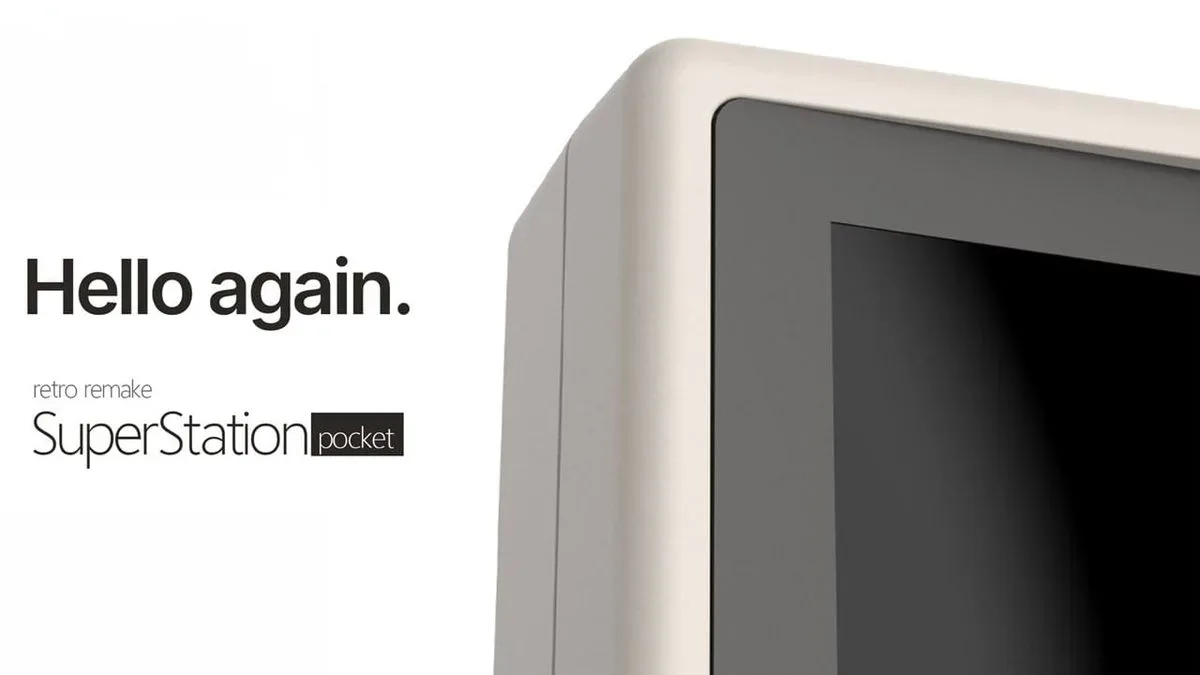
A new FPGA handheld is on the way from Retro Remake. Called the SuperStation Pocket, the portable has been teased by Taki Udon as a system built around physical Game Boy-family cartridges while also aiming to do considerably more than a conventional single-platform handheld.
The headline feature is straightforward: SuperStation Pocket is planned to play Game Boy, Game Boy Color and Game Boy Advance cartridges. But its FPGA architecture is intended to make it a broader retro-gaming device. The current claims point to downloadable hardware cores reaching up to PlayStation 1 and Nintendo 64, while an optional and reportedly affordable dock is expected to enable 4K output.
It is an ambitious combination, especially for a handheld that is being positioned as a lower-cost alternative to existing FPGA portables. Few final specifications, design details or launch information have been confirmed so far, but the teaser establishes the direction: physical cartridge compatibility, expandable FPGA functionality, open-source support, and a notably Game Boy Pocket-inspired appearance.
Embedded X/Twitter post
A cartridge-ready handheld with FPGA flexibility
FPGA hardware has become increasingly important to players who want a modern way to use classic games without relying entirely on conventional software emulation. An FPGA, or field-programmable gate array, can be configured to reproduce the behavior of old console hardware through dedicated cores. The goal is not merely to run a game file; it is to recreate the original system's logic closely enough that software operates in a manner comparable to the vintage hardware.
For useful background on this topic, read Hyperkin's SupaBoy SNES Handheld Arrives in Crimson and Transparent Prime Colors.
That technical approach is why FPGA products tend to attract enthusiasts who care about timing, controller response, video output, compatibility and the experience of using original cartridges. It also explains why a handheld with a Game Boy cartridge slot is only one part of the SuperStation Pocket's pitch. Cartridge support gives owners a direct route to their existing GB, GBC and GBA libraries, while downloadable cores could substantially broaden what the device can do.
The SuperStation Pocket is said to support cores through the PlayStation 1 and Nintendo 64 era. That wording is important. It suggests an intended upper range for the machine's FPGA options, but it does not yet provide a complete compatibility list or confirm how every platform, core or game will perform. Until detailed hardware specifications and software demonstrations arrive, questions remain around supported systems, implementation quality, save handling, controller options and the exact relationship between the handheld and its dock.
Still, the prospect is notable. A device that can play physical Game Boy-family carts while serving as a portable FPGA platform could appeal to collectors who want to keep using their original library as well as players interested in a configurable all-in-one retro setup.
An open-source approach from launch
One of the most consequential details in the early announcement is the plan for the SuperStation Pocket to be open source from launch. In the FPGA scene, openness can make a major difference to a platform's longevity. Community developers can investigate the hardware, build or adapt cores, improve tools and pursue features beyond the manufacturer's initial roadmap.
That does not automatically mean every old platform will appear on the device, nor does it guarantee that new cores will be simple to develop. Hardware recreation is demanding work, and different systems present very different technical challenges. However, an open-source commitment can reduce the risk that a device's usefulness depends exclusively on a company continuing to deliver official updates for years after release.
For prospective owners, the appeal is flexibility. The system may begin with a set of supported experiences, then gain new possibilities as its software ecosystem matures. That model has helped make FPGA platforms attractive despite their often higher prices and more technical setup requirements compared with plug-and-play retro handhelds.
It also creates a meaningful contrast with many mainstream portable consoles. Most commercial handhelds are defined by a fixed library, a closed store or a narrow set of supported formats. SuperStation Pocket appears intended to be a piece of adaptable hardware: a dedicated Game Boy cartridge player first and a platform whose capabilities can expand through FPGA cores over time.
Designed in the image of the Game Boy Pocket
The teaser indicates that Retro Remake is not simply building another handheld modeled after the Game Boy Color or Game Boy Advance. Its visual direction instead resembles the Game Boy Pocket, Nintendo's compact revision of the original monochrome Game Boy design.
That is a distinctive choice in a market full of devices that borrow heavily from horizontal 16-bit controllers, Game Boy Advance layouts, or Game Boy Color-style shells. The Game Boy Pocket silhouette is immediately recognizable: a vertical form factor, familiar face-button placement and a compact, uncomplicated look. For a handheld designed to accept several generations of Game Boy cartridges, the reference feels appropriate without being a direct recreation of any one original Nintendo machine.
No full set of colors has been announced. The teaser has prompted understandable interest in a classic grey finish reminiscent of the original Game Boy family, while Retro Remake's other hardware colors could potentially provide a template for more experimental options. At this stage, however, alternate shells and color variants have not been confirmed for the SuperStation Pocket.
The eventual ergonomics will matter as much as the styling. Game Boy, Game Boy Color and Game Boy Advance titles were built around different screen proportions, button expectations and display technologies. A successful modern FPGA handheld needs to balance the clean aesthetic of its inspiration with practical needs such as screen quality, controls, battery life, cartridge fit and access to any extra buttons needed by later cores.
Docked 4K output is part of the plan
Retro Remake's concept does not stop at portable play. The SuperStation Pocket is expected to work with a dock that offers 4K output. That feature could let owners move from the handheld's built-in screen to a television or monitor, giving the system a dual-purpose role similar to a modern portable console.
There is an important distinction between 4K output and native 4K game rendering. Classic Game Boy games, PS1 titles and Nintendo 64 software were designed for far lower resolutions. The value of a 4K-capable dock is likely to be in clean scaling, display options and a sharp signal for modern screens rather than an implication that vintage games suddenly become native 4K productions.
Specific dock functionality has not yet been outlined. There are no confirmed details on included controllers, USB support, video modes, display filters, wireless connectivity or whether the dock will be sold separately. The claim that it will be affordable is encouraging, but buyers will need concrete pricing and feature information before they can assess the full cost of a handheld-and-TV setup.
Even so, docking is a natural addition for a system with PS1 and N64 ambitions. Game Boy titles make perfect sense in a pocketable vertical handheld, but console cores become more compelling when players can sit down with a larger screen and a suitable external controller.
Pricing could be the biggest question
Price is likely to determine just how disruptive SuperStation Pocket can be. The Analogue Pocket, another FPGA handheld known for its support of Game Boy, Game Boy Color and Game Boy Advance cartridges, has a base price of $239 for its standard colors.
Taki Udon has indicated that SuperStation Pocket's price will begin with a "1." That strongly suggests a starting figure below $200, although it does not establish the exact price, what will be included in the box, or the cost of the dock and any accessories. A product priced at $199 can feel very different from one priced at $149, particularly once a dock, shipping and optional peripherals enter the picture.
Nevertheless, a starting price below Analogue Pocket's base model would be significant. FPGA handhelds are frequently treated as premium enthusiast products, and a less expensive entry point could make hardware-accurate retro play more attainable for people who already own Game Boy cartridges but have been hesitant about the cost of specialized equipment.
Price alone will not decide the contest. Display quality, build quality, software polish, availability, cartridge compatibility and long-term core support all matter. Yet an open-source handheld with original cartridge support, claimed PS1 and N64 core potential, and a lower entry price would present a compelling proposition if Retro Remake can deliver on its early outline.
What still needs to be revealed
The SuperStation Pocket has been described as a project that has been in development throughout the year, and its tease suggests the hardware is approaching a more public stage. However, it remains early. There is no confirmed release date, final retail price, detailed technical specification sheet, full software list or comprehensive look at the dock.
Questions around the screen are especially important. Retro handheld fans will want to know its size, resolution, aspect ratio, brightness, refresh behavior and how it handles the differing formats of Game Boy, Game Boy Color and Game Boy Advance software. Others will be watching for information about buttons, shoulder controls, battery capacity, storage, firmware updates and the process for loading FPGA cores.
For now, SuperStation Pocket is one of the more interesting emerging entries in retro hardware. Its proposed blend of physical Game Boy cartridges, open-source FPGA development, docked display output and an accessible price target gives it a clear identity. The next update will need to turn that promising outline into concrete details, but the early concept has already put a new challenger on the radar for handheld retro players.
Community
Discussion
Start the conversation.
No comments have been posted yet.