

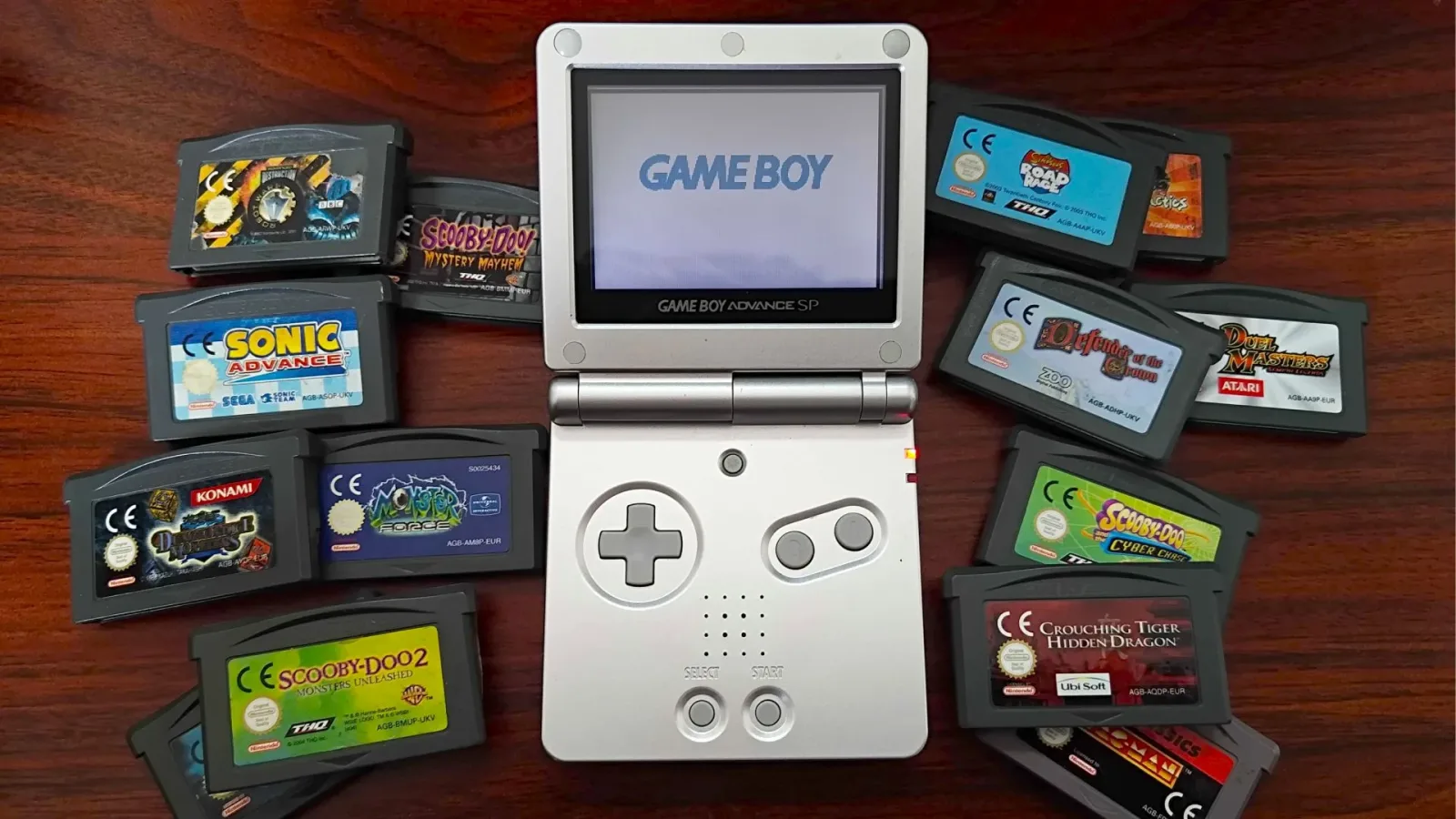
The market for Game Boy Advance-inspired handhelds has no shortage of choices, from inexpensive emulation machines to premium devices designed around original cartridges. Yet a newly shown prototype from Retro Remake founder Taki Udon could potentially occupy a rare middle ground. The project is an FPGA-based clamshell modeled after the Game Boy Advance SP, and its stated price ambition is around $100.
That target remains a major qualifier. This is not a retail announcement, there is no release window, and no final specifications have been locked in publicly. Taki Udon has framed the device as a passion project rather than a confirmed product launch. Still, the latest look at the hardware suggests the concept is moving beyond a one-off curiosity: the prototype is shown running Pokémon Ruby and Pokémon Sapphire, and Taki Udon says the team has been making substantial progress on what is being called the FPGBA SP.
The most important details are straightforward. The FPGBA SP is intended to play real Game Boy Advance cartridges, and its creator is also considering a non-clamshell, standard GBA-style version. If either model can be manufactured near that proposed price point, it would stand out in a section of the retro handheld market where FPGA hardware and physical media support usually demand a considerably higher investment.
Embedded X/Twitter post
What makes an FPGA GBA SP different?
Many handhelds that resemble a Game Boy Advance use software emulation. Those devices can be extremely capable, and they have helped make retro libraries accessible at a wide range of prices. In general, though, they run game files through an emulator rather than recreating a console's logic in configurable hardware. They also commonly focus on SD-card-based libraries instead of accepting original game cartridges.
For useful background on this topic, read Castlevania: Belmont's Curse Earns One of the Series' Best Metacritic Scores.
An FPGA, or field-programmable gate array, takes a different approach. The programmable chip can be configured to reproduce aspects of original hardware behavior at a hardware level. For enthusiasts, that can be appealing because it emphasizes accuracy, timing, and compatibility in a way that differs from conventional software emulation. It also makes an FPGA handheld especially interesting when paired with a functioning cartridge slot.
That does not automatically mean one approach is right for every player. Emulation handhelds are often cheaper, easier to acquire, and flexible enough to cover multiple systems from one device. FPGA devices may cost more and may have a narrower initial focus. But a Game Boy Advance-shaped system that combines a familiar clamshell format, original cartridge support, and FPGA technology for roughly $100 would present a compelling proposition for collectors and players who still own physical games.
"We've been making a lot of progress on FPGBA SP," Taki Udon said while confirming that the prototype plays real cartridges and that a regular FPGBA model is under consideration. The aim, Taki Udon added, is to make it work for around $100.
That price is the detail that turns an interesting prototype into a potentially disruptive one. It is also likely to be the hardest part of the concept to achieve. A final handheld would need a screen, controls, battery, shell, cartridge interface, FPGA components, production testing, packaging, and distribution, all while maintaining a budget that could leave little room for compromise. Until hardware is finalized and manufacturing plans are shared, the $100 figure should be treated as an objective, not a promise.
A second appearance with a sharper GBA focus
The FPGBA SP had already surfaced in September 2026, when Taki Udon showed the clamshell prototype running Diddy Kong Racing for Nintendo 64. That demonstration raised the prospect that the device might have ambitions beyond the Game Boy Advance, potentially through FPGA cores associated with the MiSTer ecosystem.
The new footage places the spotlight more firmly on Nintendo's 32-bit handheld. Seeing Pokémon Ruby and Pokémon Sapphire running on the device reinforces the idea that the current design is being tuned as a Game Boy Advance-inspired machine, rather than simply serving as a generic miniature FPGA platform. The GBA's library remains one of the most sought-after catalogs in retro gaming, spanning first-party Nintendo releases, role-playing games, platformers, tactical titles, and a huge selection of games that never received direct equivalents elsewhere.
A clamshell format also carries practical appeal. The original Game Boy Advance SP's folding design protects the display and controls when stored, while its compact shape helped define portable gaming in the early 2000s. Modern recreations frequently borrow that silhouette because it remains both nostalgic and useful. A potential FPGBA SP would enter a growing group of folding retro handhelds, but its planned FPGA foundation and cartridge support would distinguish it from many of those alternatives.
Where it could fit among existing handhelds
The most obvious comparison is the Analogue Pocket, a well-established FPGA handheld capable of using original Game Boy, Game Boy Color, and Game Boy Advance cartridges. The Pocket has proven that there is meaningful demand for accurate FPGA-based portable hardware, but it sits in a more premium category than the price being discussed for the FPGBA SP.
At the other end of the space are emulation-focused machines. The Ayaneo Konkr Pocket Advance starts at $129.99, while the Anbernic RG SP offers an inexpensive clamshell option for under $60. These systems demonstrate just how broad the market has become: players can choose between Android-based handhelds with higher-end ambitions and budget devices built to evoke a particular classic form factor.
However, those products do not offer the same combination being proposed here. Emulation-based hardware typically depends on software and digital game files, while the FPGBA SP is being developed with original cartridges in mind. That distinction matters to users who have already built physical collections, prefer to use their own carts, or simply want a more console-like relationship with classic software.
The proposed regular FPGBA is equally worth watching. Not every player wants a folding shell, and the original horizontal Game Boy Advance layout has its own dedicated audience. Offering both clamshell and standard versions could give the project broader appeal, although there is currently no confirmation that either version will progress to a commercial release.
The unanswered questions remain significant
For now, the prototype leaves plenty of practical questions open. There is no confirmed screen specification, battery capacity, display aspect ratio, control layout, operating interface, color selection, or list of included features. It is also unclear whether any additional FPGA cores would be included, how expansive compatibility might be, or whether Nintendo 64 functionality seen in earlier footage would be part of a final consumer device.
Support for MiSTer-related cores, if it happens, could greatly expand the machine's appeal. But that possibility should not be mistaken for a confirmed feature. The clearest demonstrated direction at present is Game Boy Advance use with original cartridges. Everything else remains prospective while the hardware is still being developed.
There are also the usual concerns surrounding any modern retro handheld. Button feel, hinge durability, display quality, cartridge fit, sleep behavior, firmware support, and long-term availability can make the difference between a promising concept and a dependable everyday system. A sub-$100 price could be exciting, but enthusiasts will understandably want to see how those fundamentals are handled before judging the device against more established options.
A project worth watching, not pre-ordering
The FPGBA SP is exciting precisely because it is not merely another Game Boy Advance lookalike. If Retro Remake can turn the prototype into a polished retail handheld while staying near its stated $100 target, it could offer a level of hardware-based retro play and physical cartridge support that is unusual at that price. It may also encourage competing manufacturers to reconsider what features are possible in affordable handhelds.
For the moment, though, the appropriate response is cautious interest. Taki Udon has shown working hardware, a cartridge-focused direction, and an ambitious cost goal, but no firm product commitment has been made. Retro Remake is also teasing work that could lead to an FPGA SNES console in both NTSC and PAL variants, suggesting a wider interest in hardware-driven recreations of classic systems.
Whether the FPGBA SP ultimately becomes a shipping device or remains an impressive development project, it highlights where retro handheld enthusiasm is headed. Players are no longer choosing only between original aging hardware and basic emulation boxes. Increasingly, they are looking for devices that combine modern convenience, familiar physical design, and closer hardware-level interpretations of the systems they grew up with. A genuinely affordable FPGA GBA SP would be a notable step in that direction.
Community
Discussion
Start the conversation.
No comments have been posted yet.