

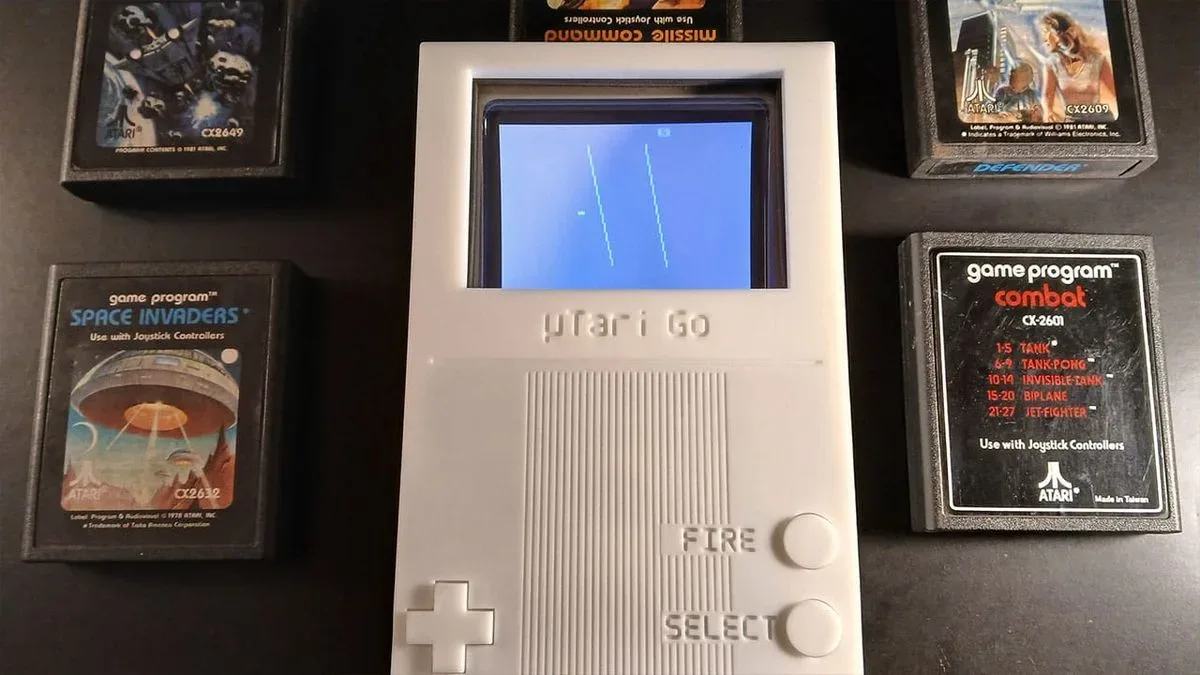
Retro handhelds are often judged by the breadth of their emulation libraries, screen quality, battery life, and how neatly they can slip into a pocket. Nick Bild's µTari Go, pronounced "micro-Tari," takes a radically different route. This is not a modern portable that runs a software recreation of Atari 2600 games. It is a purpose-built handheld machine designed to play real Atari 2600 cartridges, using an original 6507 processor and a tiny built-in CRT display.
The result is an unusual piece of hardware that feels less like a conventional consumer handheld and more like a miniature traveling Atari console. It includes the essential pieces of the classic home setup in one 3D-printed enclosure: physical controls, a cartridge slot, speakers, audio amplification, and a 4-inch cathode-ray-tube screen. Rather than trying to reproduce the old system through FPGA hardware or emulation, the µTari Go is rooted in the technology that powered Atari's original platform.
For players who enjoy the appeal of authentic retro hardware, that distinction is the entire point. The µTari Go does not just display old games on a new screen. It aims to make the Atari 2600 experience physically portable while retaining the cartridge-based character and hardware identity of the original machine.
A handheld built around the 6507
At the center of the project is the 6507 processor, the chip associated with the Atari 2600's original design. The µTari Go uses zero FPGA hardware, making this a distinctly old-school approach to miniaturization. Modern FPGA systems can reproduce classic console behavior at a hardware level, while software emulators recreate it through code. Both approaches are popular, practical, and often more accessible for everyday players. Bild's machine instead prioritizes a direct connection to the original platform architecture.
For useful background on this topic, read Pokémon Pinball Generations 1.6 Expands the Game Boy Classic With Johto's Full Pokédex.
That choice makes the project especially notable because the Atari 2600 was built as a home console. Its cartridges, controllers, display output, and power setup were never intended to travel together in a self-contained portable shell. Moving that experience into handheld form requires far more than shrinking a motherboard or attaching a compact screen. The system needs room for a cartridge, the required electronics, sound components, controls, and power input, all while accommodating the CRT itself.
Bild had already explored shrinking Atari 2600 hardware, including work on a fully functional board reported to be three times smaller than the original. The µTari Go builds upon that spirit of hardware compression, but changes the goal. It is not simply a small Atari board; it is an Atari designed to be played away from a television.
Why the CRT matters
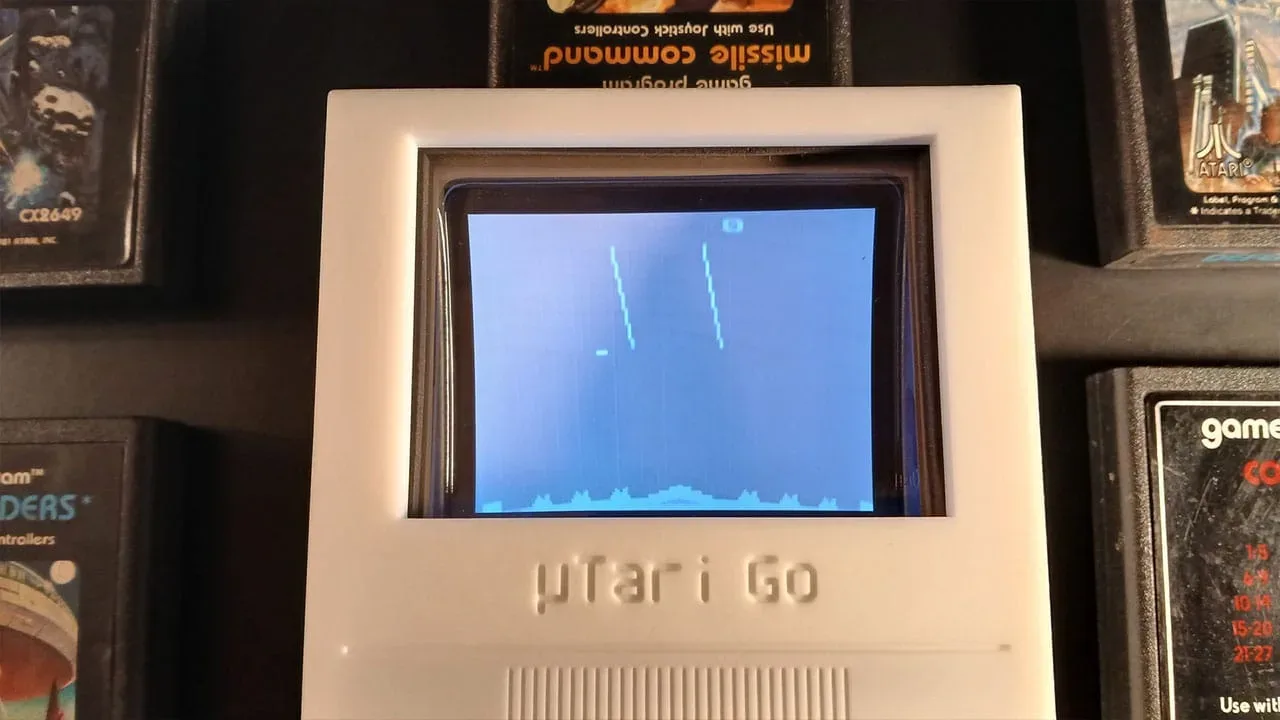
The most striking feature is the built-in 4-inch CRT. In an era when even retro-focused handhelds generally use LCD or OLED panels, carrying a cathode-ray tube inside a portable game system is a bold engineering and aesthetic decision. CRTs are bulky, fragile compared with modern flat displays, and not especially friendly to compact product design. They are also deeply linked to the visual presentation of early video games.
Atari 2600 titles were created for CRT televisions. Developers worked with the limitations and quirks of those displays: scanlines, phosphor glow, color blending, signal behavior, and the way moving sprites appeared on a screen of the period. A modern display can present the games cleanly, sharply, and conveniently, but a CRT changes the character of the image. For enthusiasts, it can make classics such as Space Invaders feel closer to the conditions under which they were originally designed and played.
The µTari Go's screen is not simply an added retro filter. It is an actual CRT, so the handheld's design embraces the physical technology of the era along with the games themselves. That makes it a particularly compelling conversation piece at meetups, conventions, or casual gatherings of retro hardware fans. It is also the kind of machine that turns loading a cartridge into an event rather than a quick tap through a digital library.
Cartridges, controls, and sound in one enclosure
Rather than relying on ROM files or a preloaded game collection, the µTari Go has a dedicated cartridge slot. Players can insert genuine Atari 2600 carts, preserving one of the core rituals of the platform. That physical interaction matters to collectors and longtime fans: choosing a game from a shelf, fitting it into the slot, and booting the system remains part of the experience.
The handheld also incorporates its own controls, speakers, and audio amplifiers. A standard Atari 2600 typically depended on a television for image and sound, as well as separate controllers for input. Packing those functions into a single housing changes the format without discarding the system's fundamental identity. It is still an Atari 2600 at heart, but now one that can be carried alongside a small selection of cartridges.
The casing is 3D-printed, fitting the project's enthusiast-built nature. That approach gives the device a handmade, experimental look rather than the polish of a mass-market portable. In this case, that is part of its appeal. The µTari Go is a showcase for what can be achieved when a retro platform is treated as a living piece of technology to be reworked, not merely preserved behind glass.
Portable power, with a caveat
The µTari Go is powered through an external 12V jack. A portable power pack can supply that power, allowing the handheld to be used outside the house. This means it is portable in the practical sense, though not necessarily as self-contained as modern handhelds with internal rechargeable batteries.
That distinction is worth keeping in mind. A CRT-equipped Atari carrying full-size cartridges was never likely to compete with a pocketable emulation device for convenience. The external power arrangement, screen technology, and cartridge format all place the µTari Go in a different category. It is best understood as a transportable retro console: a device that can go on a trip, be played away from a television, or be brought to an event, rather than something intended to disappear into a jacket pocket.
Still, the image of playing an original Atari 2600 cartridge on a plane, in a hotel room, or at a friend's house without needing a television has undeniable charm. The project makes an early home-console experience mobile in a way that most commercial retro devices do not attempt.
Not a replacement for modern retro handhelds
There is no shortage of capable handhelds that can emulate the Atari 2600 alongside countless other systems. Devices in that category generally offer compact dimensions, rechargeable batteries, digital game storage, save states, display options, and broad compatibility. For someone who simply wants easy access to a large Atari library, those products remain the more straightforward option.
The µTari Go is interesting precisely because it is not trying to win that comparison. Its value is in its specificity. It is a handheld devoted to one platform, designed around original cartridge use and original-style internals, and fitted with display technology from the same broad era. It offers a physical, mechanical, and visual experience that generic emulation hardware cannot completely replicate.
That focus also reflects a wider enthusiasm in retro gaming for hardware that keeps older ecosystems active. New devices built around vintage formats can encourage people to revisit their collections, repair old cartridges, exchange games, and perhaps even consider creating software for platforms that still have dedicated audiences. Atari 2600 homebrew development has existed for years, and imaginative hardware projects can help keep attention on a system long after its original commercial life.
A build for dedicated retro hardware fans
The µTari Go is a niche creation, and it does not need to be anything else. Its CRT, external 12V power requirement, 3D-printed body, and cartridge-based design make it a specialized device for people who appreciate the unusual intersection of electronics work and video-game history. It is not presented as a broadly available retail handheld with a confirmed price, release date, or store listing.
For makers interested in attempting a similar project, Bild has made materials available through GitHub. That is fitting for a build whose appeal lies partly in the ingenuity behind it. The µTari Go invites people to look beyond the standard model of retro gaming--downloaded libraries and universal handhelds--and consider what happens when classic hardware is physically reimagined.
With its original 6507 processor, real cartridges, compact CRT, and integrated controls, the µTari Go is a delightfully eccentric reminder that old consoles can still inspire new forms. It may not be the simplest way to play Space Invaders, but it could be one of the most memorable.
Community
Discussion
Start the conversation.
No comments have been posted yet.