

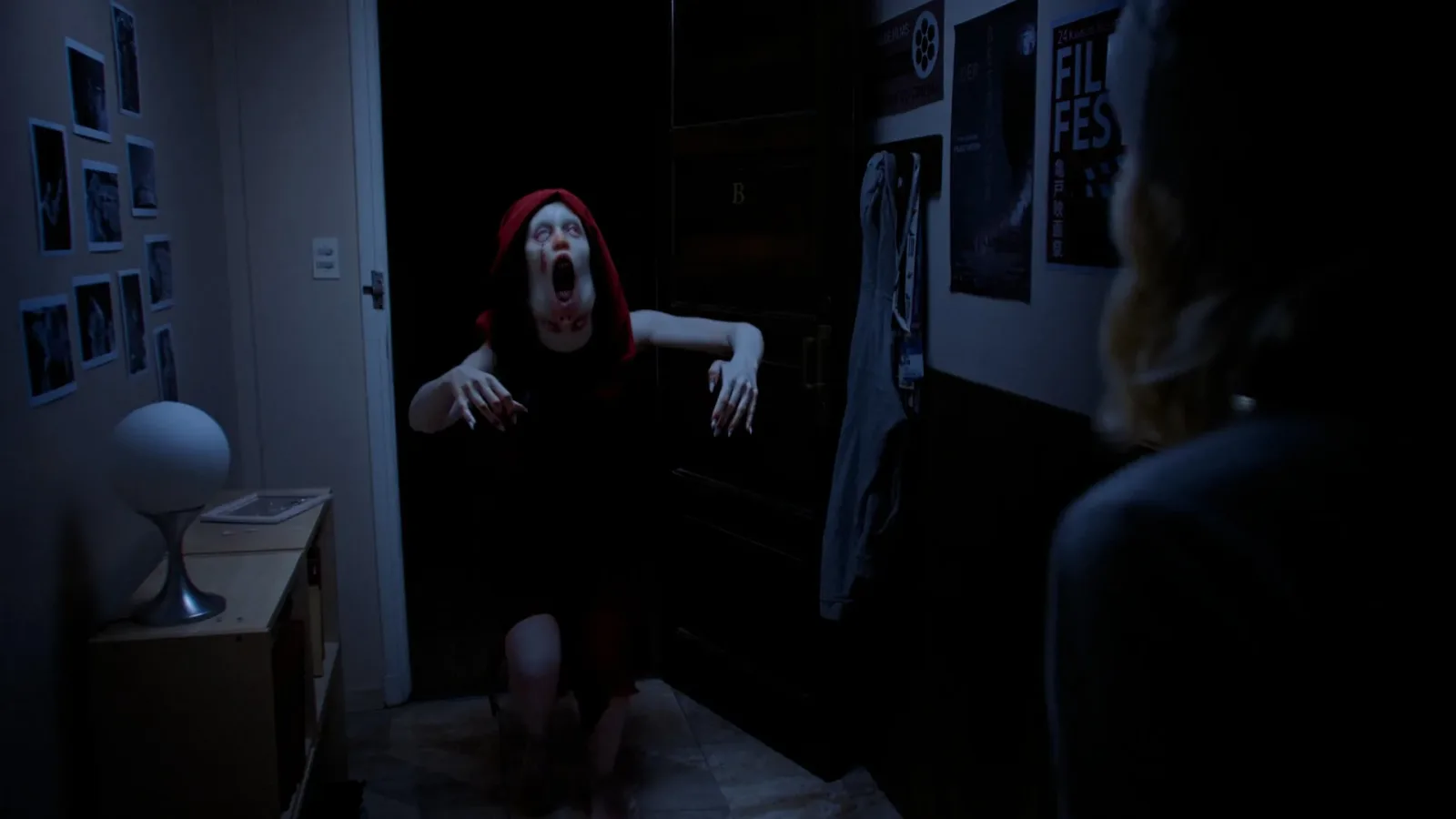
Tenebris Somnia begins with a situation that is uncomfortable long before anything supernatural happens: Julia is haunted by nightmares involving her former boyfriend, and chooses to return to the apartment they once shared in order to see whether he is all right. What should be an emotionally fraught reunion instead becomes a descent into a building full of shattered glass, damaged keepsakes, ominous markings, hostile spirits, and demons with a gruesomely practical interest in human flesh.
The result is a horror game with an unusually personal premise. Rather than sending its protagonist into an abandoned asylum, a remote village, or a laboratory full of failed experiments, Tenebris Somnia turns the remnants of a relationship into its central haunted space. The apartment building is not merely a backdrop for monsters. Its floors, rooms, objects, and memories are bound to Julia's history with her ex, forcing her to confront the past while physically fighting through the horrors that have consumed it.
Developed by Saibot Studios with the involvement of an award-winning Argentine film crew, Tenebris Somnia is positioned as an FMV-adjacent experience rather than a game composed entirely of filmed sequences. Its live-action scenes are used selectively, appearing amid conventional exploration, puzzle solving, and combat. That distinction matters: the film material is not the whole game, but an unsettling ingredient that can arrive when players are least ready for it.
Live-Action Horror Used as a Surprise, Not a Gimmick
Full-motion-video games have a long and complicated history, and players who grew up with titles such as Night Trap may immediately recognize the appeal of seeing performers and practical imagery inserted into a game's horror framework. Tenebris Somnia takes a different route from the old format, though. Instead of asking the player to move through a string of filmed scenes, it layers live action into a more traditionally playable horror adventure.
For useful background on this topic, read GTA 6 Brooklyn Mural Draws Backlash After Overnight Tagging.
That approach helps make the cutscenes feel unpredictable. A filmed moment can arrive after progress, an encounter, or a puzzle solution, giving the sensation that each breakthrough might be rewarded with another glimpse into the nightmare. Of course, in a horror game, "reward" does not necessarily mean comfort. The payoff can just as easily be a fresh scare.
One particularly striking enemy is described as a man whose head appears to be made of melted candle wax. The design is already disturbing as a concept, but the live-action presentation gives it an additional texture that a purely animated monster might not have. It is the kind of image that makes the game's film-production collaboration feel purposeful instead of ornamental.
The blending also extends beyond isolated cutscenes. Julia's health is represented during gameplay through an on-screen portrait that grows darker as she suffers damage. That visual deterioration is echoed in the filmed material: as the ordeal continues, Julia looks increasingly exhausted, with more prominent bags beneath her eyes. The connection between interface feedback and performance is a small but effective way of making the game's separate visual modes feel like parts of the same escalating story.
An Apartment Building Built From Memory
Tenebris Somnia's structure revolves around pushing through the apartment building floor by floor. Each area is tied to memories involving Julia's former partner, creating a progression system that frames emotional processing as literal monster-infested exploration. The idea is not subtle, but horror often benefits from direct symbolism when the environment supports it. Here, a place that should have represented intimacy and familiarity becomes warped by isolation, regret, and demonic influence.
One floor centers on the memory of a screening held for the couple's short film. Viewing that film is not simply background flavor; it provides a clue needed to continue. This is a useful indication of how Tenebris Somnia handles its puzzles. The game asks players to pay attention to narrative details and environmental context, rather than separating puzzle logic entirely from the characters' shared past.
Some solutions require combining items and identifying where they should be used, with a few answers demanding modest intuitive leaps. However, the game provides extra hints, which should help prevent its more obscure moments from turning into a total roadblock. That balance is important for an experience built around atmosphere and gradual discovery. A difficult puzzle can sustain tension, but an unsolvable-feeling one can quickly drain it.
The game has been compared to a "metroidbrainia," a term often used for games that combine gated exploration, accumulated knowledge, and puzzle-solving insight. Whether that label becomes a perfect fit will depend on how extensively Tenebris Somnia develops its later areas and interconnected mysteries. Still, its basic ingredients are there: revisiting spaces, learning from memories, finding tools, and slowly understanding how a hostile place fits together.
The Best Frights Are Not Limited to the FMV Scenes
Live-action sequences may be Tenebris Somnia's most immediately distinctive feature, but the game does not reserve its strongest scares for them. Its most effective tension can emerge during standard play, when the player is navigating halls and rooms and begins anticipating a threat from one direction--only to be caught off guard from somewhere else entirely.
That kind of misdirection is a classic horror-film technique, and it benefits from the player's own expectations. A visible corridor, suspicious doorway, or ominous camera framing can convince someone that they know exactly where the jump is coming from. Then the game shifts the danger behind them. It is a simple trick, but one that can be far more memorable than relentless gore because it turns attention itself into the vulnerability.
The involvement of a film crew seems especially relevant here. Horror cinema has spent decades refining the use of framing, anticipation, sound, timing, and false leads. Tenebris Somnia's most promising quality is not just that it contains filmed scenes, but that its gameplay reportedly understands the value of those techniques. The building's spaces can set up a scare even when no actor is on screen and no cutscene has begun.
For players weary of horror games that pursue shock through extreme violence or near-photorealistic bodily gore, that offers a welcome alternative. Tenebris Somnia appears more interested in suspense, bizarre creature imagery, and sustained dread than in attempting to overwhelm the player with disgust. It still has demons, ghosts, and body-horror-adjacent designs, but its central aim seems to be making players nervous about the next room, the next memory, and the next unexpected interruption.
Combat Encourages Caution--and Frequent Saving
Julia has multiple weapons available against the creatures stalking the building, including a revolver, a knife, and a lead pipe. Yet the firearm is not necessarily the most satisfying answer to every problem. Some enemies may call for a gun, but close-range hits followed by a quick retreat can be the more appealing rhythm of combat. There is something appropriately desperate about swinging a pipe at a monster in the hallway of a former home and then running before it can retaliate.
That does not mean players should treat every encounter casually. Ghostly enemies can hit hard, healing items are not abundant, and Tenebris Somnia has no auto-save. That last point deserves emphasis. Progress can be lost after an unexpected fight, especially when a player has gone too long without using a save point.
Save often. The game's hostile encounters, limited healing, and lack of automatic saving make caution more valuable than confidence.
The absence of auto-saving gives exploration additional stakes. It can make each cleared hallway and solved puzzle feel earned, but it also means players should build a habit of saving whenever they safely can. For some, this will evoke older survival-horror design, where resource management and the fear of losing progress were part of the intended pressure. For others, it will simply be essential practical advice.
A Focused Horror Experience With a Strong Identity
Early impressions place Tenebris Somnia at roughly ten hours or less for completion, though that estimate naturally depends on puzzle-solving speed, combat setbacks, and how often a player needs to retrace their steps. At around three hours into the game, its identity is already clear: this is a focused supernatural horror story that uses a failed relationship and a corrupted home as the foundation for both its drama and its scares.
Its premise is compelling because it begins with something recognizably human. Checking on an ex after troubling dreams is awkward, vulnerable, and potentially loaded with unresolved feelings. Adding demons seeking corporeal return, strange symbols on doors, and spectral attackers makes that premise fantastical, but it does not erase the uncomfortable emotional core. Julia is not entering an anonymous nightmare; she is walking back into a chapter of her own life and finding it transformed into a trap.
Tenebris Somnia's combination of filmed performances, environmental storytelling, puzzles, and old-school survival pressure gives it a distinct place among contemporary horror games. The live-action material may draw the first wave of curiosity, particularly from FMV enthusiasts, but the more lasting appeal appears to lie in how naturally it is woven into the game's exploration and scares. If the full journey maintains that balance, Julia's return to her old apartment may prove to be one of horror gaming's more memorable recent descents into personal hell.

Community
Discussion
Start the conversation.
No comments have been posted yet.