

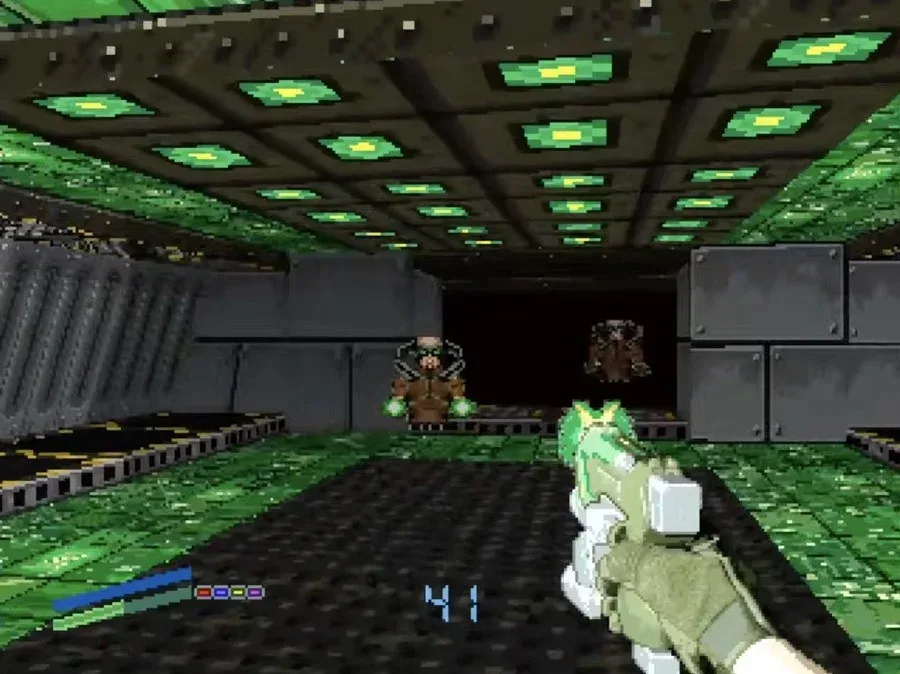
The 3DO may have vanished from the mainstream console market decades ago, but its afterlife has proved far more resilient than its original commercial run might suggest. Collectors continue to seek out the machine and its unusual software library, while a dedicated homebrew community keeps finding ways to build new experiences for the hardware. The latest project aiming to join that lineage is Terminus, a first-person space-horror shooter in development from Retro Love Letter.
Designed for 3DO systems, Terminus places players in the role of a space pirate who intercepts a distress beacon from a nearby vessel. What begins as an apparent opportunity to make easy money quickly turns dangerous: the ship's crew has been transformed into monsters. That setup gives the game a clear sci-fi horror foundation, while its first-person action and maze-like spaceship environments evoke the visual language of 1990s shooters.
A newly shared trailer has offered a closer look at the project, showing armed exploration through dark corridors, hostile creatures, digitised-looking objects, and the kind of rapid combat associated with formative genre hits such as DOOM and Duke Nukem 3D. Retro Love Letter has said the game uses a newly programmed engine rather than an adaptation of an existing commercial game engine, and specifically stresses that AI was not used in the coding of the project.
A new game for a machine with an unusual history
The 3DO occupies a peculiar place in video game history. Developed around a platform concept led by The 3DO Company and its CEO Trip Hawkins, the system was not intended to be a conventional single-brand console. Hardware makers could license the 3DO format and manufacture their own compatible machines. That approach led to products from companies including Panasonic, GoldStar, and Sanyo, creating a family of consoles rather than one definitive piece of hardware.
For useful background on this topic, read BIRDCAGE Takes Its Bullet-Hell Conflict to PlayStation, Xbox and Switch on September 23.
It was an ambitious proposal during the early 1990s. Hawkins had already established himself as the original founder of Electronic Arts, and 3DO was heavily promoted as a major step forward for interactive entertainment. Its technical ambitions, CD-based format, and multimedia focus attracted significant attention. Yet the platform struggled once it reached consumers, with its high cost and increasing competition making it difficult to sustain momentum. Sony's PlayStation, Sega's Saturn, and Nintendo's next-generation plans soon shifted the market around it.
That commercial outcome has not prevented the machine from developing a dedicated audience. Its library has become a source of fascination because it contains both interesting exclusives and strange products that could only have emerged during the CD-ROM experimentation of the period. Modern enthusiasts have also embraced the challenge of developing for its architecture. Projects such as Terminus are therefore more than novelty releases: they demonstrate that there is still technical curiosity around a platform long removed from retail shelves.
Built around a custom sector-based engine
Retro Love Letter says Terminus is built with a custom game engine created from the ground up. The project draws some inspiration from Killing Time, the 3DO first-person shooter later known for its distinctive haunted-house setting, digitised imagery, and unconventional approach to the genre. While Terminus shifts the action from supernatural mansion horror to a threatened spacecraft, that connection helps explain its blend of polygonal space and digitised visual elements.
For another perspective on this story, read Terminus Brings a New Doom-Style Space-Horror Shooter to 3DO, With Thessaly Lerner in the Cast.
The developer describes the underlying technology as a sector-based engine comparable in structure to the one associated with DOOM. In practical terms, that design is intended to let players move between areas of the ship without obvious level-loading interruptions. Retro Love Letter says players will be able to cross multiple maps seamlessly, giving the vessel a more connected feel than a sequence of isolated stages.
The game uses quad-based 3D polygons alongside digitised assets. Its textures were made by a pixel artist, while weapons and other game objects were created through a mix of custom 3D-printed models and screen captures generated using 3D modelling software. That production method is particularly fitting for the era being referenced. Digitised visual assets were a defining feature of many mid-1990s games, but here the process is being applied through contemporary tools and handmade physical models before being adapted for retro hardware.
Performance is naturally a key question for any new 3DO release, especially for a first-person shooter with 3D geometry. Retro Love Letter says the current build reaches approximately 30 frames per second during most gameplay on real hardware. As with any title still being tested, that figure may not represent final performance in every situation, but it suggests the developer is targeting a responsive experience rather than a purely technical demonstration.
NTSC and PAL support are planned
Terminus is being developed with support for both NTSC and PAL systems. The NTSC version has been tested on real hardware, while PAL support is currently being tested through emulation. That distinction is worth noting for collectors and prospective players outside North America and Japan, since regional video standards could create meaningful differences for software on older consoles.
Including both formats is an encouraging sign for a physical retro release, particularly when the 3DO's remaining user base is spread across several territories. However, PAL testing has not yet been confirmed on original hardware. Players interested in that version will likely want to watch for further updates as development progresses and the project moves closer to final production.
The game is also making use of 3DO development tools created by trapexit. Community-made toolchains are an essential part of continued development on discontinued machines, lowering barriers for creators who want to target original hardware rather than simply make games that imitate an older style on modern platforms. In this case, the project appears focused on the real technical limits and peculiarities of the 3DO itself.
Thessaly Lerner joins the voice cast
One of the most notable details attached to Terminus is the involvement of Thessaly Lerner. Lerner is known to many horror-game fans as the voice of Lisa Garland in the original Silent Hill. Lisa remains one of that game's most memorable characters, and Lerner's presence gives Terminus an intriguing connection to another landmark of atmospheric video game horror.
Retro Love Letter has not laid out the full extent of Lerner's role or identified every character in the game's cast. Still, her participation is a meaningful addition for a project whose premise centres on a derelict craft, transformed crew members, and an escalating horror scenario. The game will also feature music by Ed Wilson, adding another handcrafted component to a production built around original technology, pixel art, digitised props, and bespoke audio work.
The combination of a veteran horror voice performer and a new score may help Terminus establish an identity beyond simple nostalgia. Its inspirations are evident, but the project is not merely presenting a modern game with a retro filter. Its creators are working within a legacy hardware environment and constructing assets around the limitations and capabilities of that platform.
Testing is underway, with a physical edition planned
Retro Love Letter has confirmed that Terminus is currently in testing. A physical release is planned for the future, though no release date, price, edition details, or distribution information has been announced. Likewise, there has been no indication that the game is planned for modern consoles, PC, or other platforms; the project is presently identified as a 3DO game.
For retro fans, the prospect of a newly manufactured 3DO release remains notable in itself. First-person shooters were an important part of the system's original catalogue, but a fresh game designed specifically for the hardware offers a different appeal from simply revisiting its existing releases. If the finished version can deliver on its seamless ship traversal, horror atmosphere, custom engine, and solid real-hardware performance, Terminus could become an especially interesting addition to the console's modern homebrew scene.
There are still plenty of unknowns before that can happen. Testing can reveal technical issues, regional compatibility may require more work, and the scope of the final game has yet to be fully detailed. But the trailer and development notes indicate an unusually ambitious effort: a new, original, 3DO-native space-horror FPS that looks to the genre's past while using new tools and freshly created assets to put the forgotten console back in action.
Community
Discussion
Start the conversation.
No comments have been posted yet.