

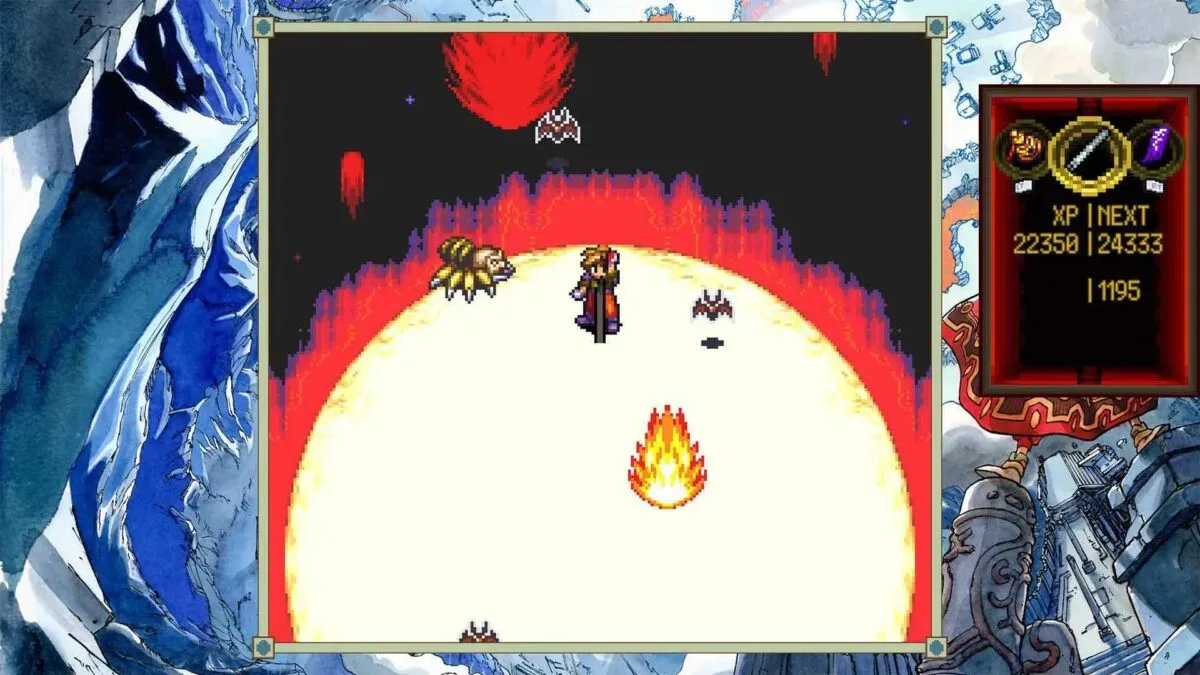
Terranigma: Rebirth will bring one of the Super Nintendo era's most celebrated and difficult-to-access action-RPGs to current hardware in 2027. Announced during the Pixel Arcadia showcase, the project is a modern port rather than a full remake, preserving the original game's pixel-art presentation, real-time combat, and adventure structure while adding select quality-of-life improvements for today's audience.
Clear River Games is handling the new release, which is planned for Nintendo Switch, Nintendo Switch 2, PlayStation 4, PlayStation 5, Xbox platforms, and PC. Its arrival will be particularly significant for players in North America: despite Terranigma's reputation among retro RPG fans, the game never received an official North American launch during its original Super Nintendo life.
That absence has helped make Terranigma a fascinating blind spot in the 16-bit catalog. The SNES is routinely remembered as one of the great RPG machines, but its best-known library can sometimes overshadow major releases that landed late, skipped important regions, or became difficult to obtain after their initial run. Terranigma fits all three descriptions. Rebirth offers a chance for a far broader audience to play it legally and conveniently without changing the fundamental experience that earned the original its acclaim.
A long-awaited wider debut for a Quintet classic
Terranigma was developed by Quintet, the studio behind other distinctive SNES-era action-RPGs including ActRaiser and Illusion of Gaia. While those games have remained prominent parts of discussions around the period's role-playing library, Terranigma has often been treated as a cult favorite: praised by people who played it in Japan, Europe, or Australia, but unfamiliar to many players elsewhere.
For useful background on this topic, read Dark Castle and Beyond Dark Castle Reach PC for Their 40th Anniversary.
Its late release on the aging console was one reason. By the time Terranigma reached its original territories, attention across the industry was moving toward newer hardware. The lack of a North American version created an even larger barrier. For years, interest in the game has largely been sustained through retrospective coverage, emulation, imported copies, fan discussion, and its standing as an unusually ambitious Super Nintendo adventure.
Rebirth changes that access situation in a meaningful way. The 2027 release is described as the first official launch for Terranigma outside Japan, Europe, and Australia. For a game frequently mentioned alongside the strongest action-RPGs of its generation, that represents more than another retro reissue. It is effectively an official introduction for a major portion of the potential audience.
Faithful restoration, not a remake
Players expecting a ground-up reconstruction should set those expectations aside. Terranigma: Rebirth is being presented as an accessible re-release that keeps the original largely intact. The trailer shown with the announcement suggests that its real-time exploration and action-focused gameplay remain close to the SNES version rather than being rebuilt with modern 3D visuals, redesigned systems, or a newly interpreted story.
That approach may be welcome news for enthusiasts who have waited decades to see Terranigma return. A remake can bring a classic to new people, but it can also substantially alter its pacing, artwork, combat feel, or identity. Rebirth appears designed to preserve what made the original distinctive while removing some of the friction involved in playing an older title on contemporary displays and hardware.
One confirmed adjustment concerns the unused space around the original game's 4:3 presentation. On widescreen screens, certain statistics can be permanently displayed in the side area beyond the classic image. It is a small feature, but one with practical value: information that might otherwise require menu navigation can remain visible while preserving the original game image itself.
Additional bonus features have also been mentioned, though their details have not yet been revealed. That leaves room for returning players to hope for archival material, optional extras, or other additions that recognize the game's history. For now, however, those features remain unspecified, and the central promise is a respectful version of the original rather than an expanded reimagining.
Why Terranigma still matters
Terranigma's enduring appeal comes partly from how confidently it combines genres and ideas that were especially popular during the 16-bit era. It is an action-RPG, but it also leans into broad-scale adventure, environmental transformation, and the sense of participating in the revival of a world. That ambition helped it stand apart even among a crowded field of Super Nintendo role-playing games.
Quintet's work from that period often gave players a more direct relationship with the worlds they inhabited than a conventional menu-driven RPG. In Terranigma, the action unfolds in real time, and progression is tied to exploration and a journey with unusually large thematic scope. The result is a game that can feel both immediately playable and much grander than its cartridge format might suggest.
For modern audiences, that combination is likely to be one of Rebirth's biggest strengths. Newcomers will be able to approach it as a preserved piece of game design from a period when developers frequently experimented with how role-playing mechanics, action gameplay, and narrative ambition could fit together. Veteran fans, meanwhile, can revisit a version intended to make the original easier to enjoy on modern hardware without replacing its foundations.
The release is also another reminder that preservation is not only about keeping famous games available. A title can be critically admired and still remain inaccessible because of regional release decisions, complicated rights situations, discontinued hardware, or the scarcity of physical copies. Terranigma has long been an example of that gap between reputation and availability.
New art connects the release to its original identity
Rebirth will also feature new key art by manga artist Kamui Fujiwara, who created character designs for the original game. Bringing back an artist connected to Terranigma's first release gives the project an added degree of continuity. While the game itself is not being remade, new promotional artwork can help establish its return as an event while retaining a connection to the visual identity that fans remember.
That distinction matters for retro revivals. There is a difference between using a classic name for a new interpretation and treating an existing game as an artifact worth presenting carefully to a new market. Everything announced so far points toward the latter. Rebirth is not trying to replace Terranigma; it is aiming to make Terranigma available again, with a handful of accommodations for a different technological era.
Questions remain around bonus content and physical editions
There are still important details to be confirmed before Terranigma: Rebirth reaches players in 2027. Clear River Games has announced the platform lineup and the basic direction of the port, but there is no full breakdown yet of the promised bonus material. It is also unclear whether every modern version will share the same feature set, or how the release will handle display options beyond the statistic panels shown around the 4:3 game screen.
Physical availability is another point to watch. The game's Steam page identifies Limited Run Games as its publisher, a detail that has fueled hopes for a boxed release in North America and potentially other regions. Given the ongoing discussion around preserving games tied to aging discs, cartridges, digital storefronts, and obsolete hardware, a physical edition would be especially fitting for a title that has spent so long outside the official reach of many players.
Still, no physical edition has been formally confirmed. Until an announcement provides specifics, any expectation of a boxed version should be treated as possibility rather than fact. The same caution applies to the undisclosed extras: they could become a meaningful draw for longtime fans, but they cannot yet be evaluated.
A promising return for an overlooked 16-bit landmark
The growing appetite for retro releases has made it easier than ever to revisit many classics, yet plenty of important games remain unavailable, region-locked by history, or remembered only through enthusiast circles. Terranigma: Rebirth stands out because it addresses one of the most notable omissions in the SNES action-RPG conversation.
When it arrives in 2027, the release will give players on Switch, Switch 2, PlayStation, Xbox, and PC an official path to experience Quintet's adventure with modern conveniences and its original character intact. Its new display features and unannounced extras may improve the package, but the most important part of Rebirth is simpler: Terranigma is finally preparing to reach the wider audience it missed the first time around.
Community
Discussion
Start the conversation.
No comments have been posted yet.