

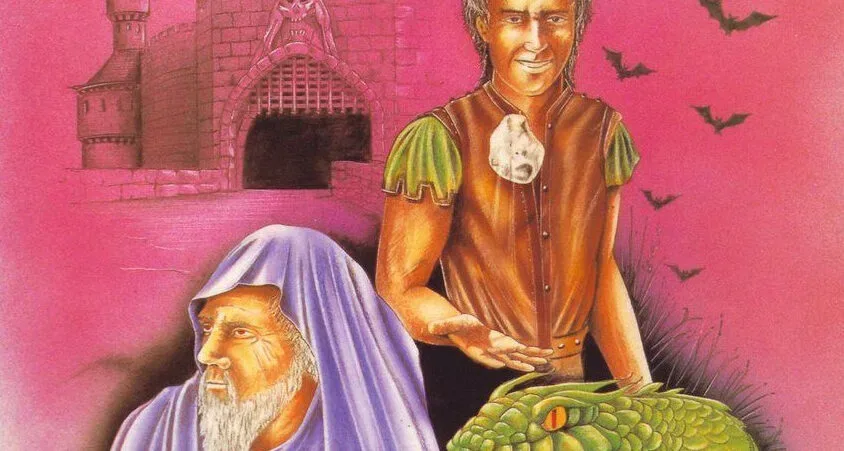
Dark Castle, one of the most distinctive action games of the original Macintosh era, is celebrating its 40th anniversary with an official move to PC. The 1986 fantasy adventure and its 1987 follow-up, Beyond Dark Castle, are now available on Steam in a port created by artist and original series co-creator Mark Stephen Pierce.
For retro game fans, it is a fittingly unusual destination for an unusual pair of games. Dark Castle was built to demonstrate just how much animation, sound, and fast-moving action could be forced out of early Apple hardware. It became a cult favorite precisely because it did not resemble the educational software, slower-paced adventures, and simulation games often associated with classic Mac libraries. Four decades later, its arrival on PC gives players a more direct way to experience a demanding, visually expressive 1-bit platform-action series without relying on browser emulation.
A fantasy action game built for an unlikely machine
The early Macintosh was not a natural home for action games that depended on elaborate character animation and quick player reactions. Its monochrome presentation and technical limitations posed a very different set of challenges from the arcade machines and home consoles that defined much of the mid-1980s. That constraint, however, helped Dark Castle stand apart.
Developed by Silicon Beach Software, Dark Castle puts players in control of a hero fighting through the fortress of the Black Knight. Rooms are packed with environmental hazards and hostile creatures, including bats, skeletons, and other dungeon threats. Players leap across platforms, duck attacks, and throw rocks at enemies while navigating stages designed around timing, positioning, and repeated attempts.
For useful background on this topic, read The Best Star Wars games Remain a Galaxy-Spanning Debate.
The game's basic premise was simple, but its execution was striking. On a black-and-white Mac screen, Dark Castle delivered animated characters and theatrical dungeon scenes with an unusual amount of personality. Its hero moved with a handmade, almost cartoon-like quality, and the Black Knight's castle felt more animated than many games of its period. The visual detail made it memorable, but it also helped make the project technically ambitious.
Dark Castle was not designed as a casual showcase. Its rooms can be unforgiving, demanding sharp reflexes and a willingness to learn enemy behavior. That tough reputation has long been part of the game's identity. Players who remember it from the Macintosh era often remember both the atmospheric animation and the punishment that came with missing a jump, mistiming a throw, or entering a room without understanding its hazards.
Mark Stephen Pierce's animation defined the series
The path to Dark Castle began with Silicon Beach Software's interest in the work of Mark Stephen Pierce. Pierce's animations had been included with VideoWorks, software that predated Adobe's later animation tools. His detailed visual style caught the company's attention at a time when developers were still exploring what kinds of games could exist on the Macintosh.
The initial discussion reportedly leaned toward a much larger science-fiction project. Pierce instead proposed something more focused: a dungeon-based action game with expressive animation and compact, dangerous rooms. The resulting concept combined the visual storytelling of a cinematic platformer with the immediate threat patterns of classic arcade games.
That blend is central to why Dark Castle still has a recognizable identity. Its hero is not merely moving across static screens; he reacts physically to hazards, bats swoop through rooms, and enemies occupy spaces that require the player to read movement patterns. The influences of games such as Donkey Kong and Space Invaders can be felt in the way players are asked to anticipate threats and work through deliberate obstacle arrangements, even as the setting remains firmly rooted in gothic fantasy.
Pierce worked with Jonathan Gay during development. Gay would later become widely known for creating Flash, but on Dark Castle he helped solve the practical challenge of getting an animation-heavy game to run on hardware that was not built for this kind of speedy action. The two collaborators worked from different cities, exchanging builds through the mail and refining the game across that distance.
Page flipping helped make the impossible look possible
One of Dark Castle's most important technical tricks was a method known as page flipping. The approach allowed the game to prepare visual elements outside the immediately visible display area before presenting them, helping it maintain the illusion of fluid action. It was an inventive workaround for a machine with limited graphical muscle, particularly when trying to fill the screen with active enemies, traps, and animated characters.
The method was apparently not one Apple was enthusiastic about, but it contributed to the game's distinctive result. Dark Castle became a showcase for what could happen when developers treated the Macintosh's limitations as a design problem rather than a reason to avoid action games altogether.
Its sound also mattered. Silicon Beach Software had already established experience with getting notable audio out of Mac software, and Dark Castle used its effects to support the tension of its rooms. The mix of visual flourish, strange fantasy threats, and harsh action made the game feel unlike much of the platform's catalog.
That does not mean Dark Castle was universally approachable. Its control demands and high difficulty can feel severe, especially to newcomers accustomed to more forgiving checkpoint systems and smoother modern movement. But for many players, that intensity is inseparable from the appeal. The castle is supposed to be intimidating, and surviving it comes from learning its strange rhythms rather than simply rushing ahead.
Beyond Dark Castle expanded the challenge
Dark Castle's success led to Beyond Dark Castle in 1987. The sequel continued the series' animated monochrome fantasy action and carried forward the first game's appetite for difficult encounters. Together, the two games became enduring cult classics within Macintosh gaming history.
They occupy a notable place in a larger tradition of Mac games that found passionate audiences despite being outside the mainstream of console and IBM-compatible PC gaming. Just as Lode Runner and later Marathon became closely associated with Apple platforms, Dark Castle developed a reputation as an important and idiosyncratic piece of the Macintosh library.
The series did make at least one earlier move beyond Apple hardware. A Sega Genesis version of Dark Castle arrived in 1991, though it did not receive the same lasting affection as the original Macintosh releases. The new Steam launch is more significant for fans because it brings both original games to PC together and comes directly from Pierce, the artist whose work was so important to their creation.
What the Steam release means for retro players
The PC versions provide an official option for anyone who wants to play Dark Castle and Beyond Dark Castle today. Until now, access for many curious players has involved vintage hardware, older releases, or emulation options such as browser-based archival versions. Steam offers a cleaner and more conventional route for modern PC users who want to see why the series earned its long-running reputation.
The release is also a reminder that the history of games is not limited to the most commercially dominant platforms. Early Mac gaming produced works that could be odd, technically constrained, and sometimes fiercely difficult, but those traits also encouraged developers to pursue ideas that might not have fit elsewhere. Dark Castle is one of the clearest examples: an action game that seems improbable for its original computer, made memorable by the determination to push that computer further.
Forty years after the first game's debut, Dark Castle's black-and-white visuals remain a major part of its charm. The lack of color does not make the world feel empty; instead, the sharp contrast emphasizes every trap, monster, and animated gesture. Its castle remains a place of bats, falling hazards, flying projectiles, and narrow escapes, with a presentation that still looks unlike most of its contemporaries.
For longtime Macintosh players, the Steam release is an opportunity to revisit a defining favorite on new hardware. For PC players who missed it entirely, it is a chance to meet a series that helped establish how inventive the Mac game scene could be when its creators embraced the machine's limitations. Dark Castle and Beyond Dark Castle may have begun as unlikely action games for an unlikely gaming computer, but their 40th-anniversary PC arrival ensures that their peculiar fortress is open to a much wider audience.
Community
Discussion
Start the conversation.
No comments have been posted yet.