

Retro Games Ltd's upcoming The A1200 has officially become an Amiga-branded product, a development that carries more significance than a simple logo change for one retro hardware release. The announcement follows a recent licensing arrangement involving the Amiga name, allowing companies including Retro Games Ltd and Commodore International to use that historic branding on their products.
For longtime Amiga fans, the news represents a potentially meaningful moment in a story that has been unusually tangled for decades. The Amiga and Commodore identities were separated after Commodore's collapse during the 1990s, and the ownership, licensing, and commercial use of both names has remained a complicated issue ever since. As a result, products designed to celebrate the platform have not always been able to present themselves using the Amiga name itself.
That is changing with The A1200. Retro Games Ltd has stated that the machine is "officially an Amiga product," positioning the forthcoming system as part of what it describes as a clearer and more unified future for the brand. The company said it is pleased to be involved in that future, with The A1200 intended to introduce the Amiga experience to another generation while honoring the qualities that made the original computers so fondly remembered.
Embedded X/Twitter post
A name with major weight in retro computing
The announcement may sound cosmetic to people outside retro computing circles, but the Amiga name is inseparable from the hardware's legacy. Commodore's Amiga computers were major creative and gaming machines, remembered for their audiovisual capabilities, distinctive software library, and dedicated user communities. The Amiga 1200, in particular, arrived late in Commodore's history but remains an especially important model for enthusiasts.
For useful background on this topic, read Sega Vs Capcom Fan Fighting Game Ends After Capcom Character Rights Complaint.
Its reputation is tied to its place in the broader Amiga family as much as it is to its individual capabilities. An A1200-inspired product that can openly carry Amiga branding therefore has a different kind of historical resonance than a generic recreation, even if its practical purpose remains familiar: giving players and retro-computing fans an accessible route back to a classic platform.
Retro Games Ltd already has experience building officially themed modern recreations of legacy hardware. Its previous Amiga-focused release, The A500 Mini, offered a compact way to revisit software associated with the earlier Amiga 500 era. However, that product could not use the Amiga name. The A1200 is now set to be different, making it the first of the company's Amiga-related systems to benefit from this newly available branding arrangement.
That distinction explains why Retro Games Ltd is treating the development as more than routine marketing. The company's message connects The A1200 to a broader effort to move the Amiga identity forward, rather than framing the system solely as another nostalgia-oriented hardware release.
Gamescom meeting highlights an unusual moment of alignment
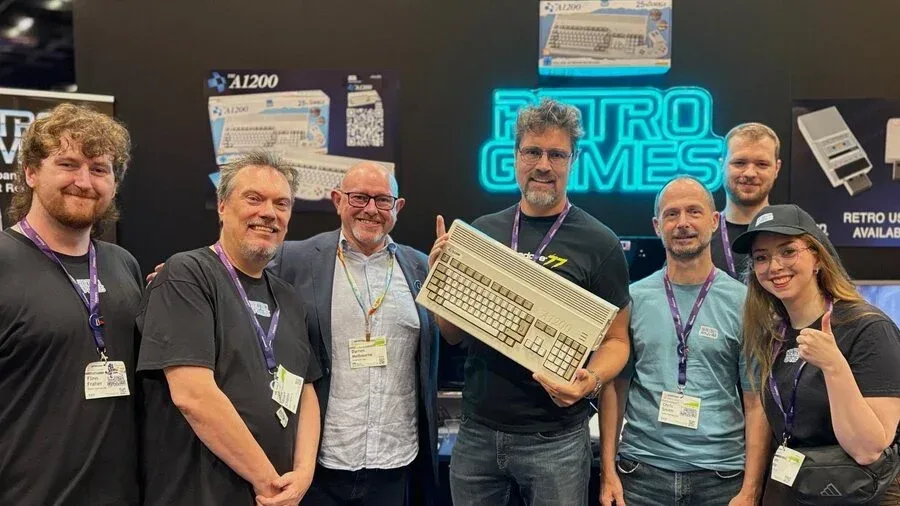
The significance of the branding news was reinforced by an image shared after the announcement from Gamescom 2026. Retro Games Ltd posted a photograph of figures representing several names central to the modern Amiga and Commodore landscape, all gathered around The A1200.
The company described the scene in deliberately teasing terms, noting the presence of its own team at Gamescom, the chief executive of Amiga Corp with a THEA1200, the chief executive of Commodore with a THEA1200, and Amiga's chief executive alongside Retro Games Ltd's joint chief executive with a THEA1200. It added only: "No spoilers."
The images show Christian Simpson, CEO of Commodore International, and Mike Battilana, head of Amiga Corporation, holding the upcoming machine. While the photos do not confirm any additional product plans or business announcements, their symbolism is difficult to miss. Representatives connected to Commodore, Amiga, and Retro Games Ltd appearing together around a system now allowed to bear the Amiga name suggests a degree of cooperation that would once have seemed far less likely.
Retro hardware often depends on a delicate balance between commercial licensing and community trust. Fans want faithful tributes, but they also pay close attention to who holds a name, who can authorize its use, and whether a product feels legitimately connected to the machine it celebrates. In that environment, public signs of alignment among the relevant parties matter.
The A1200's new status does not erase the complicated history behind the Amiga and Commodore names, but it does create a more direct connection between a modern recreation and the platform it is built to honor.
Why the Amiga and Commodore split mattered
Commodore's downfall left behind more than a catalog of beloved machines and games. It also created a long-lasting separation between brands that many users had always viewed as part of the same story. The Amiga computers had been Commodore products, yet the Amiga name went on its own path after the company's collapse. The two identities continued to carry enormous nostalgic and commercial value, but their relationship was no longer straightforward.
For the people who grew up with the machines, the distinction can feel counterintuitive. "Commodore Amiga" remains a natural phrase, and the companies' histories are intertwined in public memory. Legally and commercially, however, the situation became much more fragmented. That made official branding arrangements important and, at times, difficult to navigate for businesses hoping to make new hardware or other products based on the legacy.
The newly referenced agreement changes that picture by permitting licensed use of the Amiga name for products from companies such as Retro Games Ltd and Commodore International. It does not, on its own, reveal every detail of what future projects might emerge, and the Gamescom post offers no firm announcements beyond The A1200's status. Still, it gives the participating companies room to present their work in a more unified way.
For Retro Games Ltd, this means the product's identity can more closely match its inspiration. For Amiga supporters, it may mean fewer awkward gaps between the name on the box and the heritage being represented. For the wider retro market, it is a reminder that intellectual-property agreements can shape how preservation-minded hardware projects are introduced and understood.
What has and has not been announced
There is one point worth keeping clear amid the excitement. Retro Games Ltd has confirmed the official Amiga status of The A1200, and the Gamescom images bring prominent executives together with the hardware. Beyond that, the carefully worded "No spoilers" message leaves open the possibility that more news could follow, but it does not establish what that news will be.
No additional release date, price, technical specification, software list, or territory availability was provided in the announcement surrounding the branding development. Likewise, the shared photographs should not be read as confirmation of a newly revealed partnership beyond the licensing context already discussed. They are notable because of who appears in them and what The A1200 represents, not because they set out a detailed roadmap.
That uncertainty will likely make the situation especially interesting to watch for Amiga collectors and retro enthusiasts. The A1200 already stood out as a recreation of one of the most cherished machines in the line. Now it also arrives at a point when the official Amiga brand appears to be entering a new phase of licensed use and public cooperation.
A promising chapter for a complicated legacy
There is understandable caution whenever historic technology brands reappear. A famous logo alone cannot guarantee that a modern product will capture what users valued about the original hardware. At the same time, branding is not meaningless when it reflects an effort to reconnect a product with the history it is celebrating.
In this case, The A1200's official Amiga designation is important precisely because Retro Games Ltd's earlier Amiga-inspired system lacked that option. The transition from an A500-themed mini system without the Amiga name to an A1200 product that can use it shows how much the surrounding rights situation has shifted.
The Gamescom gathering adds a human dimension to that change. Christian Simpson, Mike Battilana, and Retro Games Ltd representatives appearing together with The A1200 does not solve every question surrounding the future of these historic brands. But it is a rare image of major figures connected to the Amiga and Commodore legacy sharing the stage, literally and figuratively, around new retro hardware.
For a community accustomed to a fragmented post-Commodore history, that is a milestone in itself. The next details on The A1200 will determine how this new chapter takes shape, but its official Amiga branding has already made the system more than just another tribute to a classic computer. It has become a visible sign that some of the old divisions around one of gaming and computing's most influential names may finally be narrowing.
Community
Discussion
Start the conversation.
No comments have been posted yet.