

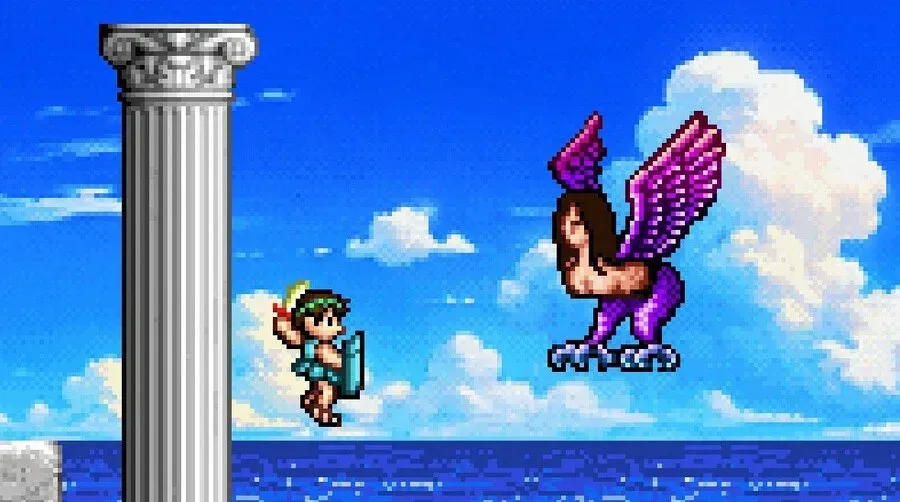
The Battle of Olympus, the Greek mythology-inspired action adventure originally released for the NES in 1988, is receiving a PC remake on Steam. Most notably, the project is not simply a modern revival led by a new studio: it is being rebuilt by the original development pair, programmer and designer Yukio Horimoto and story and graphics creator Reiko Oshida.
The two have reformed INFINITY Co., Ltd. for the remake, bringing the people responsible for the game's original code, art direction, story, and overall identity back together. Their stated goal is to give modern PC players a revised version of the classic while holding onto the atmosphere, difficulty, and fundamental spirit that defined its 8-bit release.
Early Access is planned for early next year. At that initial stage, the team intends for players to be able to complete every stage found in the original NES game and reach its ending, with the original game balance retained. That is an ambitious starting point for an Early Access build, particularly for a remake intended to reconstruct a full retro adventure rather than merely offer a small vertical slice.
An 8-Bit Mythological Quest Comes Back
The original The Battle of Olympus arrived on NES in 1988 and later reached Game Boy. It placed players in an ancient Greek-inspired world of gods, monsters, weapons, and dangerous side-scrolling routes. Its blend of exploration, platforming, NPC interactions, upgrades, and combat made it a distinctive entry in an era when many console action games focused on straightforward stage-by-stage progression.
For useful background on this topic, read DK64Rekongpiled Brings Donkey Kong 64 to PC With Widescreen, Higher Frame Rates and Mods.
The game's mythological premise was deeply personal to its creators' collaboration. Horimoto previously explained that he met Oshida during the development of their first game. The two fell in love, wanted to make a game together, and spent considerable time discussing what that project should be. Horimoto's interest in Greek myths and legends ultimately informed the setting, while their relationship and shared creative mood fed into the concept itself.
That origin story gives the remake an unusual significance. Classic-game remakes are often handled decades later by teams who admire the original work but were not involved in its creation. Here, the developers are revisiting a game that emerged from their early professional partnership. Their return offers the opportunity to reinterpret old design decisions with decades of experience while maintaining a connection to the work's original creative intent.
Zelda Was a Clear Influence on the Original
The Battle of Olympus has long been associated with Nintendo's early The Legend of Zelda games, and Horimoto has been open about that inspiration. He described the original Legend of Zelda as a key influence on his desire to create a scrolling platform game, while Zelda II: The Adventure of Link helped shape the way its character moved and fought.
In particular, Horimoto identified the jumping and walking systems as points of reference. The player's attack, crouch, and jump animations were also influenced by Nintendo's work. That inspiration is apparent in the finished NES game, which took the exploratory spirit and progression-driven structure associated with Zelda and applied them to a side-scrolling Greek adventure.
Still, The Battle of Olympus was never simply a copy of another game's formula. Its setting gave it a separate identity, taking players through a world built around Greek legends rather than Hyrule. The combination of mythology, conversation-driven progression, hidden items, and harsh action-platforming challenges made it memorable to players looking beyond the most famous NES releases of its period.
The remake's promise to preserve the original balance is therefore important. The team is not presenting the project as a total reinvention designed to smooth out every rough edge of an 8-bit game. Its plans suggest an effort to retain the demanding character of the original while providing options for players whose expectations may differ from those of NES-era audiences.
What the Steam Remake Plans to Change
INFINITY Co., Ltd. says it is personally rebuilding the game's code and redrawing its pixel art. The full version is planned to feature entirely redrawn graphics, improved visuals and animation, and additional visual effects. Those changes could give the adventure a much more polished presentation without abandoning pixel art as its visual foundation.
Rather than moving to a 3D format or replacing its retro aesthetic with a radically different look, the stated direction is a handcrafted refresh. That distinction matters for a title with strong roots in the NES library. A remake can modernize animation and effects while still respecting the screen-by-screen readability, enemy silhouettes, environments, and mood that define an 8-bit action game.
The developers also plan to introduce multiple play options. Alongside the original game balance, the remake is expected to offer Easy Mode, Normal Mode, and features aimed at speedrunning. The announcement does not yet detail exactly how those modes or speedrun-oriented tools will function, but their inclusion points to an attempt to support several different audiences.
- Veteran players may be able to seek an experience close to the original NES challenge.
- Newcomers may have an easier route into a notoriously old-school style of action adventure.
- Speedrunners could receive options built with fast, repeatable playthroughs in mind.
This approach could be especially useful for a game from 1988. The original version was made in a period when limited continues, opaque objectives, and demanding enemy encounters were standard parts of console design. Players who know the game from its original run may value that friction, while players discovering it through Steam may benefit from flexibility without requiring the remake to abandon its core identity.
Early Access Will Cover the Original Journey
The project's Early Access plan is more substantial than a short preview. The developers say the opening release is intended to include all of the original 8-bit game's stages through the ending. In other words, the core adventure should be playable from beginning to conclusion when Early Access begins, assuming development proceeds as planned.
Development work is currently focused on rebuilding core systems, recreating pixel art, and preparing the main gameplay structure for that release. The team's use of Early Access means players will be able to financially support the remake as it continues to develop, while the creators refine the presentation and work toward the additional features planned for the full version.
There is no specific Early Access date beyond the early-next-year window, and no full-release date has been announced. Details such as the exact scope of visual upgrades, the implementation of difficulty modes, and the specific speedrunning features will also need to be clarified as the project gets closer to launch.
A Rare Chance to Revisit a Cult Favorite
For retro fans, the remake is an opportunity to revisit an NES cult favorite with its original creators at the helm. For players unfamiliar with the 1988 release, it offers a potentially accessible entry point into a genre blend that sits between side-scrolling action and exploration-heavy adventure design.
The return of Horimoto and Oshida is the story's defining element. They are not only lending their names or consulting on a new adaptation; they say they are directly recreating code, redrawing art, and refining the experience for a modern PC audience. That hands-on role gives this remake a rare sense of continuity between the game's past and its future.
The Battle of Olympus was born from a shared fascination with Greek legend, a formative creative partnership, and an admiration for Nintendo's pioneering adventure design. Its Steam remake now aims to carry those same foundations into a new era, preserving the original quest while giving it a newly crafted pixel-art presentation and optional ways to play. Early Access is planned for early next year, when players will get their first chance to see how that balance between preservation and refinement comes together.
Community
Discussion
Start the conversation.
No comments have been posted yet.