

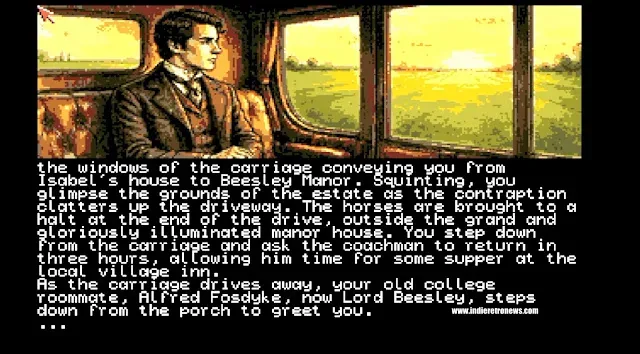
The Demon Jar; or, Fosdyke's Folly is a newly released retro-style illustrated text adventure built around Victorian-era horror, deadly decisions and the kind of parser-driven problem solving associated with classic home-computer adventures. Created by developer Alan Pemberton, the game is designed for the Amstrad, Amiga, Atari ST, Commodore 64, Commodore Plus/4 and ZX Spectrum NEXT.
Rather than aiming for a sprawling, weeks-long adventure, The Demon Jar is presented as a compact horror story intended to be completed in a single sitting by experienced players. Its premise follows young gentleman Oswald Stanley on what begins as a seemingly ordinary visit to an old college companion during a pleasant summer evening at the height of the Victorian period. That social call soon becomes something much darker, as a murderous evil spirit turns the night into a fight for survival.
The game's central tension comes from its interactive format. Players guide Oswald through the unfolding nightmare, make choices, investigate the environment and solve puzzles while attempting to prevent his story from ending badly. Pemberton has cautioned that the subject matter is not intended for children or people with a nervous disposition, establishing The Demon Jar as an adventure leaning deliberately into unsettling material rather than light supernatural whimsy.
A compact supernatural mystery for classic computers
Text adventures remain a particularly natural fit for horror. Their limited visual detail asks players to imagine what is happening between the lines, and that leaves considerable room for dread, ambiguity and the fear of an unseen threat. The Demon Jar combines that format with bespoke illustrations, offering visual punctuation for its locations and events without abandoning the text-led structure at the heart of the experience.
For useful background on this topic, read Stern Pinball Reveals Fallout Table With Vault 33, Deathclaws and V.A.T.S..
Oswald's journey is framed as a personal and increasingly dangerous encounter with a malicious force. The Victorian setting gives the story an appropriate foundation: isolated estates, formal social expectations, old friendships and a period fascination with spiritualism and the occult can all make a turn toward the supernatural feel especially potent. The game's title also hints that its horror revolves around an object with a troubling history, while the subtitle, Fosdyke's Folly, gives the adventure the flavor of a traditional gothic mystery.
Players should not expect an enormous map or a long campaign. The stated aim is a short, focused tale whose puzzles should be manageable for veteran adventure-game fans in one playthrough. That does not necessarily mean the route to success is completely risk-free. The story is designed around player agency, and mistakes can put Oswald in fatal danger. In a horror adventure, that possibility adds weight to each command, because seemingly harmless actions can carry consequences once the atmosphere turns hostile.
Classic adventure tools with a modern-minded undo option
The Demon Jar was made with DAAD Ready, a modern revival of the classic DAAD adventure-writing system. DAAD has a long connection to text adventures on 8-bit and 16-bit machines, making it an especially fitting foundation for a game targeting a broad range of vintage hardware. Stefan Vogt is credited with helping bring the system back into use.
One of the more interesting design details is the treatment of traditional memory commands. The game repurposes RAMSAVE and RAMLOAD as an undo-style feature. Instead of functioning solely as old-school save and load commands, they allow players to roll back after making a lethal or otherwise disastrous decision.
That is a practical addition for an adventure that places its protagonist in a threatening situation. Older text adventures often demanded frequent manual saving, especially before trying a risky action or entering an unfamiliar area. By adapting familiar terminology into a more immediate safety net, The Demon Jar retains a period-authentic command vocabulary while reducing some of the frustration that can come with sudden death states. Players can still feel the risk of a bad decision, but they are less likely to lose progress simply because they experimented with an object or response at the wrong moment.
The feature also reflects the game's intended pacing. A short horror story benefits from keeping players inside the mood and momentum of the night rather than forcing them to repeatedly replay large stretches after a mistake. An undo mechanism can support experimentation, which is important in a genre where observation, curiosity and testing possibilities are often the means of progress.
From Amiga to ZX Spectrum NEXT
The release spans a notable collection of retro systems: Amstrad machines, the Amiga, Atari ST, Commodore 64, Commodore Plus/4 and ZX Spectrum NEXT are all named among its targets. That broad platform list reflects the continuing enthusiasm for new games on classic hardware and modern recreations of classic formats.
For Amiga users, the game is intended for expanded configurations. The hardware requirement is worth noting for anyone planning to play it on original equipment or a setup closely matching original specifications. The multi-platform approach is supported by the Aventuras AD engine from the 1990s, which handled the considerable work involved in conversions.
Each platform has its own identity and audience within the retro scene. The Commodore 64 and ZX Spectrum remain especially closely linked with the history of home-grown adventures, while Amstrad and Plus/4 users continue to receive a steady stream of enthusiast projects. The Amiga and Atari ST, meanwhile, offer a natural home for illustrated adventures from the 16-bit era. Including the ZX Spectrum NEXT places The Demon Jar in conversation with both original hardware traditions and contemporary retro-compatible development.
This approach is more than a technical curiosity. Releasing across several machines gives an adventure like The Demon Jar a chance to reach communities that value the distinct character of their preferred systems. Text adventures are well suited to that goal because their core interaction can remain intact even as presentation and technical implementation vary from one platform to another.
Illustrations, AI-assisted graphics and development credits
The game uses bespoke graphics to accompany its text, with AI tools including Google Flow and ChatGPT assisting in their creation. The project includes an explicit disclosure that its graphics were AI-assisted. That transparency is important, particularly as developers and players continue to debate how generative tools should be used in game production and how their role should be credited.
In this case, the illustrations support a text-first adventure rather than replacing its written descriptions. Horror games often use art sparingly to establish a key moment, character or place, then rely on the player's imagination to supply the details that are not shown. The result can be a more intimate kind of fear than a fully animated presentation, especially on systems whose visual limitations are part of their historical appeal.
Pemberton is credited as the game's developer, with play-testing support from David Walton and Andrew Ryals. Testing is a vital part of any text adventure, where a puzzle that seems obvious to its author may be unclear to players approaching the situation from a different perspective. It is particularly valuable for a short game: if an adventure aims to be completed in one sitting, its clues and interactions need to guide players forward without turning the experience into an extended exercise in trying every possible command.
A deliberately old-fashioned kind of scare
The Demon Jar arrives as a reminder that retro releases do not need to imitate arcade action or platforming to feel at home on classic machines. Text adventures were among the defining forms of early computer gaming, and a new game in that tradition can use the strengths of the format rather than merely treating it as a novelty. A carefully written setting, a threatening mystery, illustrations at selected moments and a few well-constructed puzzles are enough to create a complete evening's entertainment.
For players who enjoy gothic fiction, vintage interactive storytelling and the ritual of typing instructions into a responsive world, Oswald Stanley's troubled visit offers a concise new excursion into supernatural danger. The warning about its disturbing content suggests it is best approached as a serious horror piece, despite its deliberately retro technical roots.
With support for a wide selection of classic platforms, a revived adventure-development system and a thoughtful concession to modern usability through its RAMSAVE and RAMLOAD undo system, The Demon Jar; or, Fosdyke's Folly aims to deliver a traditional text-driven haunting without asking players to accept every frustration of the past. The question for Oswald is whether he can make it through the night. The question for players is whether they can uncover the right path before the spirit emerging from the shadows claims him first.
Community
Discussion
Start the conversation.
No comments have been posted yet.