

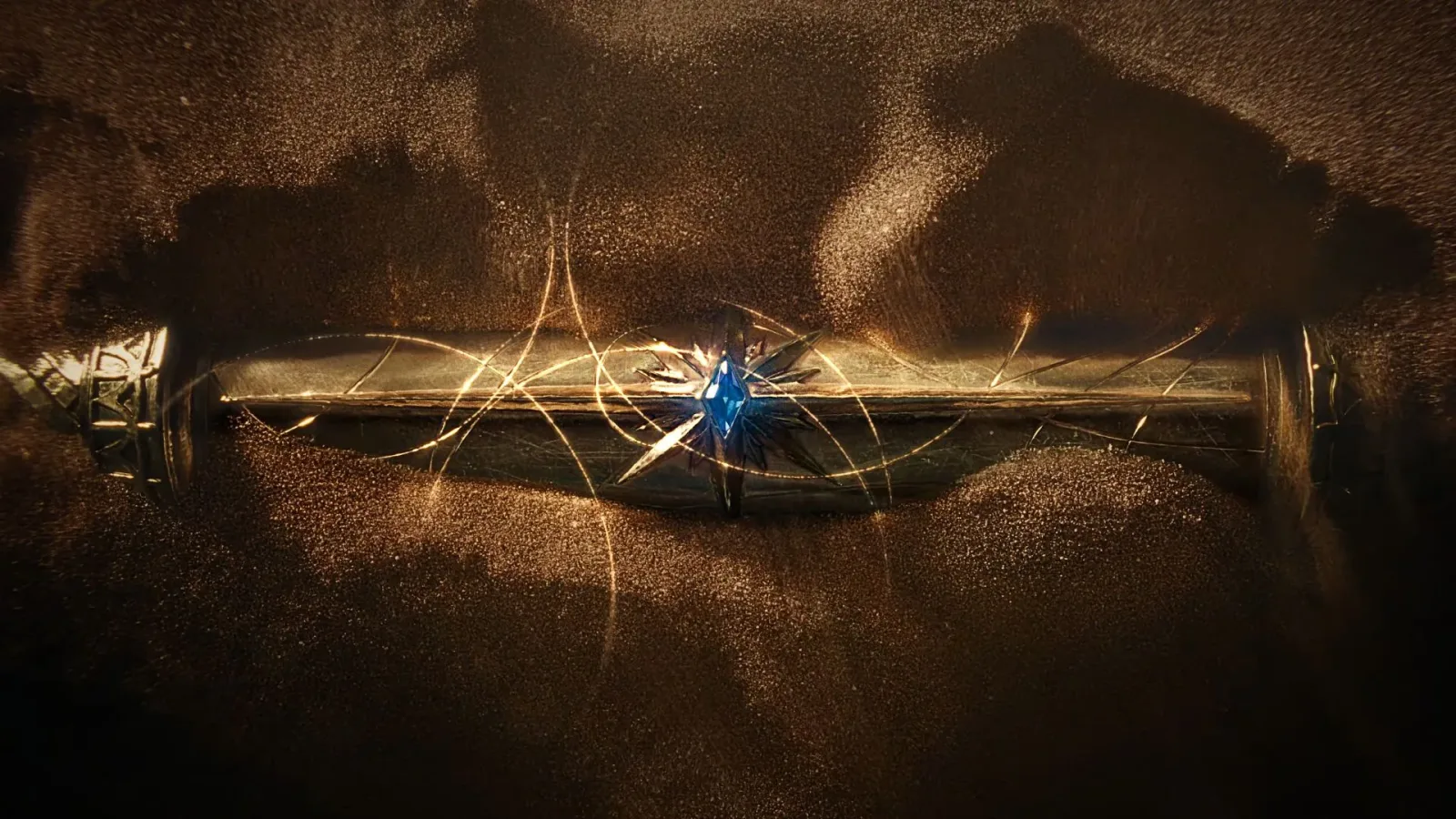
The Elder Scrolls 6: Sentinel has emerged from a long period of near-total silence with a short teaser, an official title, and just enough imagery and text to send Elder Scrolls fans into full theory-building mode. Bethesda's next mainline entry remains a distant prospect, but the newly revealed details have focused speculation around three particularly intriguing possibilities: a Hammerfell setting, a story set only a few years after The Elder Scrolls V: Skyrim, and connections to major magical artifacts or even seafaring travel.
The teaser does not provide firm answers to most of those questions. It is deliberately sparse, showing desert imagery, an Elder Scroll, and the Sentinel branding. Still, the small details have been enough for fans to compare lore, dialogue, visual motifs, and social-media wording in an attempt to understand what Bethesda could be planning for its next sprawling fantasy RPG.
Sentinel strongly points toward Hammerfell
The title is the clearest clue. Sentinel is a major city in Hammerfell, the homeland of the Redguards. For years, Hammerfell has been one of the most frequently predicted locations for The Elder Scrolls 6, often discussed alongside High Rock as a possible neighboring region. The new title gives that long-running prediction considerably more weight.
Embedded X/Twitter post
Hammerfell would be a major change of scenery after the frigid mountains, pine forests, and Nordic ruins of Skyrim. The province is associated with deserts, rocky coastlines, cities, ancient Yokudan history, and political divisions between the Crowns and Forebears. A game centered on Sentinel could explore that setting from the perspective of one of the region's most important coastal cities, while leaving room for wider travel across the province.
For useful background on this topic, read WoW: Forever Shaman Fans Lock Down Major Discord After Final Beta Patch.
The teaser's sand-filled visual language naturally supports the Hammerfell reading, but the title matters more than the desert imagery alone. Tamriel has several dry or arid locations, whereas Sentinel is a direct lore reference. Even so, the precise scale of the game world is unknown. Bethesda has not confirmed whether the adventure is confined to Hammerfell, includes High Rock, or visits any other part of Tamriel.
That uncertainty is important. The name Sentinel may identify the primary setting, a central city, or a larger narrative concept. It establishes a strong direction, but it does not yet reveal the boundaries of the map, the factions involved, or the role players will occupy within the city and province.
A date that places the story close to Skyrim
One of the teaser's most consequential pieces of text is attributed to Yazar, identified as a Moth Priest serving High Queen Iradne of Hammerfell. The citation places the passage in 4E 206. That date would be just five years after the events of Skyrim, which is set in 4E 201.
"The scroll offered only a shimmer, a veil thinly lifted to my eyes. A future lost. A victory undone. Sands of time scattered by fate."
As with any Elder Scrolls prophecy, the wording is broad enough to sustain multiple readings. The reference to a "future lost" and a "victory undone" could describe political upheaval, magical intervention, a conflict in Hammerfell, or an event involving time itself. The line about "sands of time" is especially notable given the apparent desert setting, though it may be poetic language rather than a literal indication of time travel or altered history.
What the date does establish is a potentially close relationship with the era of Skyrim. The series has often used major time gaps between numbered entries, allowing each game to build a new status quo. A setting only five years later would offer a more immediate continuation of the Fourth Era's unresolved tensions. The aftermath of the Great War, the continuing influence of the Aldmeri Dominion, the Empire's fragile state, and Hammerfell's own history of resistance could all remain highly relevant.
It also opens the door for familiar people, organizations, and events to be referenced. That does not mean returning characters are confirmed, and fans should be cautious about assuming cameo appearances from a single timeline clue. Still, some players have noted that Erik the Slayer, one of Skyrim's potential companions, speaks of wanting to travel to Hammerfell in search of work. If the new game really is set so soon after Skyrim, that old line has become an appealing basis for speculation.
Whether Erik, or any other recognizable character, actually appears is completely unknown. Bethesda could choose to use the time period for continuity without bringing back individual NPCs. References in books, rumors, quests, or background dialogue would be just as plausible as direct appearances. The larger point is that 4E 206 makes the world of Skyrim feel much closer than many expected.
Could sailing be part of the journey?
Another theory has focused on Bethesda's Spanish-language social-media activity, where wording interpreted by some fans as a reference to "sailing" prompted immediate discussion. Because Sentinel is a coastal city and Hammerfell has a long shoreline, the idea of ships and maritime exploration has obvious appeal.
There is a major caveat: the wording may not have been literal. Language that can be read as "sailing" may also be used figuratively, closer in meaning to embarking on or setting out on an adventure. As a result, it should not be treated as a confirmation of naval traversal, ship ownership, sea combat, or any other specific mechanic.
Even so, sailing would make thematic sense for a game tied to Sentinel. The city sits on the Iliac Bay, a body of water rich with potential connections to High Rock and the wider western coast of Tamriel. Ships could serve as atmospheric set dressing, fast-travel points, quest locations, or a genuine travel system. Those are very different levels of implementation, however, and the teaser offers no evidence that distinguishes among them.
The possibility also invites comparisons with Bethesda's recent experiments in spacefaring travel, but a fantasy sailing system would bring its own design questions. Would players control a vessel directly? Could islands, ruins, and coastal settlements be discovered by sea? Would travel be a focused feature or merely a way to connect major hubs? For now, those are questions for fans rather than details Bethesda has answered.
The rings around Sentinel's logo may be a lore clue
Fans have also scrutinized the circular ring imagery surrounding the Sentinel logo. The design has drawn playful comparisons to the logo treatment of Elden Ring, but Elder Scrolls players are more interested in whether the pattern points to something within Tamriel's established mythology.
One popular suggestion is the Eye of Magnus, the powerful artifact central to the College of Winterhold storyline in Skyrim. Comparisons between the teaser's rings and the artifact's visual patterns have led some fans to wonder whether the two could be related. The resemblance is not proof, but it is enough to fuel discussion about the Eye, the Psijic Order, and the kinds of magical forces that may shape Sentinel's story.
The Eye of Magnus is particularly tempting as a theory because the teaser explicitly features an Elder Scroll and a Moth Priest. Both are deeply tied to prophecy, arcane knowledge, and dangerous attempts to interpret the future. A plot involving ancient magical objects, hidden visions, and uncertain outcomes would fit comfortably within the series' traditions.
There are many other possibilities, though. Rings are common symbolic imagery in fantasy, and Elder Scrolls lore is filled with celestial, religious, magical, and architectural motifs that could produce a similar design. The teaser could be gesturing toward an entirely new artifact, a local Hammerfell symbol, an abstract representation of an Elder Scroll's power, or simply a visual identity for the game. Until Bethesda provides more context, the Eye of Magnus remains one theory among many rather than a likely confirmed feature.
Why the teaser's restraint matters
The enthusiasm around Sentinel demonstrates how much appetite there is for a new mainline Elder Scrolls game, but it also illustrates the limits of interpreting a minute-long teaser. Bethesda has offered a title, a likely location, a lore timestamp, and imagery designed to invite attention. It has not laid out the game's combat systems, protagonist, map structure, quest design, factions, platforms, or release date.
That means the most interesting discussion is not about treating every visual similarity as a solved riddle. It is about considering how the clues could fit together. Hammerfell's deserts and coastline, a date immediately after Skyrim, a Moth Priest's troubled vision, an Elder Scroll, and mysterious rings could all support a story about prophecy and political instability. They could also signal an adventure about ancient Yokudan secrets, magical intervention, or a crisis that spans more than one province.
A reported target of 2029 would still leave a long wait before players can discover what Sentinel truly contains. It would also place the game roughly 18 years after Skyrim and 11 years after Bethesda first announced the sixth mainline installment at E3 in 2018. Bethesda has stressed that it will be some time before the project is ready, so fans should expect more theory-crafting before definitive answers arrive.
For the moment, The Elder Scrolls 6: Sentinel has succeeded at one crucial task: it has made Tamriel feel mysterious again. The teaser has turned a handful of details into a sprawling set of questions, and the Elder Scrolls community is already searching every grain of sand for the next clue.
Community
Discussion
Start the conversation.
No comments have been posted yet.