

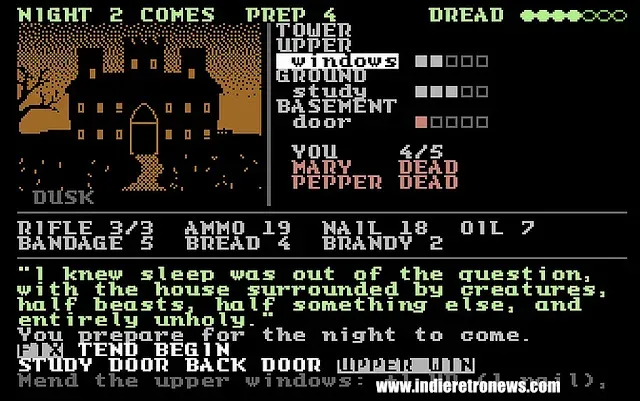
The House on the Borderland is bringing first-person survival horror to the Commodore 64, placing players in an isolated home under siege for three increasingly punishing nights. Created by developer Michael Cox, the game takes direct inspiration from William Hope Hodgson's 1908 novel of the same name, but shapes that literary influence into a compact, systems-driven battle for survival on classic 8-bit hardware.
The central objective is stark: protect the house, keep the protagonist's sister and dog alive, and withstand attacks from marauding swine-things until the ordeal is over. That simple setup carries a substantial amount of pressure because the game does not present survival as a matter of repeatedly finding fresh ammunition or supplies. Players begin with a finite stock of resources and must make those provisions last through the complete three-night siege.
For a Commodore 64 project, the premise is especially notable. The machine has a long legacy of action games, arcade conversions, adventures, and strategy titles, but first-person horror that emphasizes fear, maintenance, and resource planning creates a different kind of tension. The House on the Borderland leans into that limitation rather than attempting to mimic a modern survival-horror experience outright. Its danger comes from what the player cannot afford to waste, what might break next, and how quickly a manageable situation can become a disaster.
A siege structured around day and night
The game's three-night structure divides survival into distinct phases. Night is the period of immediate danger, as hostile creatures pressure the house and force the player to respond to the siege. Daylight, meanwhile, is not a carefree break. It is a limited window for preparing for the next assault.
For useful background on this topic, read Caveman Brings Prehistoric Arcade Peril to Commodore 64.
During the day, players must decide how to spend their time and resources. Resting can help the character recover, while repairs are needed to restore damaged defenses. There is also the responsibility of tending to the wounded. These duties mean that every daylight period becomes a planning exercise: a player who focuses too heavily on one need may leave another in a dangerous state once darkness returns.
This cycle gives the game an appropriately claustrophobic rhythm. The daytime respite is valuable, but it cannot fully erase the consequences of the previous night. Damage to the building, injuries, fatigue, and dwindling supplies all carry forward. Instead of offering a conventional power curve where players become steadily stronger, The House on the Borderland appears designed to make endurance itself the achievement.
Finite supplies make every decision matter
A strict lack of resupply is one of the game's defining survival elements. There is no dependable way to replenish the starting inventory during the crisis, so players must ration from the moment the first night begins. That condition turns even ordinary actions into meaningful decisions.
Using an item at the wrong moment may create a shortage later. Delaying a repair may preserve materials now but leave the house less able to withstand a future attack. Taking time to recuperate could be necessary for the character's condition, yet that choice may reduce the time available to help another member of the household or reinforce the building.
It is an approach that suits horror particularly well. Scarcity does more than raise difficulty; it makes the player feel vulnerable. The threat is not only the enemy at the door. It is the knowledge that the ideal response may be impossible because a vital item was used earlier, or because there is simply not enough time before nightfall.
Rather than relying solely on jump scares or relentless combat, the design frames horror as a mounting logistical problem. A run can become frightening through small failures accumulating over time: a weakened fortification, an untreated wound, a drained reserve, and an approaching night with no comfortable answer available.
The dread meter turns atmosphere into a gameplay threat
Alongside physical survival, The House on the Borderland includes a dedicated dread meter. This system reflects the protagonist's psychological state and is affected by several unsettling conditions, including darkness, eerie silence, and structural damage to the home.
If dread rises too far, the player's perception begins to distort. At the highest end of the meter, fear can leave the character completely paralysed. The idea gives the game's atmosphere a concrete mechanical role. Darkness is no longer merely a visual mood; silence is not simply an audio choice; damage to the house is not just a numerical loss. Each can contribute to a mental collapse that prevents action at the worst possible time.
That makes the house more than a backdrop. It is both a shelter and a fragile psychological anchor. When the structure is damaged, the player is not only less protected from external threats, but also more susceptible to dread. Maintaining the building therefore has two purposes: preserving its practical defenses and preventing the environment from becoming unbearable.
The dread mechanic also creates opportunities for difficult prioritization. A player may be tempted to save resources by postponing repairs, but doing so can increase the chance of paralysis later. Conversely, spending too freely to keep dread low may create another type of crisis. The game's systems appear built to overlap, ensuring that there is rarely a decision without a cost.
A classic horror influence adapted for 8-bit play
Hodgson's The House on the Borderland is an influential work of early supernatural and cosmic horror, originally published in 1908. Its strange house, hostile intrusions, and otherworldly menace make it a natural starting point for a game centered on a home under attack. Cox's adaptation does not simply retell the novel's events. Instead, it uses the work's core imagery and oppressive premise to build an original interactive survival scenario.
The swine-things are at the heart of that threat. Their attacks transform the familiar idea of defending a house into something more grotesque and surreal. The player is not guarding against ordinary intruders, and the game's dread system ensures that the danger is emotional and perceptual as well as physical.
The result is a premise with a strong retro-horror identity. It draws from a century-old piece of weird fiction while using the restrictions and strengths of the C64 to create a focused siege game. The limited setting, finite tools, and repeated nighttime assaults all reinforce the sense of being trapped in a place that should be safe but is steadily becoming impossible to hold.
Development involved AI assistance and real hardware testing
Cox has disclosed that The House on the Borderland was made with assistance from Claude Code. The developer describes the gameplay concept, detailed design work, and retro visuals as original creations, while AI assistance was used in the project's code and sound work.
The game's audio evolved in a particularly unusual way during development. Its music was refined and adapted over time, while eerie sound effects began life as AI-generated placeholders. Those temporary effects proved effective enough that they were ultimately retained for the final version.
AI involvement in game creation remains a subject of active discussion, especially when it concerns creative assets. In this case, the disclosure is unusually specific about where assistance was used and how certain sounds made their way from placeholder material into the finished project. Players interested in the production side can therefore evaluate the game with a clearer understanding of its development process.
Importantly for a C64 release, Cox says the game was extensively play-tested on actual Commodore 64 hardware. That practical testing matters for a project built around an older machine, where performance, controls, timing, and audiovisual behavior can differ significantly from an emulator-based development environment. It also suggests that the game's design has been considered in the context of the original platform rather than only modern tools.
A new horror experiment for C64 players
The House on the Borderland stands out because it treats the Commodore 64 as a platform for slow-burn survival horror rather than simple nostalgia. Its three-night campaign, non-renewable supplies, repair and recovery decisions, and fear-driven paralysis system aim to make each successful choice feel temporary and each mistake increasingly costly.
For retro players, the appeal is likely to be the combination of familiar hardware and an uncommon genre direction. For horror fans, it is the prospect of a tense home-defense scenario in which the player must manage both the condition of the house and the condition of the mind inhabiting it.
Surviving the swine-things is only part of the challenge. The harder task may be keeping the home intact, conserving enough resources for the final night, and resisting the dread that threatens to turn terror into helplessness.
Community
Discussion
Start the conversation.
No comments have been posted yet.