

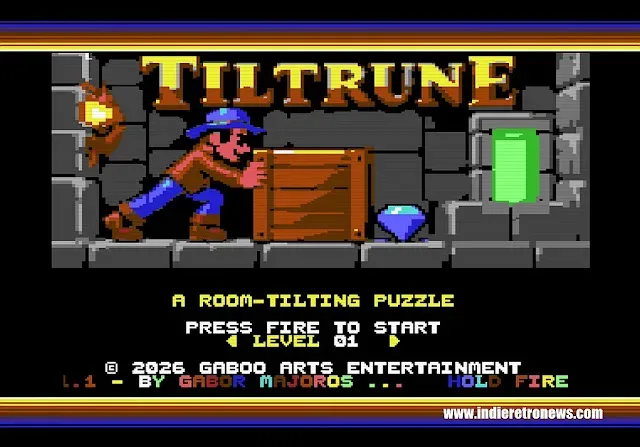
Tiltrune is a new puzzle game from Gaboo Arts Entertainment that treats gravity as the central obstacle, tool and source of chaos. Developed with AI assistance, the game is launching for both the Commodore Amiga and Commodore 64, asking players to solve compact rooms not merely by walking and pushing objects, but by turning the entire playfield on its side.
The concept is immediately understandable yet full of consequences: rotate a room 90 degrees left or right, and gravity follows. A wall that prevented progress a moment earlier can become the floor. A crate that seemed safely parked can suddenly become falling debris. Gems, the player character and movable blocks all respond to the new orientation, forcing careful planning before every flip.
It is an especially fitting idea for the two classic computer formats. Puzzle games have always been at home on the Amiga and C64, but Tiltrune's screen rotation mechanic gives its rooms a physical, toy-box quality. Each chamber becomes a self-contained mechanism, with its contents rearranging themselves whenever the player changes the direction of gravity. Rather than providing a simple shortcut, every rotation can solve one problem while creating another.
A puzzle game where the level itself moves
Tiltrune puts players in control of an explorer navigating a collection of enclosed vaults. The objective is more demanding than simply finding the exit: every gem in a room must be collected before the green exit can be used. That means a route that reaches the door early is not necessarily a winning route. Players must account for collectibles scattered across ledges, corners and areas initially cut off by walls or hazards.
For useful background on this topic, read The House on the Borderland Brings Three Nights of Survival Horror to Commodore 64.
Rotating the whole room is the key to reaching those otherwise inaccessible spaces. When the environment turns, objects tumble in the new gravitational direction. The explorer can fall into a freshly opened route, boxes may shift into useful positions, and gems can become reachable. Yet the same action can make a room much more dangerous. A poorly timed flip could drop the player onto spikes, leave a necessary crate stranded, or send a block falling where it blocks the intended solution.
This makes Tiltrune a game of anticipating motion rather than reacting after the fact. Players need to look at the room as a four-directional puzzle, considering what the layout will become after each 90-degree turn. It is not enough to ask where a crate is now. The important question is where it will land after the room rotates, what it may collide with along the way, and whether it can still be pushed into a useful place afterward.
Crates are particularly important because they can serve several jobs. They can be pushed around manually, used to create routes and, crucially, positioned to absorb dangerous falls. In rooms containing lethal spikes, a carefully placed crate can be the difference between a survivable gravity shift and an immediate failure. This introduces a deliberate setup-and-payoff rhythm: arrange the pieces, flip the room, assess the new arrangement, then begin preparing for the next transformation.
More than 80 rooms across five vaults
Gaboo Arts Entertainment has built Tiltrune around more than 80 main puzzle rooms divided between five distinct vaults. That is a substantial room count for a focused, single-screen puzzle format, particularly because the basic mechanic supports many variations in level design. Early challenges can teach the implications of changing gravity, while later rooms can combine collectibles, falling objects, constrained movement and spikes into tighter multi-step problems.
The campaign does not stop with the five vaults. Tiltrune also includes a special final chamber and bonus challenges that unlock after the main game. These post-game stages give players an additional reason to return once the primary sequence has been completed, and they suit a design built around refining strategies. A room that initially feels impossible can often become readable once its gravity changes are mapped out mentally.
Performance goals add another layer for players who want more than a straightforward clear. The game includes par targets, star ratings and detailed performance statistics. Those features suggest that completing a chamber is only one measure of success; players can also work toward more efficient solutions and stronger ratings. An animated tally at the end of a run provides a dedicated wrap-up for that performance, while high scores can be saved to disk.
For puzzle enthusiasts, the presence of disk-saved scores is a welcome detail. It gives long-term attempts and replay sessions a persistent record, whether the goal is improving a personal result or comparing runs among players sharing the same machine. The statistics and target system also make Tiltrune well suited to a gradual mastery curve, where experimentation eventually gives way to cleaner, better-planned solutions.
Undo and retries encourage experimentation
A puzzle game based on falling objects has obvious potential for accidental failure, especially when a single rotation may move several things at once. Tiltrune addresses that risk with a generous 100-state undo buffer. Players can reverse a large number of recent actions rather than restarting every time a plan goes wrong. It is an important quality-of-life feature for a game that asks people to test complex sequences and learn through trial, error and observation.
Unlimited retries further reduce the penalty for taking risks. Instead of making players conserve lives or replay a long series of unrelated levels after an unsuccessful attempt, the design lets them focus on the room currently in front of them. That approach supports the game's central idea: discovering how a space behaves under changing gravity should be interesting, not exhausting.
The undo system could prove particularly valuable in rooms where crates need to be used as buffers against falls. A player may have the correct broad plan but misjudge one placement by a single tile or rotate too early. With a deep rewind history available, they can inspect the mistake and adjust the sequence without losing the useful understanding gained during the attempt.
That forgiving structure does not necessarily make the puzzles easy. Instead, it removes friction around difficult puzzles. There is a difference between a room that is challenging because its solution requires insight and one that is frustrating because every experiment demands a full restart. Tiltrune appears designed to emphasize the former, allowing players to probe its systems and develop creative answers to each chamber's layout.
The Amiga edition preserves the C64 foundation
Tiltrune is arriving simultaneously on Amiga and Commodore 64, with the Amiga release adapting the original C64 version rather than altering its core design. The rooms, rules and controls are retained, ensuring that the same puzzle campaign and gravity-shifting play are available across both systems.
The Amiga version adds reworked graphics along with animated title and reward screens. It also features Amiga music and sound effects, giving the edition audiovisual enhancements while maintaining the established puzzle structure. That balance is sensible for a game whose identity depends on exact room layouts and predictable object behavior. Changing the presentation can make use of the Amiga's strengths without compromising the carefully constructed logic of the stages.
Meanwhile, the Commodore 64 version remains the original foundation for Tiltrune's design. Bringing the same game to two beloved platforms makes the project notable within the active retro development scene, where new releases often arrive for one machine at a time. Here, fans of either format can engage with the same central challenge: seeing a familiar room from an unfamiliar angle, then deciding whether to turn the world again.
A compact idea with plenty of depth
Tiltrune's premise is strong because it changes the meaning of ordinary puzzle-game elements. Walls are temporary barriers rather than fixed boundaries. Floors are only floors until the next rotation. Crates are not merely movable blocks; they are potential shields, supports and hazards. Even reaching the exit is conditional, since every gem must first be claimed.
With over 80 main rooms, five vaults, extra challenges, scoring goals and a generous undo feature, the game is structured to support both casual problem solving and determined optimization. The rotating-room hook is simple enough to explain in a sentence, but each chamber can ask players to reason through several possible orientations and a chain of object movements before committing to an answer.
For Amiga and C64 owners looking for a new puzzle experience built around the strengths of classic single-screen design, Tiltrune offers an inventive take on gravity manipulation. Its rooms do not just contain the puzzle. With every 90-degree flip, the room becomes the puzzle.
Community
Discussion
Start the conversation.
No comments have been posted yet.