

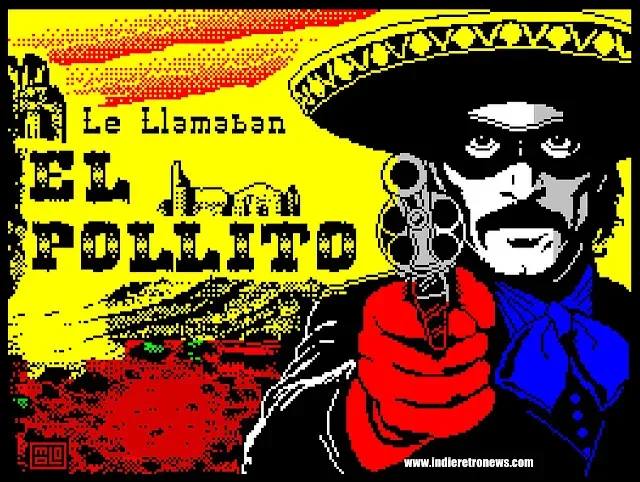
ZX Spectrum owners have a new reason to reach for the joystick: They Called Him El Pollito (The Legend of the Little Chicken), a Spaghetti Western-inspired shoot-'em-up from Furillo Productions. Set amid the sun-baked, dangerous reaches of Bernard Valley, the game turns its unlikely protagonist into a revolver-wielding frontier hero on a mission to save the person closest to him.
Its hero is known simply as The Chick, a feather-ruffling vigilante whose quiet life is shattered when Rosita, the local schoolteacher and his great love, is kidnapped. Rumours point toward the notorious Joe the Mad Miner, but the apparent abduction is only the first part of a larger mystery. As The Chick rides into action, the trail suggests that somebody far more influential may be directing events from behind the dusty scenes of the frontier.
The setup gives the game a playful identity while remaining faithful to the kind of urgent arcade premise that suits the ZX Spectrum. There is a villain to pursue, hostile country to cross, and a clear objective at the heart of the action: get through Bernard Valley, survive its dangers, and bring Rosita home.
A Western tale built for arcade action
The Legend of the Little Chicken uses the language and atmosphere of classic Spaghetti Westerns, filtering it through the colourful, fast-moving structure of a Spectrum shoot-'em-up. The lawless setting, the kidnapped schoolteacher, the lone gunslinger and the possibility of a shadowy mastermind all give the adventure a knowingly cinematic flavour. Rather than placing a conventional cowboy at the centre of the story, Furillo Productions makes its central avenger a chicken, giving the game its memorable title and offbeat personality.
For useful background on this topic, read Ghouls 'n Ghosts Enhanced Project Gives Amiga Port a Major Technical Upgrade.
That tonal contrast is a major part of the appeal. Bernard Valley is presented as a place of threats, criminals and hidden schemes, yet the game's hero is The Chick. The result is a premise that can embrace danger and melodrama without taking itself too seriously. It is a tale of frontier justice where the gunslinger has feathers, the damsel in distress is Rosita, and the suspected kidnapper bears the very Spectrum-friendly name of Joe the Mad Miner.
Players are asked to take control of The Chick and push forward into the unknown. The journey is not solely about settling a score with a presumed criminal; it is also about discovering whether Joe the Mad Miner is really responsible or merely another piece of a larger plot. That extra layer gives the rescue mission more intrigue than a straightforward chase.
SEUD foundations with Furillo Productions additions
Under the hood, the game was created with a heavily modified edition of SEUD, Jonathan Cauldwell's Shoot-Em-Up Designer. The toolkit has long been associated with accessible development for Spectrum-style action games, but The Legend of the Little Chicken is not described as a simple stock production. Furillo Productions substantially customised the software for its own project, shaping it around the game's Western setting and arcade ambitions.
The development also incorporates Furillo Productions' proprietary ambush module, designed for use with the Mojon Twins' MK1 engine. That combination is notable for retro-development followers because it brings together tools and ideas with established roots in the modern Spectrum homebrew scene. The project's technology reflects a practical approach to building a fresh game on vintage hardware: start with proven foundations, then adapt and extend them to suit a specific creative vision.
Environmental elements including rocks and serpents draw on free asset libraries. Furillo Productions has been clear about that part of the production, while positioning the overall experience as an original arcade game. In a platform community where new games are often made by small teams with specialised tools, that openness helps clarify the divide between supporting visual resources and the game's larger design, scenario and gameplay construction.
The important point for players is that the game is designed around energetic shooting action rather than merely serving as a technical exercise. Its tools and modules provide the framework, but the destination is a distinctive Western-flavoured challenge built around a rescue, a conspiracy and a determined chicken with a loaded revolver.
Bernard Valley's dangers await
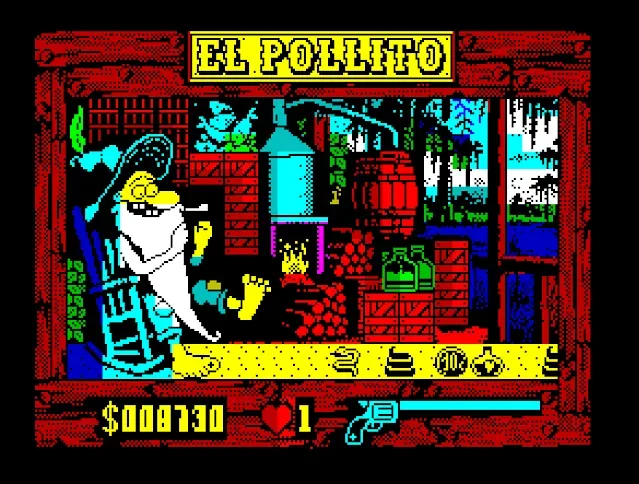
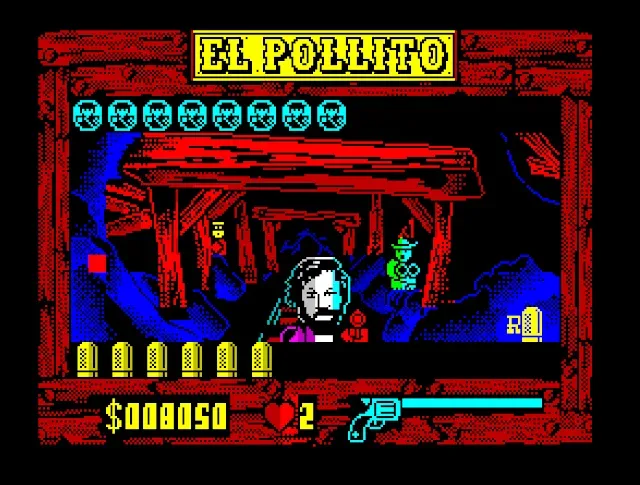
The badlands of Bernard Valley are the stage for the entire conflict. It is a setting made for hostile terrain, sudden attacks and memorable enemies, with environmental features such as rocky formations and serpents helping establish the rough frontier mood. The visual concept leans into the constraints and strengths of Spectrum-era game design: instantly readable hazards, bold setting cues and action that needs to make an impression within a compact technical format.
That setting also supports the game's "ambush" concept especially well. A Western journey through isolated territory naturally invites surprise dangers and pressure from enemies lurking ahead. While the available details do not outline every stage or mechanic, the emphasis on a high-energy arcade experience suggests that caution and quick reactions will matter as much as The Chick's willingness to charge toward trouble.
Rosita's disappearance provides the personal stakes, but the hinted puppet master broadens the scope. The Chick is not simply headed for one confrontation. He is moving into a situation where the obvious culprit may not be the ultimate enemy. For a shoot-'em-up, that narrative hook gives players a reason to see the trek through to its conclusion beyond chasing a high score or mastering the action.
A welcome addition to the Spectrum's modern library
New ZX Spectrum games continue to demonstrate the longevity of the platform, and The Legend of the Little Chicken arrives with an especially characterful pitch. Its blend of Western genre fiction and cartoonish heroism feels well suited to the machine's active homebrew audience. The game is not attempting to disguise its retro roots; it embraces them, from its shoot-'em-up structure to its use of established Spectrum development tools.
At the same time, Furillo Productions has given the familiar format a clear theme. A standard blaster can become far more memorable when the player is crossing a fictional valley as a chicken vigilante searching for his kidnapped beloved. The details are deliberately heightened: a lawless region, a feared miner, a schoolteacher named Rosita and a hidden power manipulating the conflict. It is an adventure pitched with the enthusiasm of a Saturday-morning arcade game and the visual shorthand of old Western cinema.
For players who enjoy discovering contemporary software for classic systems, that combination may be the game's biggest draw. It promises the immediate readability of a traditional shoot-'em-up while delivering a premise that is hard to confuse with anything else in the Spectrum catalogue. Whether Joe the Mad Miner is truly the villain or not, Bernard Valley clearly has plenty of trouble waiting for anyone brave enough to enter it.
The Chick's mission is clear
The Legend of the Little Chicken puts its challenge in direct terms. Rosita needs rescuing, danger stands between her and The Chick, and the truth behind the kidnapping may be buried beneath several layers of frontier deception. The revolver is ready, the badlands are waiting, and Bernard Valley's fate now rests with its most unusual gunslinger.
For ZX Spectrum fans seeking another new adventure built with the machine's enduring arcade spirit in mind, Furillo Productions' latest project offers a lively trip into the dust, danger and absurdity of a feathered Spaghetti Western. The only question left is whether The Chick can fight through the valley, expose the force behind the plot and make it back to Rosita in one piece.

Community
Discussion
Start the conversation.
No comments have been posted yet.