

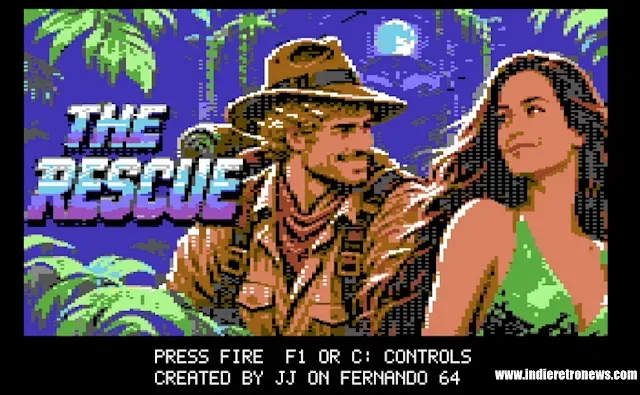
The Rescue is a new Commodore 64 action game from Fernando64JJ that embraces the high-pressure military adventure style associated with the machine's late-1980s era. Set in a hostile jungle region controlled by the ruthless Colonel Varga, the game puts players in the boots of John Jericho, a soldier sent on a desperate operation to recover Adri, a medical camp worker taken prisoner after recording evidence of the militia's atrocities.
The setup is deliberately direct, but the mission itself is broader than a single run-and-gun assault. The Rescue begins with helicopter combat over dangerous coastal and delta environments before moving into a lengthy ground campaign. Across ten stages, Jericho must breach locations including enemy airfields, ancient temple sites and the Colonel's defended stronghold. The game's central hook is the decision between loud aggression and more careful infiltration: players can attempt to overpower resistance, or use cover and positioning to avoid an all-out alert.
That structure gives the C64 release a classic arcade-action premise with room for tactical play. Instead of treating every encounter as a straightforward shooting gallery, The Rescue asks players to pay attention to how they move through hostile territory, when they engage guards, and what happens when the enemy realizes an intruder is nearby.
A rescue operation that starts in the air
Before John Jericho can begin the land assault, he has to survive two helicopter flight phases. These opening sequences take the action across coastlines and river delta territory, where enemy jets and gunships threaten the mission from the air. The change in perspective and vehicle gives the game an opening that feels more like a full military insertion than a conventional on-foot jungle level.
For useful background on this topic, read World of Warcraft Forever Revises Dungeon XP Rules After Anti-Boosting Fix Disrupts Normal Groups.
For a Commodore 64 action title, shifting between air combat and infantry action is an ambitious way to frame the campaign. The flight segments establish Colonel Varga's control of the region while also giving players immediate pressure: aerial enemies must be avoided or confronted before the true rescue mission can continue. They are not merely a cinematic introduction; they are part of the danger Jericho faces in reaching the occupied interior.
Once the helicopter sections are complete, the operation moves to the ground. The environments are built around enemy-controlled spaces rather than an empty wilderness. Airstrips, temple areas and fortified facilities suggest a campaign that steadily carries players deeper into militia territory and closer to the prisoner. Each new area also helps reinforce the sense that Varga's forces are entrenched across the whole region.
Stealth is rewarded, but force remains an option
The Rescue's ground levels are built around a choice that should be familiar to fans of tense action games: move silently, or make enough noise that every opponent in the area knows exactly where you are. Players can creep through bushes, search for valuable intelligence and take down guards from behind. Successfully handling a stage without raising the alarm leads to substantial bonuses at the end of that level.
That reward system makes quiet play more than an optional bit of role-playing. It gives players a practical reason to study guard placement and use the jungle cover available to them. Gathering intel and remaining undetected can directly improve a run's final score or reward, creating an incentive to replay stages and refine an approach rather than simply rushing ahead.
At the same time, an alarm changes the conditions dramatically. Once Jericho is exposed, the screen can fill with hostile riflemen, snipers and attack dogs. The difference between a hidden takedown and an open firefight is therefore not just cosmetic. It determines how much opposition must be managed and how quickly a controlled situation can become overwhelming.
This contrast is likely to be one of the game's strongest features. A player who prefers immediate combat is not locked out of progressing, but the consequences of that approach remain clear. Meanwhile, players looking for a more methodical challenge can try to keep their presence concealed while navigating each dangerous area. The result is a design that can support different styles without removing the stakes from either one.
Ten stages of escalating enemy territory
The main ground campaign spans ten stages, providing the rescue mission with a clear sense of escalation. The locations move beyond generic jungle backdrops and into spaces that reflect the militia's operations and the history of the surrounding territory. Enemy airstrips place Jericho near military infrastructure, while ancient temples add a more mysterious and hazardous setting to the advance. Eventually, the mission reaches Colonel Varga's own heavily defended compound.
That final destination matters because The Rescue is framed as a targeted operation rather than a broad war story. Adri's abduction is the immediate reason for the mission, and Varga is the figure at the center of the danger. By moving through increasingly fortified locations, the game presents the player with a route toward the person responsible rather than a disconnected series of action scenes.
The final confrontation takes place in the Colonel's pitch-black quarters, setting up a more suspenseful end than a simple open battlefield clash. Darkness turns the enemy leader's personal space into another tactical problem, and it is an appropriate last obstacle for a game that has spent much of its campaign contrasting visibility, concealment and alarms.
Each enemy type is also said to require a distinct strategy to defeat. That detail suggests that survival will depend on more than firing quickly. Riflemen, snipers, dogs and the aerial threats encountered earlier all bring different pressures to the mission. Learning how to respond to them should be essential as the campaign gets harder and the cost of being detected rises.
A presentation built for C64 action fans
The Rescue aims to pair its action with a presentation that recognizes the visual and audio identity of the Commodore 64. It includes full-screen title artwork as well as separate illustrations for every level. Those images can help give each stage its own character before play begins, particularly in a campaign that moves between coastlines, military facilities, ruins and the final compound.
Music is provided by Retroverse Jack, who has composed a cinematic SID soundtrack for the game. The SID chip remains one of the C64's most celebrated features, and a cinematic score is a fitting match for a mission built around helicopter assaults, covert movement and a climactic confrontation with a militia commander. The soundtrack has the potential to do more than provide background noise; in this kind of action game, it can define the tension of a clean infiltration as effectively as the panic of a triggered alarm.
The release also arrives with an intentionally old-school fictional setting: players are transported back to 1987, the same period in which the Commodore 64 was still a major platform for action games. That framing suits a project that appears designed to evoke the era's bold military adventures while adding an explicit stealth-and-reward layer to its structure.
Why The Rescue stands out
New games for classic hardware often succeed when they understand what made the original platform compelling without treating nostalgia as the only feature. The Rescue's premise points in that direction. It uses the C64 for a large-scale action story with helicopter sequences, a ten-stage infiltration campaign, varied locations, enemy-specific tactics and a soundtrack designed around the system's distinctive sound hardware.
Its most notable idea may be the tension between stealth and brute force. A successful quiet run can earn major bonuses, but a mistake can turn the level into a chaotic fight against riflemen, snipers and attack dogs. That makes every bush, guard route and collected piece of intelligence potentially meaningful. Rather than presenting the jungle solely as scenery, the game makes it part of the player's tactical toolkit.
With John Jericho heading into Colonel Varga's territory to save Adri, The Rescue offers a focused mission with plenty of room for escalating danger. Whether players choose to slip past patrols, strike from behind or fight their way through an alerted militia, the journey from aerial insertion to the dark final quarters promises a distinctly retro action challenge built for the Commodore 64.
Community
Discussion
Start the conversation.
No comments have been posted yet.