
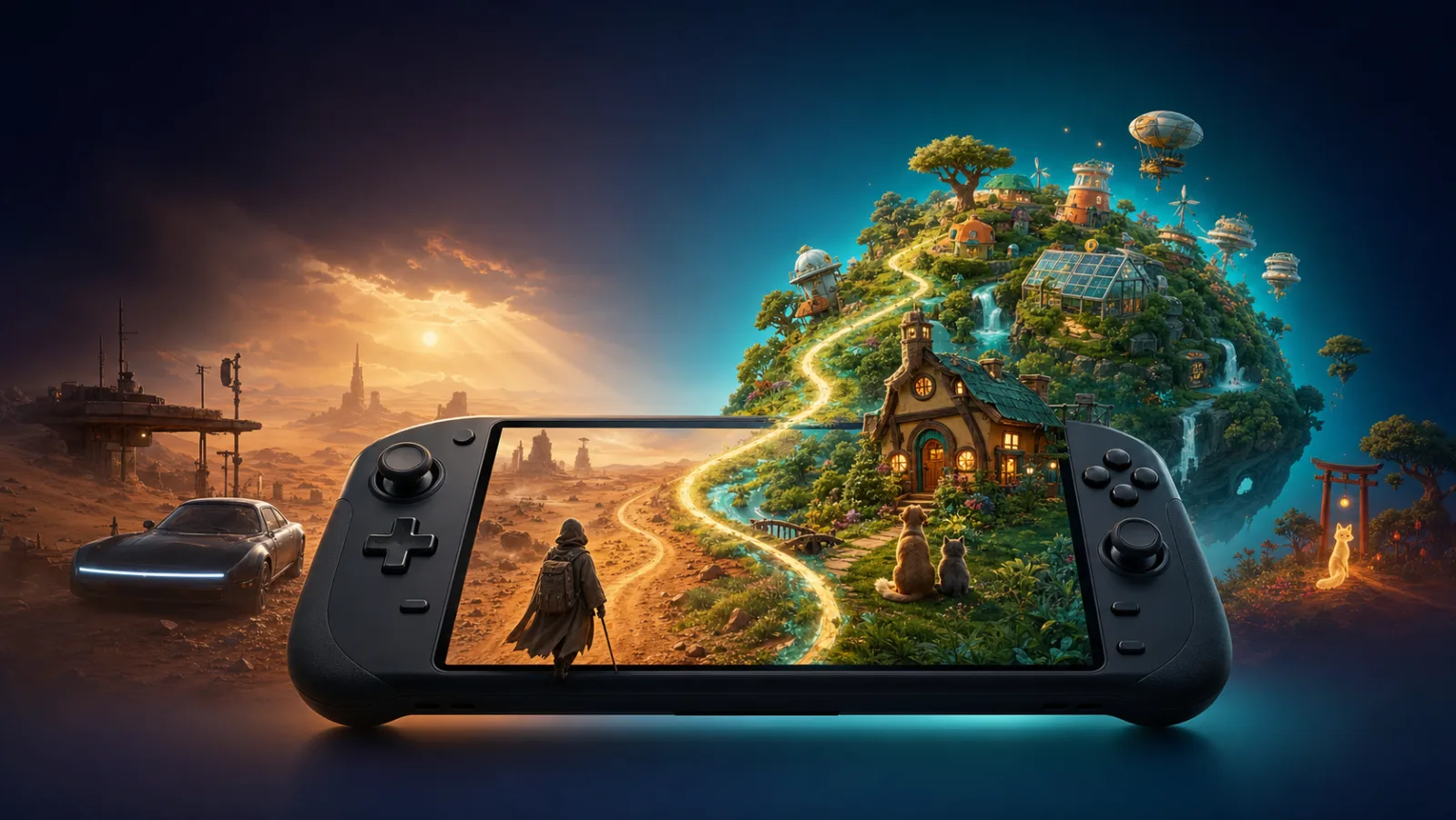
Choosing between The Road of Dust and Sorrow and Petit Planet is less about finding two versions of the same experience and more about identifying what you want from your next game. Both are adventure-led titles with distinctive visual and thematic identities, and both are positioned for play across more than one platform. Their core appeal, however, could hardly be more different.
The Road of Dust and Sorrow is a story-driven atmospheric thriller with pixel-art visuals, adventure and puzzle structure, and survival-horror elements. It is designed as a short, intense experience. Petit Planet, by contrast, is a free-to-play cosmic life simulation centered on building a home, sharing a planet with fuzzy neighbors, and exploring everyday life in a much softer, more open-ended setting.
That creates a clear divide. One game aims to concentrate tension, mystery, and problem-solving into a focused journey. The other aims to make a place players can inhabit, shape, revisit, and share. For handheld players in particular, this comparison is useful because each game speaks to a different strength of portable play: a contained narrative session versus an ongoing daily-life routine.
The Road of Dust and Sorrow is listed for Nintendo Switch, Nintendo Switch 2, PC, PlayStation 5, and Xbox Series X|S, with a December 3, 2026 release date. Petit Planet is listed for Android, iOS, Nintendo Switch 2, and PC, with a December 31, 2026 release date. Before choosing based on a platform alone, it is worth looking at how their structures, atmosphere, social possibilities, and likely staying power line up with your own gaming habits.
The quick verdict
Choose The Road of Dust and Sorrow if you want a deliberate, story-first adventure with uneasy atmosphere, puzzles, and survival-horror flavor. Its short and intense framing makes it the more natural pick for players who value a strong sense of forward momentum and would rather reach an ending than settle into a long-term routine.
Choose Petit Planet if you want a cozy, creative simulation built around home-building, community life, discovery, and cross-platform flexibility. It is the better fit for players who enjoy returning to a personal space over time, collaborating with other people, and treating a game as a relaxed part of their regular routine.
Neither game is inherently the "better" purchase for every player because they are chasing radically different feelings. The more useful question is simple: do you want a destination, or do you want a home?
At a glance: the biggest differences
- Core mood: The Road of Dust and Sorrow is tense, shadowy, and unsettling; Petit Planet is warm, social, and cosmic in a cozy sense.
- Main activities: The Road of Dust and Sorrow blends adventure, puzzles, and survival-horror elements; Petit Planet focuses on home-building, community, and everyday discovery.
- Session style: The Road of Dust and Sorrow suits intentional, story-progress sessions; Petit Planet suits short check-ins as well as longer creative sessions.
- Scope: The Road of Dust and Sorrow is explicitly framed as short and intense; Petit Planet is structured as a life simulation, a format naturally suited to ongoing play.
- Social focus: The Road of Dust and Sorrow is presented as a solo atmospheric thriller; Petit Planet is a cross-platform experience involving neighbors and shared planetary life.
- Platform fit: The Road of Dust and Sorrow reaches Nintendo, PC, PlayStation, and Xbox ecosystems; Petit Planet reaches Android, iOS, Nintendo Switch 2, and PC.
- Business model: Petit Planet is identified as free-to-play. No business model is listed for The Road of Dust and Sorrow.
Gameplay comparison: focused puzzles versus everyday possibility
The Road of Dust and Sorrow is built around momentum
The defining gameplay promise of The Road of Dust and Sorrow is its blend of adventure and puzzle gameplay with survival-horror elements. That combination suggests a game where movement through its world matters: players will not simply be decorating or collecting for their own sake, but advancing through an unsettling experience while encountering obstacles that ask to be understood or overcome.
Its pixel-art presentation is important here. Pixel art can give a game a strong visual identity without requiring a huge visual footprint, and it can be especially effective when atmosphere depends on what is suggested rather than plainly shown. In a thriller, darkness, isolation, environmental details, and the implication of danger can all do meaningful work. The game's stated emphasis on atmosphere indicates that its tension is likely to come from the relationship between its story, its spaces, and the player's uncertainty about what lies ahead.
The puzzle component should appeal to players who like a break from pure action. A good adventure puzzle changes the pace: it asks for observation and reasoning rather than reflex alone. Coupled with survival-horror elements, puzzles can make progress feel earned and raise the stakes of every detour. Players who enjoy being guided through a curated sequence of mysteries, rather than given a wide toolset to define their own goals, should find this structure more appealing.
The key expectation to set is scale. This is described as a short, intense experience. That is not a limitation when it matches what you are looking for. A shorter game can be a virtue for players with crowded libraries, limited free time, or a preference for completing stories rather than maintaining a persistent in-game life. It can also make the atmosphere more potent because the game does not need to dilute its central mood with endless activities.
Petit Planet is built around inhabiting a world
Petit Planet approaches adventure from the opposite direction. It is a cosmic life simulation, and the central verbs are building a home, sharing a planet with fuzzy neighbors, and exploring the possibilities of everyday life. Rather than pushing players down a tense route toward a conclusion, it positions the player within a place that can be personalized and gradually made meaningful.
The game's adventure, role-playing, and simulation labels matter together. Adventure implies discovery, role-playing suggests a personal presence within the setting, and simulation points toward routine, expression, and systems that support everyday play. Home-building gives players a direct way to create visible results from their time. Community life gives that space a social context. The cosmic setting supplies a broader imaginative frame, allowing the game to feel whimsical without abandoning the comforts associated with a life sim.
This is the stronger choice for players who do not need every session to produce dramatic narrative progress. In a life simulation, a satisfying session can be as simple as adjusting a home, checking in on neighbors, exploring a little further, or deciding what to do next. That makes Petit Planet attractive for players who like games that accommodate changing energy levels. Some nights call for deep involvement; others call for a low-pressure ritual.
Because Petit Planet is intended as a cross-platform experience and includes Android and iOS alongside PC and Nintendo Switch 2, it also has the potential to fit more naturally into a fragmented schedule. A player who divides time between a larger screen and a phone will likely see more value in a game rooted in community, home, and repeat visits than in a finite thriller designed for concentrated attention.
Atmosphere and tone: dread versus comfort
The tone gap between these games is substantial, and it should influence your decision as much as genre does.
The Road of Dust and Sorrow is explicitly an atmospheric thriller with survival-horror elements. Its title alone reinforces a sense of hardship and melancholy, while its premise signals an experience that wants players to feel alert. This is the game to consider when you want a darker palette: isolation, unease, shadows, danger, and a story that places emotional weight on the path forward. Its pixel-art visuals are not merely decorative; they support the identity of an indie thriller that can use stylization to build mood.
Petit Planet is openly cozy. Its setting is cosmic, but its interests are intimate: a home, neighbors, and the small pleasures of everyday life. The fuzzy-neighbor concept gives the community angle a friendly, approachable texture. This is not a game that appears designed to test your tolerance for dread. It is a game for relaxing into a pleasant rhythm, building something personal, and letting a fictional world become familiar.
Players sometimes assume that cozy automatically means shallow and horror automatically means demanding. That is too simplistic. Cozy games can offer meaningful creative decisions and a powerful sense of belonging, while short thrillers can be accessible precisely because their goals are focused. The real difference is emotional intent. The Road of Dust and Sorrow asks you to lean into tension. Petit Planet asks you to settle in.
Handheld and platform fit
For a handheld-gaming audience, both titles deserve attention, but they reach portable players in different ways.
Nintendo Switch and Nintendo Switch 2
The Road of Dust and Sorrow is listed for both Nintendo Switch and Nintendo Switch 2. That makes it the more flexible choice for players already invested in Nintendo hardware across generations. A short, story-driven adventure can work especially well in handheld mode: a player can make tangible progress in a focused session, pause at a natural break, and return when ready to re-enter its atmosphere.
Petit Planet is listed for Nintendo Switch 2 rather than Nintendo Switch. For players planning around the newer Nintendo hardware, its home-building and community-driven approach could be an excellent portable companion. Life simulations have an inherent handheld appeal because they can support both brief routine visits and longer, relaxed creative play. Still, prospective players should keep the Switch 2-only listing in mind if their current device is a Nintendo Switch.
Mobile and PC
Petit Planet has the clearest portable advantage in the broadest sense because it is listed for Android and iOS as well as PC. That matters for a cross-platform life sim. A game based on maintaining a home and participating in community life can benefit from being near at hand. Mobile compatibility does not automatically determine quality or depth, but it does make Petit Planet the obvious contender for players who want access beyond a dedicated console or computer.
The Road of Dust and Sorrow is listed for PC, but not mobile. Its PC version gives it a straightforward home for players who prefer keyboard-and-mouse environments or a desktop screen for a darker adventure. Yet its Nintendo versions provide the portable route for players who want to experience its story away from a desk.
PlayStation and Xbox
The Road of Dust and Sorrow has a major advantage for players who primarily use PlayStation 5 or Xbox Series X|S. It is listed for both platforms, while Petit Planet is not listed for either. If your preferred place to play is a current PlayStation or Xbox console, the decision is uncomplicated: The Road of Dust and Sorrow is the relevant choice from this pair.
That broader console reach also makes the thriller easier to consider for households where players use different ecosystems. Petit Planet's cross-platform identity remains compelling, but its platform map is centered on mobile, PC, and Nintendo Switch 2 rather than the full console field.
Longevity: finishing a story or creating a routine
Longevity means different things in these two games. It should not be reduced to raw hours.
The Road of Dust and Sorrow is presented as short and intense. Its value is likely to rest on the completeness of the journey: story, atmosphere, puzzles, and the experience of carrying its tension through to a conclusion. A compact game can leave a vivid impression because it respects the player's time and avoids overstaying its central idea. If you enjoy discussing a finished story, remembering a specific sequence, or clearing a game from your backlog with a sense of closure, that type of longevity can be deeply satisfying.
Petit Planet has a different kind of staying power. Home-building, neighborly life, and discovery are foundations for recurring play. The appeal is not only in seeing what happens next but also in seeing what your own planet becomes. A simulation can remain engaging because player goals evolve: first establish a home, then improve it, then explore more, then spend time within the community, then return to refine the space again.
The free-to-play model is relevant to expectations, but it does not by itself tell players how the experience will feel or what their long-term spending will be. The useful point is that players considering Petit Planet should approach it as a continuing cross-platform game rather than assume it will follow the same self-contained rhythm as The Road of Dust and Sorrow. In contrast, no business model is listed for The Road of Dust and Sorrow, so its comparison should stay focused on its genre, format, and platforms.
Who should choose The Road of Dust and Sorrow?
- Story-first players: Choose it if you want the game to lead you through a crafted thriller rather than ask you to invent your own daily goals.
- Puzzle fans: Its adventure and puzzle blend is the stronger fit for players who enjoy progress built on observation and problem-solving.
- Horror-curious players: The survival-horror elements make it the better match for those who want unease and suspense without committing to an open-ended simulation.
- Players with limited time: Its short, intense format is ideal if you want a memorable experience that does not demand a long-term routine.
- PlayStation and Xbox players: It is the only game in this comparison listed for PlayStation 5 and Xbox Series X|S.
- Current Nintendo Switch owners: Its Nintendo Switch listing makes it the more direct option if you are not planning specifically around Nintendo Switch 2.
Who should choose Petit Planet?
- Cozy-game fans: Choose it if the idea of a cosmic home, friendly neighbors, and low-pressure daily life sounds more appealing than suspense.
- Creative players: Home-building creates room for personal expression and gives time spent in the game a visible, individual result.
- Social players: Its focus on sharing a planet and community life makes it the better fit for people who enjoy a connected experience.
- Routine-driven players: If you like returning to a game for small goals, familiar places, and gradual development, its life-simulation format is the stronger match.
- Mobile players: Android and iOS versions make it the clear choice for people who want a game that can live on a phone or tablet as well as PC.
- Nintendo Switch 2 and PC players: Its platform support gives it a natural home on either device, especially for players interested in cross-platform play.
The final choice
The Road of Dust and Sorrow vs Petit Planet is ultimately a comparison between concentrated atmosphere and ongoing comfort. The Road of Dust and Sorrow is for the player who wants to enter an unsettling pixel-art world, work through puzzles, feel the pressure of survival-horror elements, and come away with a complete story-driven experience. It is the more focused, dramatic, and traditionally adventure-shaped option.
Petit Planet is for the player who wants to make a home in a cosmic setting, spend time among fuzzy neighbors, and find value in the ordinary acts of building, exploring, and participating in a community. It is the more flexible, social, and routine-friendly option, with a particularly strong case for mobile and Nintendo Switch 2 players.
If you want a game for a specific mood, choose The Road of Dust and Sorrow. If you want a game that can become part of your day-to-day play life, choose Petit Planet. Both have a place in a varied handheld and cross-platform library, but they answer entirely different needs--and knowing which need you have is the best way to choose well.
Community
Discussion
Start the conversation.
No comments have been posted yet.