

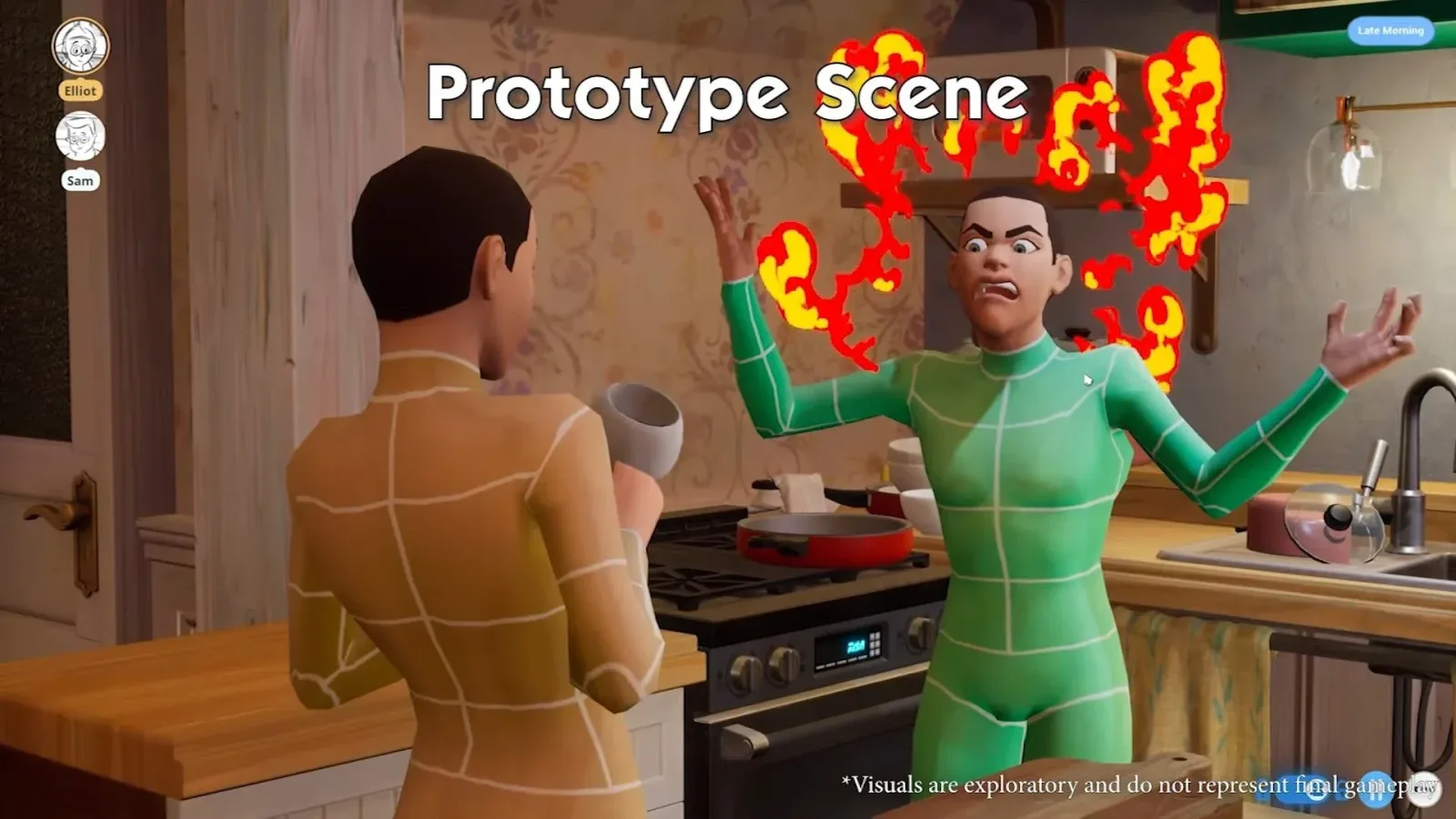
EA's latest company-wide shakeup has created fresh uncertainty around The Sims, one of the publisher's most enduring franchises. Following news of 400 layoffs and the closure of BioWare, internal messaging from EA executives Cam Weber and David Tinson indicates that Maxis is being redirected toward a project known as Project Evergreen. At the same time, development on another Sims-related effort, codenamed Project Lotus, has been paused.
For players who have spent years trying to understand what comes after The Sims 4, the announcement lands in the middle of an already confusing period. EA has discussed a future for the series without firmly presenting a traditional, numbered successor. A project publicly known under the codename Project Rene had at one point appeared to be a likely next-generation Sims game, but its direction has seemed increasingly difficult to pin down. Now, with Project Lotus paused and Project Evergreen becoming Maxis' stated priority, the future of the series looks even less settled.
EA shifts its Sims focus to Project Evergreen
In the internal email, Weber and Tinson said EA's Lifestyle division would concentrate on the long-term potential of both The Sims and skate. The message specifically said the company would prioritize Project Evergreen for The Sims, giving its team more time to achieve the game's wider vision. To make that change possible, EA is pausing work on Project Lotus.
"In Lifestyle, we're focusing on the long-term potential of The Sims and skate. We're going to prioritize our efforts on 'Project Evergreen' for The Sims to give the team more time to reach the full potential and vision for the game, and to help make this possible, we're pausing development on 'Project Lotus.'"
For useful background on this topic, read Subnautica 2's 'Early Access 2.0' Promises Its Most Frightening Region Yet.
The wording provides a clear statement of priorities, but it leaves major questions unanswered. EA has not publicly laid out what Project Evergreen is, what form it will take, or whether it is intended to be a direct successor to The Sims 4. It is also not clear what a pause means for Project Lotus in practical terms. A paused project can potentially return later in a changed form, be folded into another effort, or remain dormant indefinitely. No further details were provided on that point.
That lack of definition is especially significant for a series with a huge player base accustomed to long support cycles. The Sims 4 launched in 2014 and later became free-to-play, remaining the active centerpiece of the franchise for more than a decade. Its longevity has been supported by frequent expansions, game packs, kits, updates, and an extensive modding scene, but it has also intensified demand for clarity about the next major step.
Why Project Lotus is being linked to Project Rene
Project Lotus has not been publicly explained in depth, yet it has been widely rumored to be an alternate codename connected to Project Rene. Rene itself was initially revealed as what looked like a possible successor to The Sims 4. Although EA avoided branding it as The Sims 5, early material gave players reason to view it through that lens.
Those early glimpses emphasized a detailed customization system and multiplayer-oriented features. The prospect of shaping furniture and spaces with granular controls fit naturally with the creative identity of The Sims, while the social component suggested a significant evolution from the largely single-player mainline games fans knew. For some players, that combination sounded like a promising foundation for a new era. For others, multiplayer raised concerns that the series could drift away from the personal, sandbox-driven play that has defined it for decades.
Over time, Rene's apparent direction became more contentious. Around 2024, screenshots circulated that appeared to show a game resembling prior mobile entries in the franchise. The project was also identified as free-to-play. Those details encouraged concerns that a game once perceived as a traditional generational leap could instead become a more heavily monetized, mobile-influenced platform.
Additional reports and playtest details further fueled the debate. Some descriptions suggested Rene might be positioned as a platform with similarities to services such as Roblox. Later playtests reportedly included experiences that closely resembled popular Roblox formats, including the fashion-focused game Dress to Impress. The possibility of Sims-style social spaces and creator-driven activities is not inherently incompatible with the franchise, but players questioning the project's identity saw these elements as evidence that it was moving away from the kind of mainline life simulation they wanted.
A pause that divides the Sims community
Reaction to the pause has been split. Some Sims fans have greeted the news with relief, particularly those who were uneasy about the free-to-play, multiplayer, and mobile-like signals tied to the project believed to be Lotus or Rene. From that perspective, placing the project on hold could give Maxis room to reassess what players expect from the next major Sims experience.
Others are far less optimistic. EA's broader layoffs and the closure of BioWare have naturally made any restructuring announcement feel more alarming. Fans are not just evaluating a single paused game; they are looking at a publisher undergoing a major operational change while one of its most important series enters another period of ambiguity.
The intensity of the response also reflects frustration that has accumulated over several years. EA has repeatedly made it clear that The Sims 4 remains important, even as it explored future projects. Yet the company has not offered the kind of simple transition that many players expected after such a long-running installment: the announcement of a clearly defined new numbered entry, its core features, and a straightforward answer about how it will coexist with the existing game.
Instead, the conversation has been filled with codenames, limited demonstrations, reported playtests, changing impressions, and questions about whether a conventional The Sims 5 was ever the plan. The move from Lotus to Evergreen as Maxis' central focus extends that uncertainty rather than resolving it.
What Project Evergreen could be
Very little is known about Project Evergreen, but reporting from Sims Community has suggested that it may be the new name for Project X. Project X has been described as a single-player game separate from Rene, and one that seems closer to the idea of a mainline Sims release.
That possibility has given some fans reason for cautious excitement. If Evergreen is indeed a separate single-player project with the scope of a traditional Sims game, it may represent the direction many players have been asking EA to pursue: a new life simulator built around households, neighborhoods, building, customization, storytelling, and offline personal play, rather than one centered primarily on shared online spaces.
However, that remains unconfirmed. The Project X connection is reporting and community speculation, not a full official explanation from EA. It should not be treated as confirmation that Evergreen is The Sims 5, nor does it establish its platforms, business model, feature set, or release timing. For now, the only firm point is that EA has chosen it as the priority for Maxis' Sims development efforts.
There is a certain irony in the codename itself. "Evergreen" often suggests longevity, continuous relevance, and ongoing support. That may be fitting for a franchise built around games that live for years through expansions and community creativity. But after the exceptionally long life of The Sims 4, some players may hear the name as a reminder of how long they have already waited for a decisive new chapter.
The Sims 4 remains the known quantity
Whatever becomes of Lotus, Rene, and Evergreen, The Sims 4 is still the established Sims product. Its free-to-play status lowers the barrier for new players, while its enormous catalog of additional content and active community keep it at the center of the franchise. That stability matters, particularly while EA's plans for the next project are in flux.
At the same time, continued support for a familiar game does not completely answer the demands of players hoping for a more substantial technological and creative reset. A new mainline Sims game would carry expectations for more flexible worlds, deeper simulation systems, improved building tools, stronger performance, and a business model that feels respectful of the audience. It would also have to navigate the pressure of competing life-simulation games, including Paralives, which has drawn attention with ongoing free updates.
Project Evergreen may eventually provide the clearer path forward that Sims fans have been waiting for. It could also simply become the next chapter in a long sequence of evolving plans. EA's announcement establishes a new priority, but not yet a concrete vision that players can evaluate. Until Maxis and EA share more, the immediate takeaway is straightforward: Project Lotus is paused, Project Evergreen is now the focus, and the question of what comes after The Sims 4 remains open.
Community
Discussion
Start the conversation.
No comments have been posted yet.