

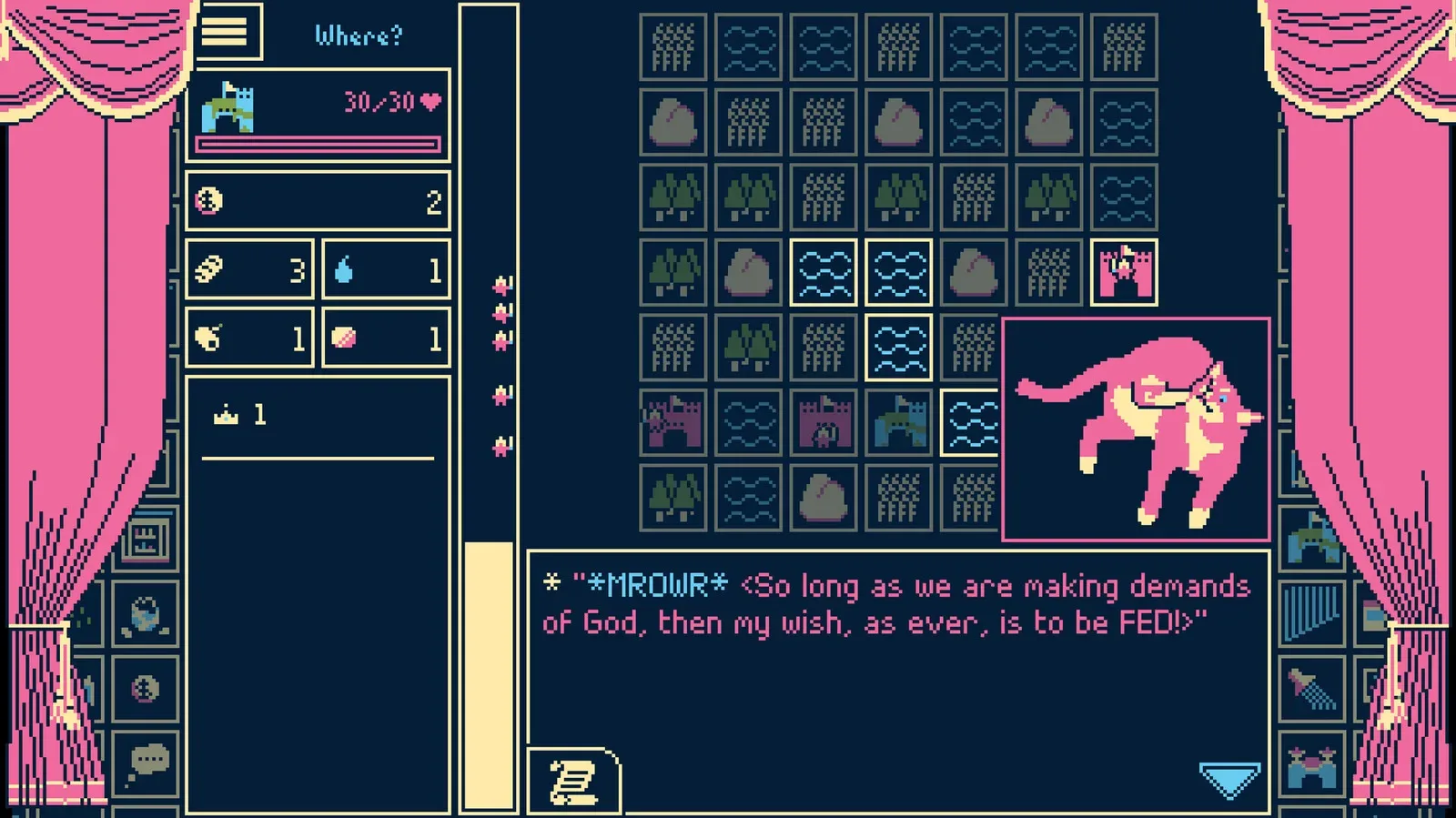
Titanium Court, the unusual strategy game that has built momentum since its Steam debut in April, will reach Nintendo Switch, Nintendo Switch 2, PlayStation 5, Android and iOS on October 29. The expansion gives a much larger audience access to one of 2026's most distinctive independent releases, a game that combines run-based progression, match-three board manipulation, defensive battles, role-playing systems and visual-novel storytelling.
Created by developer AP Thomson and published by Fellow Traveller, Titanium Court initially arrived on PC via Steam. It had already attracted attention before launch after winning the Seumas McNally Grand Prize at the Independent Games Festival Awards earlier this year. Thomson was also part of the team behind Consume Me, which won the same prize in 2025.
The October 29 release is particularly notable because Titanium Court's structure appears well suited to several very different ways of playing. Its battles are built around discrete runs, while its narrative premise and surprises encourage continued experimentation. A phone version may make it an easy game to pick up for a brief session, while the Switch and PlayStation 5 editions will bring its surreal kingdom and tactical puzzles to living-room screens.
A war fought in two very different phases
Titanium Court describes each run as a war. Rather than following a conventional campaign map or a familiar deckbuilding loop, each war is composed of multiple battles. Those battles are divided into two linked stages, and success depends on understanding how decisions in the first stage reshape the conditions of the second.
For useful background on this topic, read Henry Cavill Had to Prove He Was Really Henry Cavill Before Inviting Geralt Voice Actor Doug Cockle to The Witcher Premiere.
The opening phase resembles a match-three puzzle game. Players move tiles around a grid containing elements such as wheat, rivers, forests and enemy castles. Forming groups of three matching tiles can produce resources connected to those tiles, while matching enemy strongholds can remove them from the board. It is a familiar foundation on paper, but Titanium Court uses it less as a simple score-chasing activity and more as a method of building, changing and sometimes compromising the next battlefield.
That is because the board is not merely an abstract puzzle. The placement of tiles matters once the battle advances to its defensive stage. Enemies attempt to attack the player's base, itself represented by a tile on the grid. Resources gathered through matching can be spent before that confrontation begins, allowing the player to recruit soldiers and other workers, strengthen defenses, and make the best of a board that may not have developed exactly as planned.
The result is a loop with multiple pressures running at once. A move that delivers useful wheat or clears a dangerous castle may also alter the routes, terrain or defensive possibilities available in the coming attack. It is not enough to hunt for immediate matches. Players must weigh the value of resources against the practical state of the field they are constructing.
Rules are part of the puzzle
While Titanium Court carries the roguelite label, it does not appear to chase the same power fantasy as games where a clever player can quickly assemble an unstoppable build. Its systems deliberately impose constraints. Stores can limit how much trading is possible, and the game can prevent an apparently decisive tactic from being used at all.
Those restrictions are not just obstacles layered on top of the strategic game. Discovering what is permitted, what is blocked and why those limits exist is part of the experience. Titanium Court asks players to adapt to a strange set of institutional and magical rules rather than simply find the fastest route around them.
That gives its roguelite structure a different flavor from titles focused primarily on escalating numbers or endlessly compounding combinations. Individual wars still invite replay and learning, but progress is tied to understanding a peculiar world as much as mastering the tile board. A failed attempt can reveal something about the game's logic, its economy or the social systems governing its fantasy court.
For players interested in strategy games that make friction meaningful, that approach could be Titanium Court's central appeal. The game's challenges are not presented as neutral mathematical barriers. They are wrapped into the fiction of a realm with rules that can feel arbitrary, baffling or funny until their purpose becomes clearer.
A queen in a kingdom that makes no sense
The oddness of Titanium Court extends well beyond its combat structure. The player character is the court's newly installed queen, someone who starts the game with little idea of how they arrived in this kingdom or what exactly is expected of them. Their broader goal is to find a way home, but the place they must navigate is anything but a standard fantasy setting.
Its world places modern and mythical ideas next to one another without concern for consistency. Road signs exist alongside dragons. Faeries may not understand the very concept of cars. The game also makes room for references to baseball, Jenga and a wide range of other pop-culture touchstones. This intentionally mismatched setting supplies the visual novel side of Titanium Court, which appears to be as important to its identity as the strategic encounters.
That mixture helps explain why the game is difficult to reduce to a single genre. It is a roguelite because it is structured around repeatable wars. It is a tactical puzzle because tile movement and matching determine resources and battlefield conditions. It has RPG elements through its recruitment and resource decisions. And it uses visual-novel storytelling to establish its protagonist, court and deliberately offbeat kingdom.
Rather than treating those components as separate modes, Titanium Court connects them through the queen's position in the world. The systems that tell players they cannot trade freely or pursue a preferred solution are also part of life inside an unfamiliar court. The comedy and narrative strangeness give context to rules that might otherwise feel like straightforward mechanical limitations.
More places to play an acclaimed indie
The new versions mean Titanium Court will no longer be limited to Steam. Nintendo players will have access on both Switch and Switch 2, while PlayStation owners can play on PS5. Android and iOS editions complete the rollout, bringing the game to mobile devices on the same October 29 date.
No pricing details, feature differences or platform-specific enhancements were announced alongside the release date. It is also not yet clear whether the console and mobile versions will include any changes to controls, interface design or progression compared with the Steam edition. The underlying game, however, has a natural case for portability: battles can be approached as self-contained strategic problems, while the larger narrative provides a reason to keep returning after a war concludes.
Mobile is perhaps the most intriguing destination for Titanium Court. Match-three mechanics are immediately recognizable to phone players, but the surrounding design promises something considerably more involved than a standard puzzle game. It asks users to manage resources, prepare a defense and work within opaque limitations, all while following a story about an accidental queen caught in an absurd realm. That could make it an appealing alternative for players looking to replace endless scrolling with sessions that are compact but mentally engaging.
At the same time, the PlayStation 5 and Switch releases should provide a route for players who prefer to spend time with its narrative and tactical layers in longer stretches. Switch and Switch 2 versions offer the additional choice between handheld and television play, a useful fit for a game that may work equally well as a short puzzle-driven diversion or a deeper strategic undertaking.
October 29 is the next step for Titanium Court
Titanium Court's move to consoles and mobile arrives roughly six months after its April Steam launch, following a year in which independent games have had to compete for attention in an exceptionally crowded PC marketplace. Its recognition at the Independent Games Festival Awards helped distinguish it, but its premise does much of the remaining work: few games combine a tile-matching battlefield with castle defense, courtly restrictions, dragons, road signs and an unexplained royal appointment.
For anyone who missed the PC release, October 29 will be the first chance to see why the game has been praised for its style, humor and unusually interwoven systems. For existing players, the additional formats offer a new way to revisit its wars and uncover more of the rules governing its bizarre kingdom.
Titanium Court launches for Nintendo Switch, Nintendo Switch 2, PlayStation 5, Android and iOS on October 29.
Community
Discussion
Start the conversation.
No comments have been posted yet.