

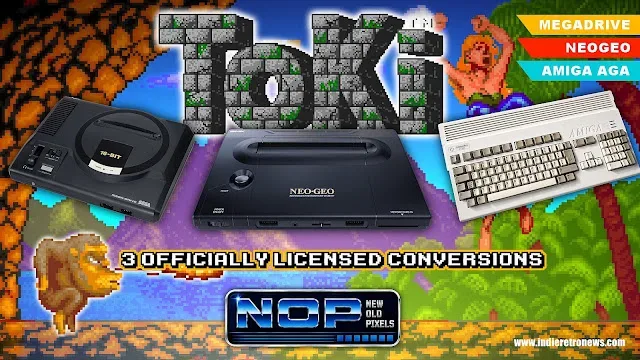
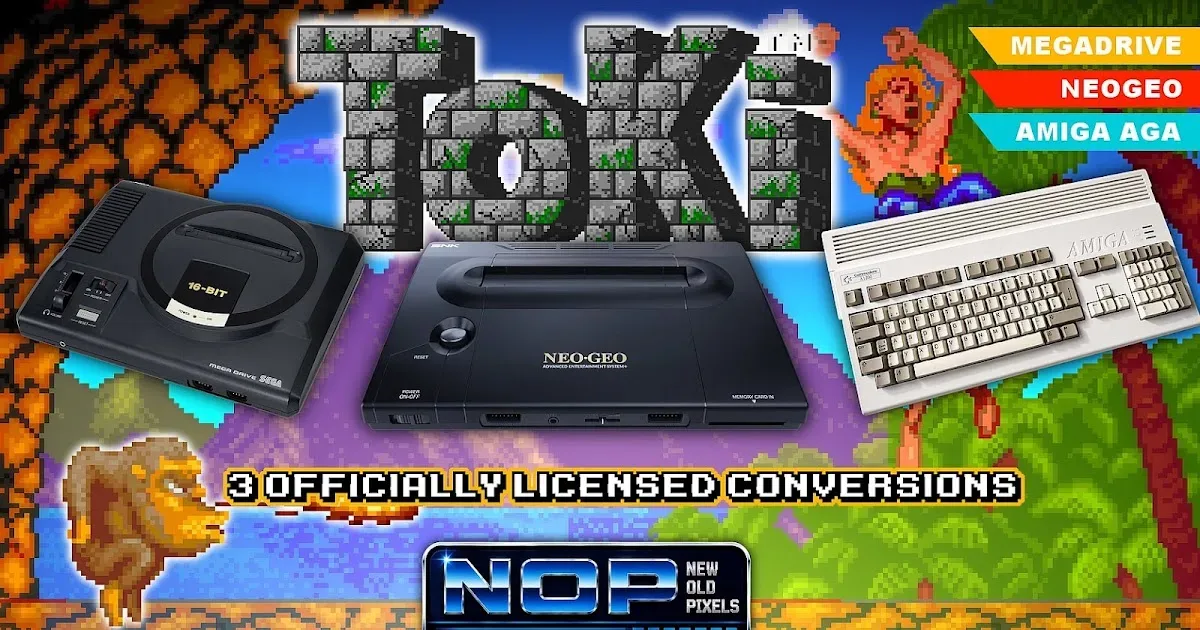
Toki, the classic arcade platformer from the late 1980s, is set to return to original-era hardware through a new series of licensed physical conversions. New Old Pixels has confirmed that separate editions are actively being developed for the Commodore Amiga AGA, Sega Mega Drive and SNK Neo Geo.
The project is built around an ambitious central promise: each release is intended to be a genuinely faithful conversion of the arcade game rather than a loose reinterpretation shaped primarily by the compromises of its target system. New Old Pixels holds an exclusive license to adapt and promote Toki across these three platforms, and says its work will focus on recreating the arcade experience while still taking advantage of the distinct strengths of each machine.
That makes these editions particularly interesting for retro players. Toki has appeared on home systems before, including machines represented in this new project, but the goal here is not simply to revisit those earlier adaptations. The developer and publisher wants to deliver versions that more closely reflect the original cabinet's gameplay, visual presentation, animation and music on hardware that many enthusiasts still play today.
Three Machines, One Arcade Target
The Amiga AGA, Mega Drive and Neo Geo could hardly be more different in their historical roles and technical identities. Yet each offers a compelling basis for an arcade-focused Toki release.
For useful background on this topic, read Moonstone AGA Project Brings a Human-Reviewed AI Remaster to the Amiga Cult Classic.
The Amiga AGA edition will target the enhanced graphics architecture associated with later Amiga systems. An AGA-based conversion has the potential to make use of the machine's richer colour capabilities while aiming to preserve the sharp character art and colourful stages associated with the arcade game. For Amiga collectors, the project is also notable because it is designed for original hardware rather than being positioned only as a modern digital release.
On Sega's Mega Drive, the challenge is different. The console remains one of the most popular platforms for new physical retro software, but its developers must work within a hardware profile that encourages careful technical choices. The new port is intended to prioritize arcade-style gameplay, fluid movement, graphics and sound while being tailored specifically to Sega's 16-bit machine.
The Neo Geo version is perhaps the most immediately fitting on paper. SNK's hardware has long been closely linked with arcade presentation, large character sprites and premium physical cartridges. That does not remove the work involved in an authentic conversion, however. The stated objective is still to match the original Toki arcade experience as closely as possible, rather than simply relying on the Neo Geo's arcade heritage as a shortcut.
Importantly, these are not being presented as one port moved mechanically from system to system. The team says each edition will be shaped around the capabilities of the hardware it is running on. The shared target is accuracy to the arcade game; the route to that target will vary by platform.
What Faithful Means for Toki
New Old Pixels has identified several areas it wants to preserve: the original gameplay, crisp graphics, smooth animation and the game's recognizable soundtrack. Those categories are central to why Toki is remembered as more than a standard run-and-jump platformer.
The game's arcade identity rests on its animated lead character, colourful environments and unusual combat hook. Its hero attacks enemies by spitting projectiles, lending the action a distinctive visual rhythm that sets it apart from more conventional platform games of its era. Any attempt at a close home conversion has to balance player control, enemy behaviour, projectile action, scrolling and audiovisual detail at the same time.
For a project such as this, fidelity is about more than reproducing stage layouts. The feel of movement, the timing of jumps, responsiveness during attacks and the clarity of on-screen action can all influence whether a conversion feels like the arcade original. Likewise, animation and music are not merely decorative. They contribute to the personality and pace that players associate with the cabinet.
The announcement does not yet lay out a technical feature-by-feature comparison between the three new releases and the original arcade version. It also does not detail what compromises, if any, may be necessary on particular systems. That is likely to become clearer once screenshots and gameplay footage are revealed. For now, the stated direction is clear: the project is pursuing an authentic arcade conversion standard, with platform-specific implementation rather than a single generic build.
Physical Releases for Original Hardware
All three versions are planned as complete physical editions intended to run on the corresponding original systems. In an era when retro releases are often available as ROM files, downloads or limited digital packages, that physical focus is a meaningful part of the announcement.
The editions are expected to pair the games themselves with collector-oriented presentation. New Old Pixels has said it is putting care into packaging that is meant to suit the status of a celebrated arcade title. Specific box contents, cartridge or disk formats, manuals, regional variations and edition tiers have not yet been announced, so collectors will need to wait for those details before deciding which release is right for their setup.
Making software for active retro hardware communities involves more than producing a playable game. Physical compatibility, reliable manufacturing and packaging all matter, especially when releases are meant to be used on machines that may be decades old. The commitment to original systems means these Toki editions are aimed squarely at players who still maintain their classic computers and consoles, as well as collectors who value a shelf-ready release.
It also gives each platform its own appeal. An Amiga owner may be drawn to seeing a more arcade-focused version on AGA hardware. Mega Drive fans may want to compare the new build with the console's prior history with Toki. Neo Geo collectors, meanwhile, will have an opportunity to consider how the title translates to a system famed for bringing arcade-style software into the home.
A New Look at Earlier Home Versions
Toki is not unfamiliar territory for either the Amiga or Mega Drive. Earlier versions on those platforms were already regarded as worthwhile in their own ways. That history raises the stakes for the new releases, because players will not evaluate them in a vacuum. They will naturally compare the updated conversions with the home editions they remember, as well as with the arcade game that remains the project's reference point.
The new undertaking therefore has an opportunity to be both a preservation effort and a technical reinterpretation. The developers are not changing the game into a modern remake or pursuing a newly imagined version of Toki. Instead, the aim is to revisit the question of what an arcade-accurate release could look like when built deliberately for these older platforms.
That distinction matters. Retro projects can take many forms: enhanced ports, remasters, fan revisions, demakes and entirely new sequels. This initiative is specifically centered on licensed conversions and on closing what New Old Pixels sees as a gap in the original hardware libraries. Its success will depend on how convincingly the finished versions capture the arcade game's immediate feel while respecting the individual character of the Amiga AGA, Mega Drive and Neo Geo.
Footage, Screenshots and Pre-Orders Still to Come
There is no release date yet for any of the three Toki editions. New Old Pixels has indicated that the production timeline is still developing, with further updates planned as work continues.
The next major details expected from the project are:
- Official screenshots from the Amiga AGA, Mega Drive and Neo Geo versions.
- Gameplay videos showing the conversions in motion.
- Production progress updates.
- Pre-order information for the physical editions.
Those reveals should provide the first substantial opportunity to judge how the three versions differ in practice. Still images will offer a look at visual fidelity and interface choices, but video will be especially important for a platformer whose appeal depends heavily on animation, scrolling, control response and action pacing.
Until then, the announcement is a promising one for arcade preservation enthusiasts and owners of classic hardware. A licensed, physical Toki release for three very different retro platforms is already a notable prospect. The stronger claim--that these will be the faithful arcade conversions many players have wanted--will ultimately be tested when the games are shown running and, later, when they reach original Amiga AGA, Mega Drive and Neo Geo systems.
Community
Discussion
Start the conversation.
No comments have been posted yet.