
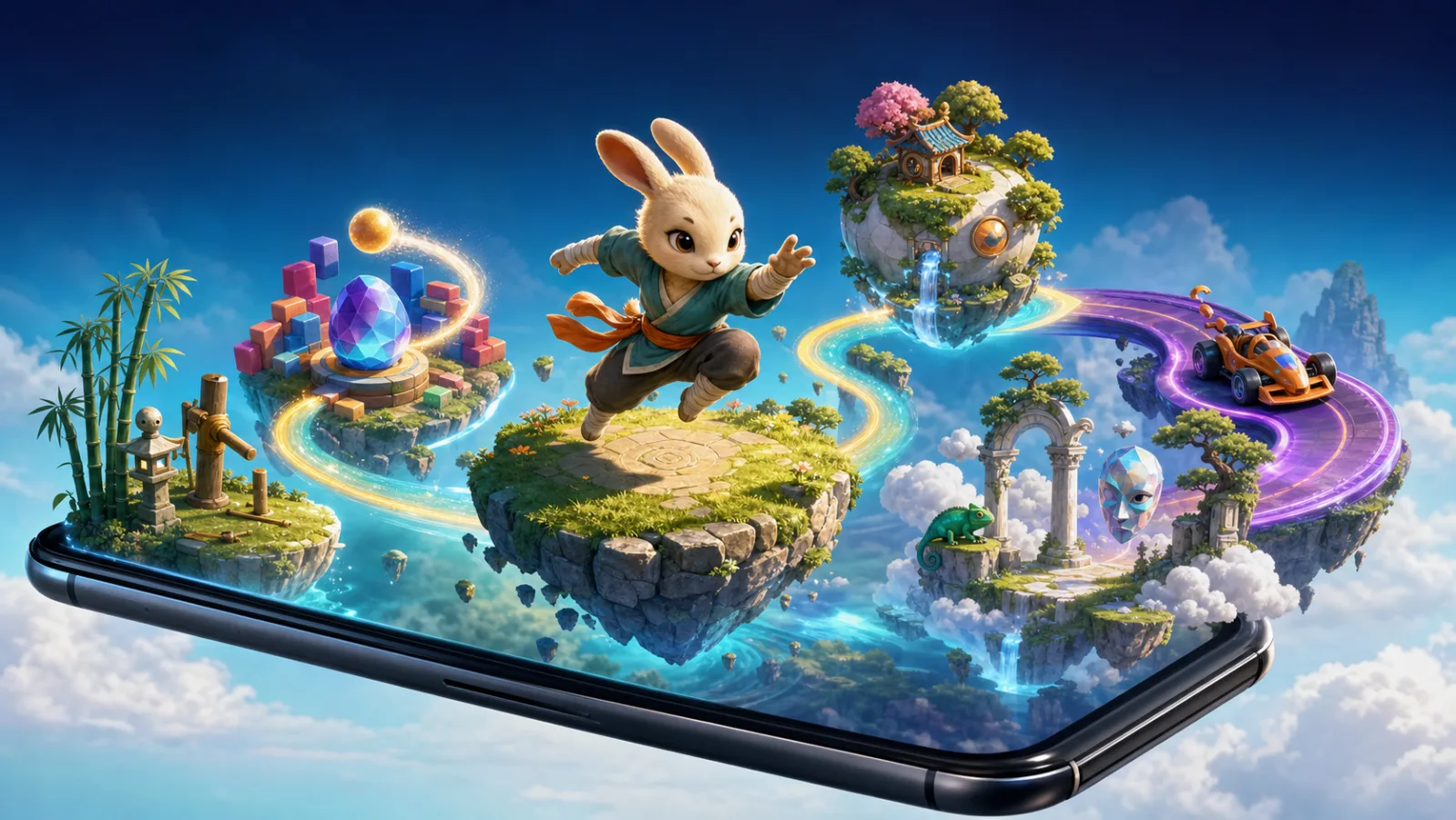
Mobile gaming is at its most interesting when a shortlist does not treat the phone as a single genre. A good mobile pick can be a slow, personal life simulator built around making a home. It can also be a precision platformer that asks for fast reactions, an arcade brick-breaker that turns every power-up into a gamble, or a compact racer made for chasing the checkered flag. The five games ranked here are connected by Android or iOS support, but they offer very different reasons to pay attention.
This is not a ranking based on review scores, price, current storefront status, or assumptions about how any version controls. Instead, it weighs the ideas each game brings to mobile players: the clarity of its hook, the range of its play, the strength of its identity, and the type of player most likely to enjoy it. One entry is a future release, while the others come from different eras of game design. That mix is useful. It means this list is as much about finding a play style as it is about finding a single all-purpose recommendation.
For players who want a simple starting point, Petit Planet is the pick to watch for relaxed creative play, Kung Fu Rabbit is the most direct choice for level-based action-platforming, and Krypton Egg is the strongest fit for old-school arcade volatility. The remaining entries are no less worthwhile; they simply speak more directly to players with a taste for character-driven retro racing or uncompromising platform-game challenge.
How these five mobile picks were ranked
"Best" means different things to different players, especially on mobile. Some people want a game they can return to for a few minutes at a time. Others want a substantial sequence of stages, puzzles, bosses, collectibles, or a world that rewards a longer-term routine. Because these games are so different, the ranking favors a blend of versatility and distinctiveness rather than pretending that a racing game and a life simulation can be measured by the same narrow standard.
- Mobile-friendly identity: Does the core concept make sense for players looking for a portable experience?
- Gameplay variety: Are there multiple systems, goals, or challenges beyond a single repeated action?
- Long-term appeal: Does the game offer a reason to keep learning, collecting, building, or improving?
- Audience fit: Is it easy to identify the player who will get the most out of it?
Platform history also matters. Several games here have roots outside phones and tablets, with versions across consoles, handhelds, computers, or older systems. That is a benefit for readers who enjoy seeing how a familiar game idea travels between formats. It is not a promise that every listed platform version is identical. The important point is that these are games with personalities strong enough to remain recognizable across generations of hardware.
5. Karateka
Best for: players who appreciate foundational action games, deliberate one-on-one combat, and a focused rescue story.
Karateka is the most historically rooted game on this list, but its premise remains immediately clear. A returning martial artist finds his village destroyed and his bride-to-be, Princess Mariko, taken by the warlord Akuma. With only karate available to him, he must battle through increasingly powerful warriors, enter Akuma's mountain fortress, and ultimately confront the warlord himself. There is no need for a complicated setup: the game is built around a determined advance through enemy territory.
Its place at number five is not a dismissal of its importance. It reflects how specialized its appeal is beside the more system-rich games above it. Karateka comes from an era in which a compact concept could carry an entire adventure. The focus is hand-to-hand conflict, escalating opposition, and forward momentum. Players looking for customization, a large collection loop, a home to decorate, or a broad selection of courses will find those desires better served elsewhere in this ranking.
What Karateka offers instead is concentration. The stakes are personal, the route is direct, and the martial-arts framing gives every encounter a clear dramatic purpose. That makes it a smart pick for someone curious about older action design or for a player who wants a game that does not bury its objective under layers of extra systems. The challenge is about overcoming a series of fighters and reaching the final confrontation, not about wandering through a sprawling world.
The game's wide platform history includes Android and iOS as well as Apple II, Atari systems, Commodore systems, DOS, Family Computer, MSX, PC-9800 Series, Amstrad CPC, Sinclair ZX Spectrum, and more. That breadth reinforces its status as a durable retro artifact. For mobile players, it is best approached with the right expectation: this is a classic, linear martial-arts journey whose value lies in its simplicity and its place in the action-game lineage.
4. Kid Chameleon
Best for: retro platform fans who want a high-stakes virtual-world premise and the satisfaction of clearing a demanding route.
Kid Chameleon turns a familiar arcade fantasy into the basis for a platform adventure. Casey enters a virtual-reality arcade game after its rogue boss, Heady Metal, begins kidnapping players who cannot complete it. Taking the name Kid Chameleon, he sets out to clear every level, defeat every boss, and save the missing kids before confronting the villain at the center of the game.
That premise gives Kid Chameleon a useful sense of urgency. It is not merely a mascot moving through abstract stages; it is a player character stepping into a dangerous game to beat it from the inside. For anyone who likes the old idea of arcade worlds with lives on the line, that framing still has appeal. The goal is uncompromisingly clear: complete the levels, overcome the bosses, and reach Heady Metal.
It ranks above Karateka because its platform structure suggests a broader adventure-shaped challenge. The stated task of clearing every level and each boss makes it the stronger choice for someone who wants a longer platforming commitment. At the same time, its 1992 origins mean prospective players should seek it for the character of a retro game rather than expecting modern convenience or an open-ended simulation. This is a direct, level-clearing experience with a virtual-reality arcade theme, not a gentle sightseeing tour.
Kid Chameleon is also a natural recommendation for players who value a game's original hardware identity. It was developed by Sega Technical Institute and published by Sega, with release platforms including Sega Genesis and Sega Mega Drive/Genesis alongside Android, iOS, Linux, Mac, PC, and Wii. The range of platforms makes it part of a larger retro ecosystem, while its mobile connection makes it relevant to players building a portable classics list.
Choose Kid Chameleon when you want the feeling of taking on an entire arcade challenge rather than dipping into a low-pressure pastime. It is for the player who sees a hard route and a final boss as an invitation, not a warning.
3. Konami Krazy Racers
Best for: players who want colorful, course-based racing with recognizable Konami characters and a clear race-to-the-finish structure.
Konami Krazy Racers earns the middle position because it provides the most immediate change of pace in this top five. Where the games below it lean into fighting or platforming, this is a racing game centered on reaching the checkered flag. It brings together eight classic Konami characters and sends them across 16 courses, including Cyber Field, Ice Paradise, Pop 'n Beach, and Skybridge.
The named courses matter because they establish a sense of variety before a race even begins. Cyber Field suggests a different mood from Ice Paradise, while Pop 'n Beach and Skybridge give the roster a set of distinct places to compete. That variety is essential to the appeal of a racing game with a compact course list: the objective stays understandable, but the scenery and track themes keep the journey from feeling like the same contest repeated without context.
The character selection is its other major draw. The roster includes Ninja from Metal Gear Solid, Dracula from Castlevania, and Goemon from Mystical Ninja. This makes Konami Krazy Racers a particularly appealing choice for players who enjoy seeing different corners of a publisher's history gathered into one game. It is not necessary to know every character to understand the race, but familiarity adds another layer of charm.
Released in 2001 and developed by KCEK, Konami Krazy Racers has a straightforward appeal that remains useful for mobile-minded players: select a character, learn the courses, and race for the flag. Its listed platforms include Game Boy Advance, iOS, and Wii U. The Game Boy Advance connection is especially fitting for a game whose course-based design and quick competitive premise align naturally with handheld gaming culture.
This is the pick for a player who would rather master a collection of tracks than solve platform puzzles or survive an arcade screen full of hazards. It may be lower than the top two because the supplied details emphasize a more focused racing package, but that focus is exactly why it belongs on the list. Konami Krazy Racers knows what it is: a character racer with 16 themed courses and a cast drawn from classic Konami properties.
2. Krypton Egg
Best for: arcade players who enjoy brick-breaking fundamentals, unpredictable power-ups, and sudden shifts into monster battles.
Krypton Egg begins with the recognizable language of Breakout-style arcade games: bounce a ball with a paddle, destroy every brick, and clear the level. That foundation is easy to grasp, but the game's appeal comes from how much chaos it layers over that simple goal. Bricks can contain random power-ups that alter the paddle, add balls, enlarge balls, provide paddle thrusters, or arm the paddle with weapons for shooting bricks.
Just as importantly, not every power-up is helpful. Krypton Egg makes its item system a source of tension rather than a guaranteed reward. A player cannot treat every falling bonus as an automatic advantage. That small design decision creates a more alert style of arcade play. The screen can change quickly, and a good run depends on reacting to the state of the ball, paddle, bricks, and incoming item effects rather than simply collecting everything in sight.
The game goes further by adding monsters to the playfield. These enemies can interfere with the ball or destroy the paddle on contact, turning a basic brick-clearing stage into something closer to a moving hazard course. Every few levels, Krypton Egg also shifts into special action sequences in which players defend against incoming monsters or fight a boss while avoiding missiles. Those sequences give it a broader identity than a purely traditional paddle-and-brick game.
This mixture of action, arcade, puzzle, and shooter elements explains why Krypton Egg sits so high in the ranking. It has a clean core loop, but it does not remain trapped by it. Players can enjoy the satisfaction of breaking bricks while also dealing with random power-ups, threats on the field, and boss-focused interruptions. It is the list's best choice for someone who wants moment-to-moment unpredictability without needing a large narrative framework.
Originally released in 1988, Krypton Egg was developed by Hitsoft and published by Hitech Productions and HitSoft. Its platform list includes iOS, legacy mobile devices, Windows Mobile, Windows Phone, Amiga, Atari ST, DOS, Mac, and PC. That history places it firmly in the tradition of computer and arcade-style action, making it an excellent radar pick for players who enjoy mechanics-first games that remain engaging because every screen can go wrong in a new way.
1. Petit Planet
Best for: players who want a cozy, creative game to follow, especially those drawn to home-building, community life, and cross-platform play.
Petit Planet takes the top spot because it has the broadest long-term lifestyle premise of the five games. Described as a cosmic life simulation game, it centers on building a home, sharing a planet with fuzzy neighbors, and exploring the possibilities of everyday life in a cosmic setting. Rather than asking players to defeat a single final boss, win a sequence of races, or perfect a single mechanical skill, it points toward a more personal kind of play: shaping a place and participating in a community.
That is an especially strong fit for a mobile radar list. Home-building and everyday discovery are concepts that can support both brief check-ins and longer sessions, depending on how a player wants to engage with their planet. The appeal is not simply the space setting. It is the combination of cosmic scale with small-scale domestic goals. A planet may sound vast, but the stated focus on a home and fuzzy neighbors gives the game an intentionally intimate center.
Petit Planet is categorized as adventure, role-playing, and simulator, a combination that suggests it is not being defined by one activity alone. The known pillars are clear: build, share, and discover. For players exhausted by constant competition, that makes it the most inviting option in this ranking. For players who enjoy creative ownership, its planet-based setting offers a compelling frame for making a space feel like their own.
It is important to set expectations accurately. Petit Planet is listed as free-to-play, designed as a cross-platform experience for Android, iOS, and PC, with a release date of December 31, 2026. That makes it a game to keep on the radar rather than one to treat as an established option today. Its number-one placement is therefore about potential and fit, not a claim that it is already available or that its final structure is known beyond the supplied overview.
Even with that caveat, it is the most future-facing recommendation here. Players who want their mobile games to feel like places rather than tests will likely find its concept the most appealing. Petit Planet is for the builder, the decorator, the community-minded player, and anyone who likes the thought of turning a small cosmic corner into a home.
Which of these five should you keep on your radar?
The right choice depends less on the ranking number than on the feeling you want from a game. Pick Petit Planet if building a home and meeting fuzzy neighbors sounds more appealing than competing under pressure, and if you are comfortable following a title planned for 2026. Choose Krypton Egg if you want arcade action with power-ups that can help or hurt, plus the surprise of monsters, missiles, and bosses. Go with Konami Krazy Racers if themed courses and a cast of classic Konami characters are your route to a satisfying portable race.
If platforming is the priority, the decision is more specific. Kid Chameleon is for players who want an extended retro quest through a dangerous virtual-reality game, complete with levels and bosses standing between Casey and Heady Metal. Karateka is for those who want a concentrated martial-arts challenge: one fighter moving through Akuma's forces toward a final hand-to-hand confrontation.
Together, these games show why a mobile category can hold so many different kinds of experiences. It can preserve the immediacy of arcade design, carry the focused structure of classic platformers and racers, or point toward a gentler cross-platform social simulator. Keep the one that matches your habits on your radar, but do not overlook the others. A player who wants a calm building project today may want a demanding boss battle tomorrow, and a good mobile library leaves room for both.
Community
Discussion
Start the conversation.
No comments have been posted yet.