

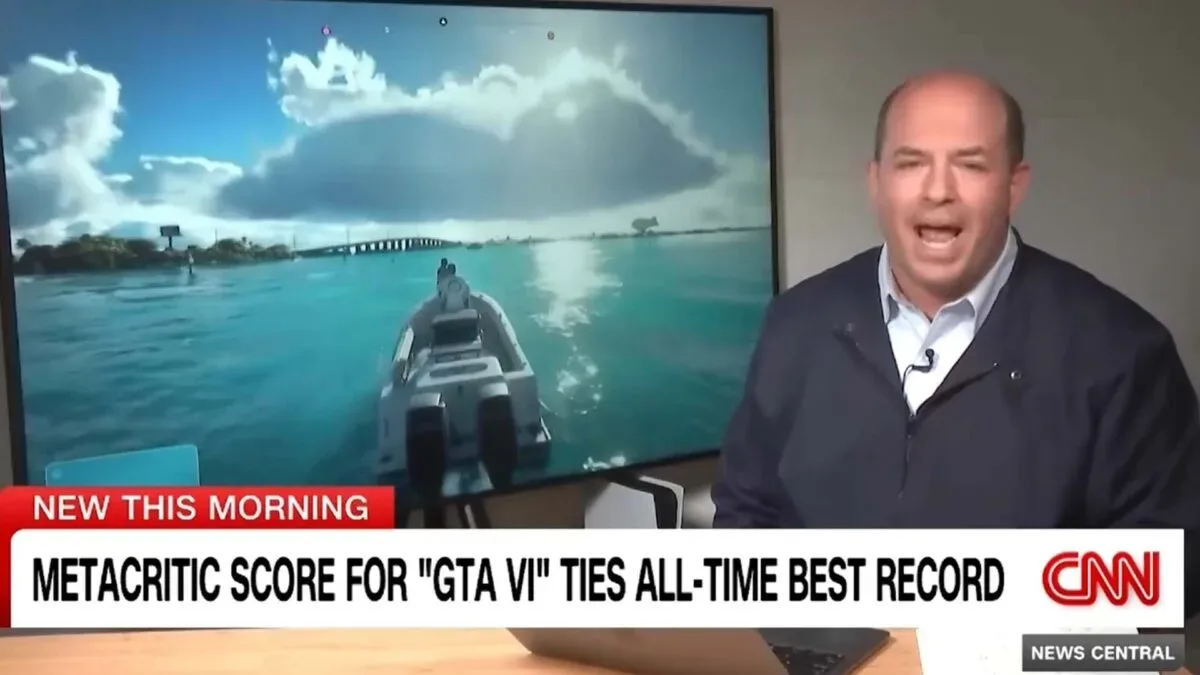
A televised discussion of Grand Theft Auto 6 has drawn widespread criticism after one commentator attempted to make the game accessible to non-gamers by likening it to an especially intense version of Pac-Man. The comparison was delivered during a segment addressing the newly launched Rockstar Games release and has since become a talking point among players, observers, and people frustrated by the way video games are still introduced to broad television audiences.
The line of explanation was simple: viewers unfamiliar with games were invited to imagine Pac-Man, but with chasing, being chased, and highly realistic visuals. It may have been intended as a quick metaphor for an audience that does not follow game releases. Instead, many viewers felt it reduced one of the industry's biggest modern releases to a decades-old arcade reference that says little about what Grand Theft Auto is, why the series is culturally prominent, or how contemporary open-world games actually play.
The response has been especially sharp because GTA 6 is not an obscure new property that needs an elementary introduction. Grand Theft Auto is one of the most recognizable names in entertainment, with a long history of blockbuster releases, controversy, critical discussion, and enormous public visibility. Even people who have never played an entry are often aware of its basic identity: crime-focused open worlds, vehicles, cities to explore, missions, action, and the freedom to cause chaos outside of the main story.
That common understanding does not mean every viewer should be expected to know the details of GTA 6. But the Pac-Man shorthand exposed a familiar problem. When games receive major attention outside enthusiast spaces, coverage can sometimes rely on comparisons that are old, overly broad, or plainly inaccurate. That approach may be meant to bridge a knowledge gap, yet it can leave the impression that games remain a novelty rather than a medium with its own history, genres, vocabulary, and audience.
For useful background on this topic, read GTA 6 Prompts US Police Departments to Tell Players to Keep Crime in the Game.
Why the Pac-Man comparison landed so poorly
At the most basic level, Pac-Man and Grand Theft Auto have very little in common beyond movement through spaces while avoiding or pursuing other characters. Pac-Man is an arcade maze game built around collecting dots, managing routes, and evading ghosts. Its rules are immediate and tightly contained. Grand Theft Auto 6, by contrast, is a large-scale open-world game in a series known for driving, exploration, story missions, satire, combat, systemic mayhem, and player-led detours.
Describing a game through its most abstract possible verb can make almost anything sound alike. By that standard, a stealth game could be described as hide-and-seek, a racing game as a very fast trip to the store, or a role-playing game as a complicated board game. Those comparisons are not necessarily useless in a casual conversation, but they become inadequate when they are presented as the main explanation for a major work.
The issue is not that Pac-Man is unimportant. Quite the opposite: it is one of the defining games in the history of the medium, instantly recognizable across generations and a reasonable cultural reference point in the right context. The frustration comes from treating it as the default frame through which a modern game must be understood. It suggests that the easiest available language for discussing games remains rooted in the arcade era, regardless of how much design, technology, and audience expectations have changed.
It also misses the features that make Grand Theft Auto distinctive. A more useful brief description could mention that GTA 6 is an open-world crime game set in a detailed fictional environment, where players take part in narrative missions while also being free to drive, explore, interact with the world, and attract police attention through their actions. That is not an exhaustive breakdown, but it establishes the genre, the setting, the gameplay structure, and the series' basic premise without asking viewers to map everything onto an unrelated arcade classic.
A major release deserves more precise language
Grand Theft Auto is an unusually large target for generalized coverage because it exists at the intersection of games, popular culture, technology, business, and public debate. New installments do not arrive as routine releases. They create anticipation on a scale that reaches far beyond committed players, and they inspire discussion about production, online communities, content, sales expectations, and the influence of interactive entertainment.
That makes precision more important, not less. A television segment does not need to become a detailed review or a lengthy game-design lecture. It does, however, benefit from acknowledging what it is discussing. If a news program can quickly explain the premise of a major television drama, a superhero film, or a music release in language that respects the audience's intelligence, the same standard should apply to a video game.
For decades, games coverage aimed at non-players often leaned on a small collection of reference points: Pac-Man, Space Invaders, Mario, or the idea of children gathered around an arcade cabinet. Those images can provide useful historical context, but they no longer describe the full shape of the medium. They certainly do not capture the experience of playing a contemporary blockbuster designed around a massive virtual setting, cinematic presentation, player agency, and ongoing cultural discussion.
Games are now discussed through adaptations, streaming, esports, fan communities, hardware, soundtracks, and celebrity performances. Recent years have also seen game adaptations become major television and film events, including projects based on The Last of Us and Fallout. These successes have helped expose more people to game worlds and characters, but they have not entirely eliminated the tendency to speak about the games themselves as if they need to be translated from an unfamiliar hobby.
The broader problem is not expertise
Criticism of the segment does not mean every broadcaster, anchor, or commentator must be a dedicated player. Nobody should need encyclopedic knowledge of game mechanics to cover a major cultural event. The same is true of movies, sports, books, fashion, or any other field: general-interest journalists often cover subjects outside their personal specialties.
The expectation is more modest. Broad coverage should avoid clichés that flatten the subject being discussed. It should use a basic level of preparation, recognize the difference between historical references and accurate descriptions, and seek language that gives newcomers a real foothold. A person does not need to play dozens of hours of Grand Theft Auto to understand that it is not meaningfully explained by calling it Pac-Man with advanced graphics.
There is also a difference between saying, "This game includes pursuits, so it may remind some viewers of the tension of being chased in an arcade game," and presenting Pac-Man as the central analogy. The former identifies one small sensation. The latter risks defining the whole experience through a comparison that leaves out the game's world, structure, themes, and identity.
For longtime players, reactions to moments like this are often shaped by a larger history. Gaming has grown into a vast entertainment business and a central part of global culture, yet some mainstream conversations still default to language that feels decades behind the audience. The irritation is less about one awkward sentence than about the recurring sense that games are treated as an exception: something important enough to cover when it becomes impossible to ignore, but not important enough to describe with care.
How to explain GTA 6 to someone who does not play games
There are several clearer ways to introduce GTA 6 without assuming prior knowledge. A short explanation could call it a blockbuster open-world action game. Another could describe it as an interactive crime story set in a large fictional city and surrounding region, where players can follow a main narrative or spend time freely exploring the environment. Both descriptions communicate more than the Pac-Man comparison while remaining understandable to a broad audience.
Depending on the context, it could also be useful to explain why the release matters. Grand Theft Auto is a long-running series whose entries are known for exceptionally detailed worlds, ambitious scope, and immense mainstream interest. That tells viewers why a news program is discussing the game at all. It places GTA 6 within a franchise legacy instead of reducing it to a vague exercise in pursuit.
There is room for criticism, caution, and debate in that description as well. Grand Theft Auto has always been associated with mature material and provocative satire, and coverage can address those elements directly if they are relevant to the discussion. Clear language does not require promotional language. It simply requires acknowledging the actual work rather than treating video games as interchangeable variations on an old arcade template.
An awkward metaphor, and a useful reminder
The Pac-Man remark will likely be remembered as an amusingly clumsy television moment, particularly because it was attached to a game as widely recognized as GTA 6. But it has also renewed a worthwhile conversation about media literacy around games. As games continue to command attention across entertainment and culture, the quality of the language used to discuss them matters.
Pac-Man deserves recognition as a foundational classic. Grand Theft Auto 6 deserves to be described as the kind of game it is. Those two ideas are not in conflict. The problem begins when the history of games is used as a shortcut that prevents a modern release from being understood on its own terms.
For viewers who do not play, a good explanation should open the door. For players, it should demonstrate that the person doing the explaining has met the subject halfway. In the case of GTA 6, that means moving beyond ghosts, mazes, and arcade metaphors--and recognizing one of gaming's largest franchises as a complex, contemporary cultural event.
Community
Discussion
Start the conversation.
No comments have been posted yet.