

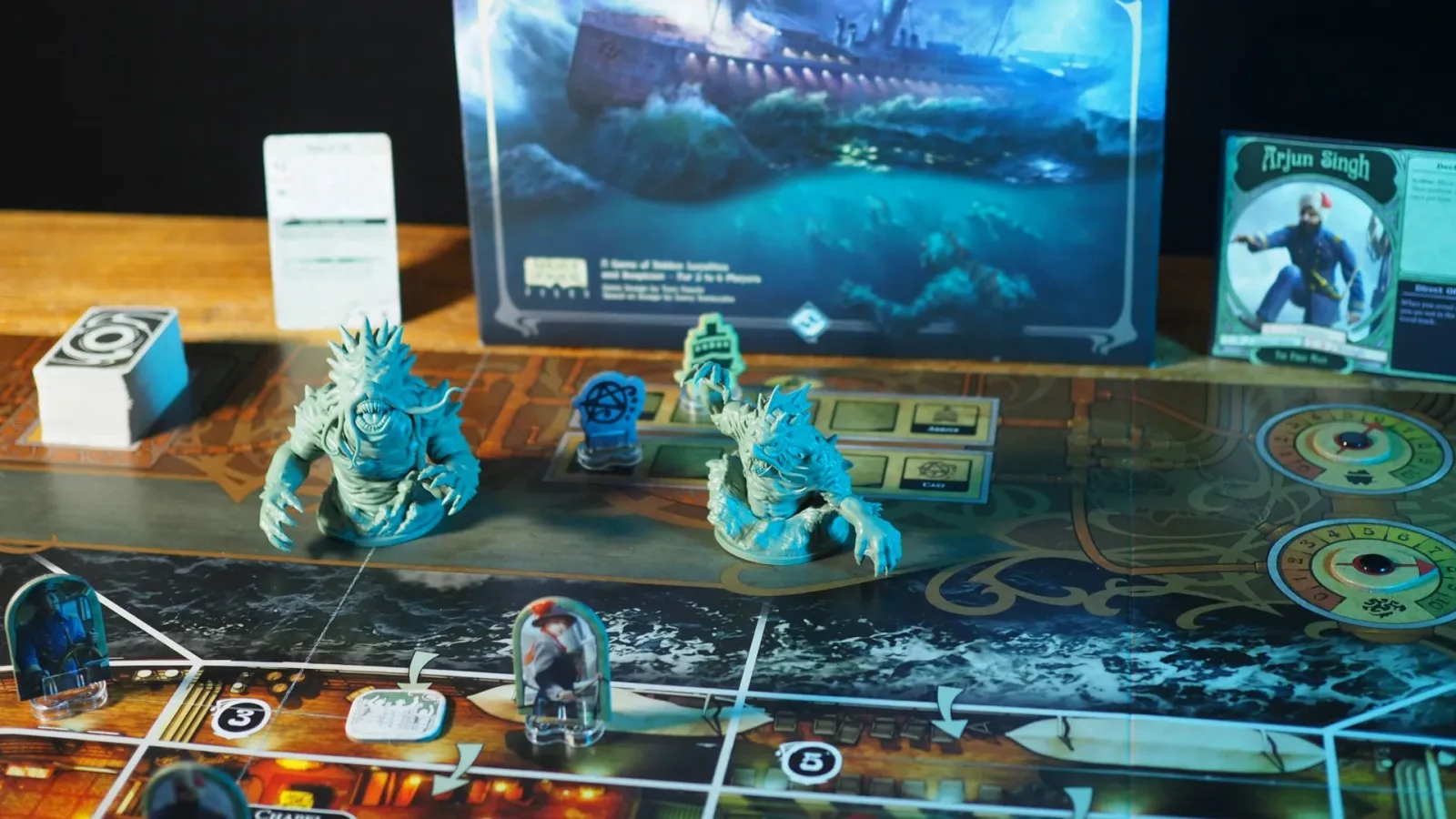
There are plenty of board games built around monsters, haunted houses, ancient gods, and the familiar promise that something with too many teeth is about to ruin everyone's evening. Unfathomable understands that those threats are only part of what makes horror memorable. The truly frightening possibility is sitting across the table: the person helping patch the ship's hull, offering advice during a crisis, and calmly insisting they are on the team might be working to make sure nobody reaches shore.
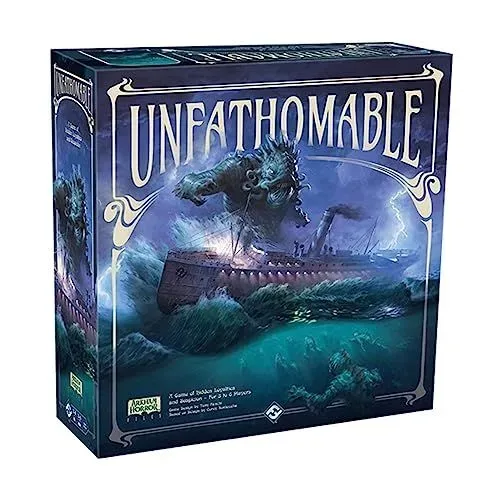
That tension is at the center of Fantasy Flight Games' 1920s-set nautical horror game. Designed for three to six players and generally lasting between two and four hours, Unfathomable is a large, demanding experience. It asks the group to manage invading creatures, dwindling supplies, damage across a steamship, dangerous events, and the pressure of reaching safety. At the same time, it plants uncertainty in every decision, because one or more players may secretly be Deep One hybrids waiting for the right moment to sabotage the voyage.
The result is not simply a cooperative monster-fighting game with a traitor bolted on. Its central systems make cooperation itself suspect. A setback may genuinely be bad luck. It may be caused by a player who lacked the cards needed to help. Or it may be the work of somebody whose public concern for the ship is a carefully maintained performance. Unfathomable gets its horror not only from the ocean outside the vessel, but from the slow realization that consensus around the table may be impossible.
A voyage that gets worse by the turn
Unfathomable transports players to the Prohibition-era 1920s. The setting begins with a passenger ship traveling across the ocean, a premise that initially suggests comfort, glamour, and distance from the chaos of life on land. That mood disappears quickly. A few days after departure, storms gather, the sea becomes increasingly unnatural, and grotesque creatures begin emerging from the water to board the ship. Somewhere in the darkness is a far larger presence, barely visible but clearly responsible for the catastrophe closing in around the passengers.
For useful background on this topic, read AYN Odin 3 Portal Pre-Orders Open for 7-Inch OLED Android Handheld.
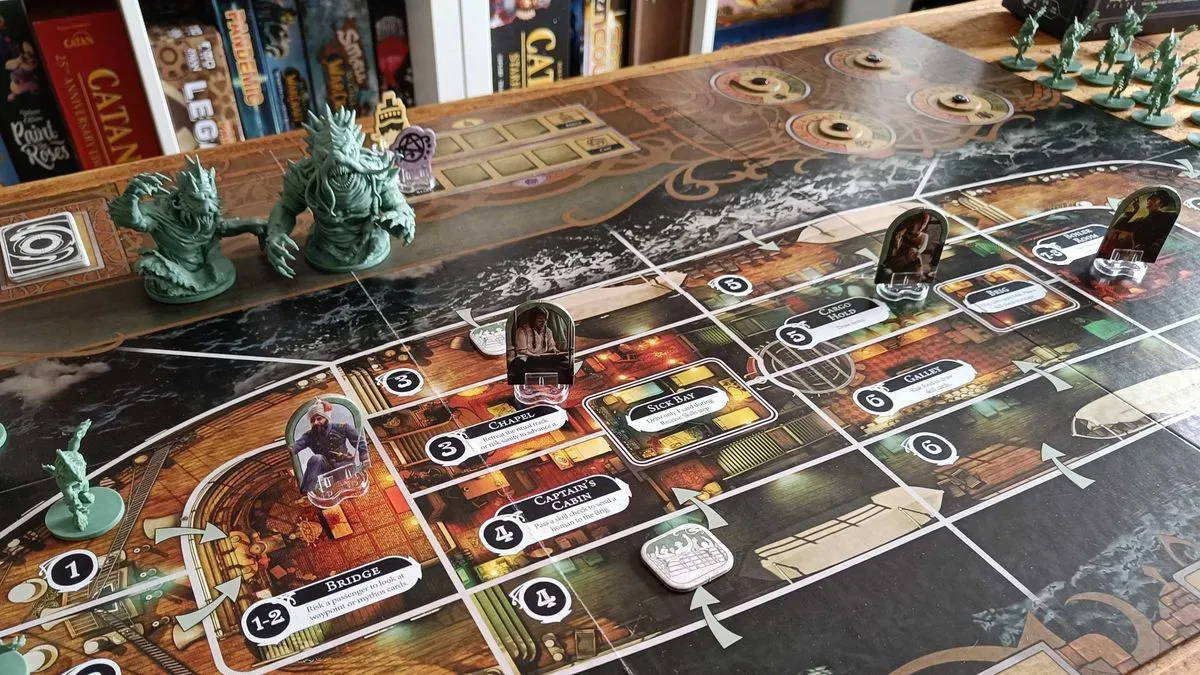
From there, the group's broad objective is simple to explain and difficult to achieve: keep the ship alive long enough to escape. Deep Ones climb aboard, damage needs repairing, resources are threatened, and the crew cannot merely eliminate every creature and relax. More enemies are always ready to rise from the depths. The game creates a sense of attrition, with players making difficult choices about where to act, what threat can be left unattended, and how much risk they can tolerate before the entire situation becomes unrecoverable.
This framework would already make for a compelling survival game. A ship is an especially effective setting for this kind of pressure because there is no real retreat. Every room matters, every breach feels immediate, and every lost resource is a reminder that the group is trapped in the middle of an ocean that has become hostile. But Unfathomable's best idea is that the players cannot be certain the group is actually trying to solve the same problem.
The crisis deck creates suspicion without easy proof
The game's defining moments come through event cards that introduce developments, emergencies, and dilemmas the players must overcome. When a crisis appears, players contribute cards in an effort to hit a required total. In a normal cooperative game, this would be a straightforward exercise in pooling the right resources. Here, however, contributions are hidden and shuffled before the result is revealed.
Loyal players are expected to add positive values to help the group pass the test. Secret traitors can place negative cards into the same pile, quietly dragging the effort down. Since the cards are mixed, failure does not reveal who made it happen. Even success can leave questions hanging in the air. Did everyone help? Did someone try to sabotage the check but get outweighed? Did a player withhold useful cards so they would seem less suspicious later?
This is where Unfathomable earns its reputation as a game of paranoia. There is no convenient scene in which a traitor walks away from the table to break an engine. Sabotage is embedded in routine cooperation. A player can make a reasonable argument, contribute unseen cards, and then watch a crisis fail alongside everybody else. The act is subtle enough that accusations need to be built from behavior, probabilities, previous decisions, and the all-important confidence with which somebody explains why they could not help.
That structure gives every player a role in shaping the drama. Loyal players must decide when to trust, when to challenge a suspicious decision, and when an accusation is likely to do more damage than the alleged sabotage. Deep One hybrids have an equally interesting task: causing enough harm to move the game toward disaster while avoiding the kind of obvious interference that turns the whole table against them. A good traitor does not need to look malicious. They need to look useful.
Cooperation becomes a performance
Hidden-traitor games often succeed or fail on whether they give players meaningful reasons to doubt each other. Unfathomable has plenty. Because the ship faces multiple pressures at once, there are rarely perfect actions. One player may focus on fighting Deep Ones while another prioritizes repairs. Someone may spend valuable cards now rather than saving them for a future crisis. Another may argue that resources should be protected even if the choice leaves a section of the ship vulnerable.
Those decisions have legitimate strategic trade-offs, which is crucial. If every questionable move were clearly irrational, identifying a saboteur would be trivial. Instead, the game lets players interpret the same decision in several ways. Was that choice a mistake? Was it selfish? Was it the only realistic option? Or was it a deliberate attempt to create a loss while maintaining plausible deniability?
The social element is therefore not a break from the board-game systems; it is inseparable from them. Discussions around a crisis are about numbers, cards, timing, and resources, but they are also about trust. A player's explanations become evidence. Their sudden certainty, their reluctance to commit, or their habit of pushing a risky plan can all become part of the case against them. For groups that enjoy reading one another and debating motives, this makes even quiet turns feel charged.
In Unfathomable, the most alarming question is often not whether the ship can survive the next disaster, but whether the people assigned to save it want it to survive at all.
A substantial horror game, not a quick party diversion
Its two-to-four-hour playtime makes clear that Unfathomable is built for a dedicated game night rather than a fast, lightweight round. The length also serves its atmosphere. Suspicion has time to develop gradually, loyalties can be tested by repeated crises, and a player who appears trustworthy early on may become the center of attention much later. The game's narrative emerges from the sequence of disasters and arguments rather than from a single reveal.
That commitment will not suit every table. Players looking for a brief social-deduction game may find the larger rule set and extended running time intimidating. A group needs to be prepared to track the state of the ship, manage a steady flow of threats, and remain engaged even when the spotlight is elsewhere. It is also best with people comfortable with suspicion and debate staying within the game. The design invites accusations, but its most memorable sessions are likely to come from groups that can enjoy the performance without treating it as a personal conflict.
For the right audience, though, the scope is a major strength. The game does not use its Lovecraftian setting merely as decoration for a deduction exercise. The mounting pressure from the sea gives players a reason to make hard choices, while the traitor system turns those choices into potential flashpoints. Killing monsters is satisfying, but it never fully solves the problem. Passing a crisis may offer relief, yet it can also lead to a new wave of questions about who contributed what.
Why it fits the Halloween table
Unfathomable is particularly well suited to seasonal horror sessions because it provides more than surface-level spooky imagery. Its creatures, storms, and unknowable force beneath the water establish the mood, but the real hook is the dread of compromised teamwork. The game captures the feeling of being cornered in a disaster where every resource is limited and every ally might have a private agenda.
That combination also makes it a strong choice for players who want horror with active participation rather than passive storytelling. Nobody is simply waiting for the next frightening reveal. Players must defend the vessel, repair the damage, contribute to the group's crises, make their case, and decide whom to believe. The game's tension comes from the fact that every contribution can matter, while nobody can fully verify where that contribution came from.
Unfathomable can carry a higher full-price cost, though it has often appeared with discounts. Its scale, component-heavy premise, and lengthy sessions mean it is best approached as a game a regular group will revisit rather than an impulse purchase for one October evening. For players who enjoy strategic cooperation, theatrical bluffing, and horror that turns friendly conversation into evidence, it offers a potent mix.
On this ship, the Deep Ones are dangerous, the storms are unforgiving, and the unseen titan in the water is an ever-present nightmare. Yet the person calmly telling everyone that they did their best on the last crisis may be the threat that matters most.
Community
Discussion
Start the conversation.
No comments have been posted yet.