

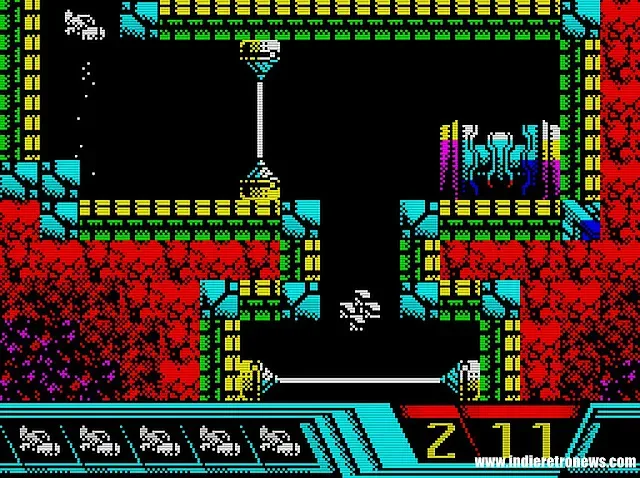
Vallation, Sokurah's ZX Spectrum action shooter inspired by Cybernoid, has received a further-updated 128K edition. Originally released in 2016, the game puts players in the cockpit of a small spacecraft attempting to break free from a hostile pirate planet, but this version is positioned as a substantial revision rather than a minor compatibility update.
The expanded release builds on feedback from the game's community with reworked mechanics, a larger visual set, dramatically increased enemy variety, dedicated ZX Spectrum 128K audio, Kempston joystick support and a high-score table. Its biggest addition is a fifth stage designed as a wide, non-linear maze. Across the whole adventure, Vallation now contains 150 screens.
That screen count is notable for a game rooted in the Spectrum's compact, immediate arcade-action tradition. The main campaign comprises 101 screens over four levels, while the newly emphasized final area contributes a further 49. Rather than simply offering one last linear combat stretch, the fifth level asks the player to explore branching routes, locate key items and ultimately open the path to the escape teleporter.
A desperate flight through a pirate fortress
Vallation's premise is straightforward in the best old-school sense: get out alive. The player pilots a nimble ship through an enemy installation on a pirate-controlled world, searching for an escape while the complex attempts to destroy them. The setting is outer space, but the level design is less about open cosmic travel than dangerous rooms and corridors packed into a hostile mechanical labyrinth.
For useful background on this topic, read Cat Simulator 64 Brings Cozy Feline Mischief to Commodore 64.
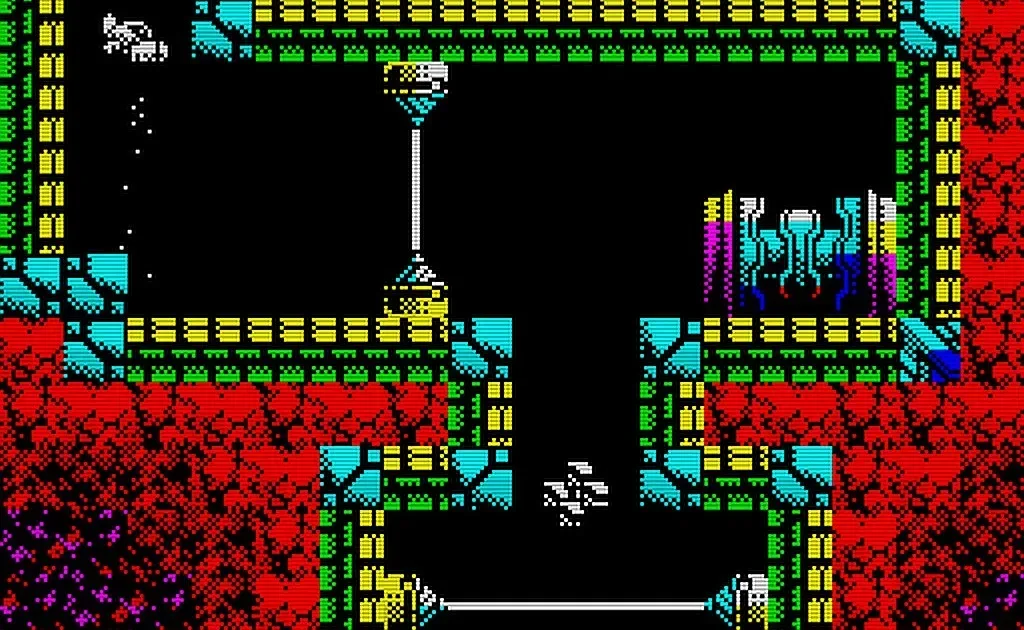
The immediate comparison is Cybernoid, the celebrated run-and-gun shooter whose influence is explicitly central to Vallation's identity. Like that classic, Vallation revolves around careful movement through densely defended areas where threats can arrive from several directions and momentum can become a liability. Laser barriers obstruct routes, enemy fire has to be avoided, and indestructible missiles make it dangerous to linger or assume every hazard can be eliminated.
That structure creates a very different rhythm from a conventional scrolling shooter. Success is not solely about keeping a constant stream of bullets on screen. Players need to learn the shape of each area, recognize where threats emerge, choose when to push forward and avoid trapping the ship in a bad position. The escape fantasy may be simple, but the route outward is deliberately unforgiving.
More than a basic 128K conversion
The 128K edition is described as an expanded overhaul developed in response to player feedback. Among the clearest changes is the amount of artwork available to the game. Vallation now has twice the number of visual tiles, giving Sokurah more material with which to construct the enemy complex and distinguish its locations.
Enemy variety has also been increased threefold across the levels. For an arcade game built around repeated encounters, that can be a meaningful change. More enemy types can alter the visual character of individual rooms, but they also help prevent the challenge from becoming too predictable. A player who has learned how to deal with one pattern may need to reassess their approach when a different foe, projectile behavior or room arrangement appears.
Sokurah has also rewritten the game's mechanics. The update includes more attractive projectile visuals and enemies that are easier to defeat. Those adjustments suggest an effort to preserve Vallation's pressure while making combat read more clearly and feel less punishing. In a game where lasers, incoming fire and unkillable missiles are all competing for the player's attention, clarity is not merely cosmetic; it can be crucial to understanding what happened during a tight encounter.
The addition of a high-score table is another appropriately arcade-minded touch. Completion remains the obvious long-term objective, but score tracking gives returning players another target and encourages cleaner, more confident runs. It is the sort of feature that fits a Spectrum shooter especially well, extending the appeal beyond a single successful escape.
Dedicated sound and classic control support
As a Spectrum 128K-focused release, Vallation also includes dedicated 128K audio. The machine's expanded audio capabilities remain a major reason that 128K editions can feel distinct from their 48K counterparts, particularly in games that rely on sustained atmosphere between bursts of action. A hostile space complex benefits from music and sound that can reinforce its pressure without reducing the importance of responsive play.
Kempston joystick support arrives alongside the audio improvements. For players with compatible hardware or modern setups configured around that interface, it provides a familiar control option for this style of Spectrum action game. Keyboard play remains a defining part of the platform's history, but joystick compatibility is welcome in a fast title that asks for precise dodging and rapid course corrections.
These details underline the difference between simply making a game run in a particular Spectrum configuration and designing a version that takes advantage of it. The 128K label here is tied to new presentation and control features as well as the much larger game structure.
The fifth level changes the shape of the adventure
The new fifth level is Vallation's most ambitious structural feature. Its 49 screens bring the total from the core game's 101 to 150, but its importance is not only numerical. It is non-linear, with multiple paths and essential pickups distributed around the maze. Players must locate those items before the final escape teleporter can be unlocked.
The design has been compared to Sabre Wulf transported into space. That is a useful description because it emphasizes exploration and route knowledge over a simple march from left to right or room one to room two. The player is not merely surviving whatever appears next; they are building an understanding of a connected environment and working out which branches contain progress.
For Vallation, this makes the conclusion feel like an escape operation rather than only a final sequence of difficult enemy rooms. The ship is navigating a place that must be understood. A route that looks promising may not contain the item currently needed, and a useful pickup may require returning through spaces that have already proven dangerous. The final teleporter becomes a genuine objective to earn, not just a finish line encountered automatically.
It also gives the game a different kind of replay value. Early attempts can be about mapping the space and learning where vital objects are hidden. Later runs can focus on moving more efficiently, reducing mistakes and developing a more reliable route through the maze. In a compact 8-bit format, that kind of non-linear endgame can add considerable longevity.
A continued evolution of a 2016 Spectrum game
Vallation's enhanced edition had appeared previously on Sokurah's main site, but the version now available through itch.io has been further updated. That continuing work is fitting for a project shaped by community response: the game has not been treated as a fixed artifact from 2016, but as a Spectrum release that can still be refined, enlarged and rebalanced.
For retro players, it is also a reminder that new software for the ZX Spectrum is not limited to deliberately tiny experiments or nostalgia-only recreations. Vallation embraces a recognizable 8-bit action-game lineage, yet it aims to expand on that foundation with a sizeable screen count, a broad enemy roster, updated mechanics and an exploration-driven final level.
Fans of demanding shooters, maze-like action design and Spectrum homebrew with a distinctly arcade sensibility will likely find the revised Vallation worth investigating. Its premise remains direct: survive a pirate planet's defenses and escape. The updated 128K version makes that journey longer, more varied and more elaborate, while retaining the tense room-by-room danger that defines its Cybernoid-style core.
Community
Discussion
Start the conversation.
No comments have been posted yet.