

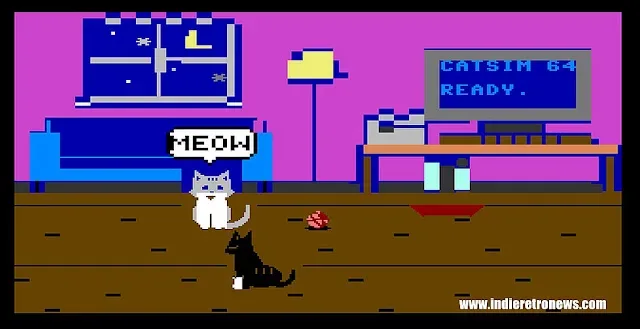
Cat Simulator 64 is inviting Commodore 64 owners to trade heroic quests, high scores and interstellar battles for a much quieter kind of adventure: being a cat in a comfortable living room. Developed by illobo, also known as netmilk, with assistance from Claude AI, the new family-friendly C64 title puts players in control of an adorable black cat with distinctive white socks.
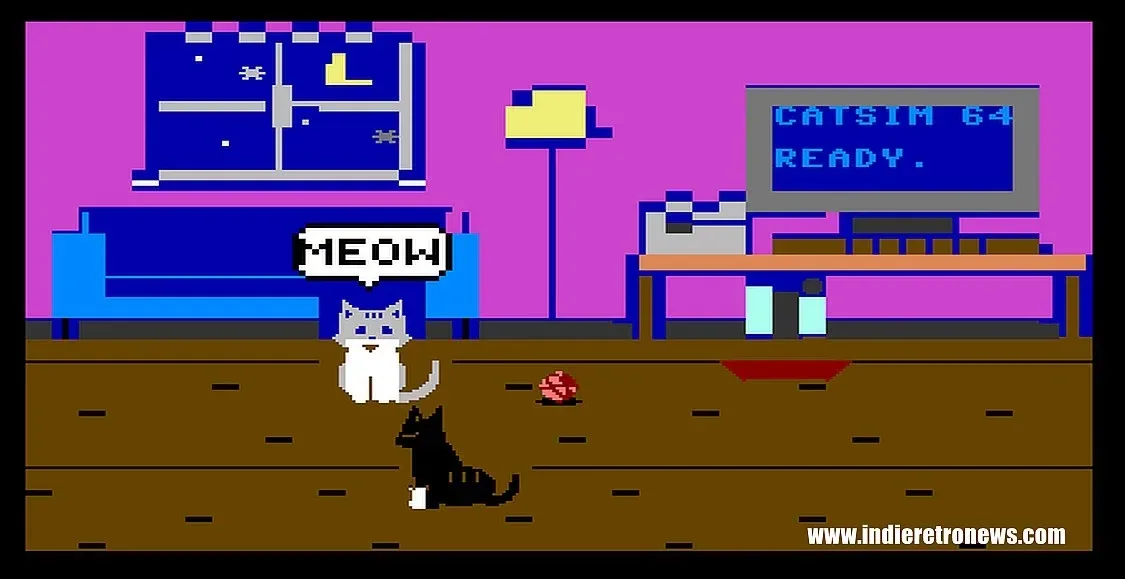
The premise is intentionally modest, and that appears to be the charm. Rather than sending its feline lead across sprawling stages or filling the screen with demanding objectives, Cat Simulator 64 focuses on familiar cat behavior inside a single warm, domestic setting. The room includes a sofa, a food bowl, a ball or bundle of yarn, and even a Commodore 64 computer for the player character to inspect. It is a small digital space, but one designed around the simple pleasures and curious habits associated with a house cat.
Players can run around the room, eat, sleep and meow. Those actions may sound uncomplicated, but they suit the game's cozy concept: the fantasy is not about saving the world, but about spending time as a cat with few responsibilities beyond comfort, curiosity and the occasional burst of energy. The result is a retro game that embraces a gentler pace while making playful use of the Commodore 64's enduring identity as both a games machine and a beloved piece of home-computing history.
A living room built for feline priorities
Cat Simulator 64's setting gives the black-and-white-pawed protagonist the sort of surroundings that make immediate sense from a cat's point of view. A sofa provides a likely place to relax, while the food bowl handles a more practical feline need. Yarn is present for play, though it also proves to be the game's clearest source of potential conflict. The C64 within the room adds a self-referential touch, placing the real-world machine at the heart of the virtual home.
For useful background on this topic, read World of Warcraft: Forever Makes the Long Road Feel Like the Point.
That room is more than a backdrop. Its objects define what players do and how they approach the experience. A conventional retro platformer might ask players to master obstacles or defeat enemies. Here, the interactions are rooted in everyday domestic behavior. Moving quickly across the room can be its own amusement. Stopping to eat or nap is part of the intended rhythm. Meowing lets the cat announce itself, whether that is done politely or at a particularly inconvenient moment.
This approach gives Cat Simulator 64 a distinctly toy-like quality. The available actions encourage experimentation without presenting the living room as a dangerous place. For players who enjoy games where the appeal comes from inhabiting a role rather than chasing strict progression, the idea of a cat-focused sandbox on Commodore hardware is an unusual fit in the best way. It turns a familiar household scene into a space for low-stakes digital mischief.
There is another cat, and it has boundaries
The room is not occupied by the player character alone. A grey AI-controlled cat serves as a companion, roommate and occasional reminder that a shared home comes with rules. This second cat has its own will and routines, choosing to sleep or play when it feels like doing so. Players are encouraged to interact with the grey cat and say hello, but companionship does not mean unrestricted access to every toy in the room.
The crucial rule concerns the grey cat's favored ball of yarn. Taking it is enough to provoke an immediate response: an angry pixelated hiss. That reaction is a fittingly feline detail, giving the AI companion a clear personality without turning the game into anything harsh or frightening. It also adds a small social dimension to the otherwise peaceful simulation. Players can explore the room and indulge their own cat instincts, but they will need to consider the preferences of their virtual housemate.
The yarn incident is especially effective as a piece of environmental storytelling. Anyone familiar with cats will recognize the logic instantly. An object that seems communal may, in practice, belong to the pet that has decided it belongs to them. Cat Simulator 64 uses that idea to make its grey companion feel less like a passive decoration and more like a creature with opinions. The hiss is not merely an animation; it is a concise lesson in respecting another cat's territory.
A deliberately gentle kind of retro game
Family-friendly games have always had a place on classic computers, but Cat Simulator 64 stands out by pursuing an everyday subject that retro software has rarely treated as the main attraction. Cats have appeared in countless games as mascots, enemies, collectibles and sidekicks. A game centered on the ordinary routines of being one is a different proposition, particularly on a platform as technically and culturally specific as the Commodore 64.
Its concept also demonstrates why new C64 releases remain interesting decades after the hardware's original era. Modern retro development is not limited to recreating familiar genres. Developers can use old machines to explore smaller, stranger or more personal ideas that might be overlooked in a market driven by scale. A cat simulator set entirely in a living room does not need a vast world to establish a memorable identity. Its focus is clear from the moment players see the sofa, the food bowl and the waiting yarn.
The game's domestic atmosphere may be particularly appealing to people looking for a brief, approachable experience. There is room for a child to enjoy the visual joke of a cat causing trouble, while older C64 fans may appreciate the novelty of seeing such a contemporary, relaxed premise realized on their preferred hardware. The title does not need elaborate stakes to create a sense of place. It is built around a recognizable environment and a familiar animal behavior that many players will immediately understand.
Claude AI is credited as part of the development
illobo/netmilk developed Cat Simulator 64 with help from Claude AI. That credit places the game among a growing number of creative projects where AI tools are acknowledged as part of the production process. The available details do not specify which elements were assisted by the tool or how that assistance was used, so it would be premature to draw broader conclusions about its precise role in the finished game.
What is clear is that the release remains presented as a game by illobo/netmilk, built around a focused creative idea: a cozy feline playground for Commodore 64. In a project of this scale, the core appeal comes from the execution of its setting, character behavior and interactions. The black cat's white socks, the grey companion's independent routine and the angry reaction to yarn theft collectively give the game its personality.
For the retro scene, transparency about development tools can be useful without overshadowing the game itself. Cat Simulator 64's strongest hook is still easy to describe without technical jargon. It lets players be a cat, in a room full of cat-friendly things, on a machine that many enthusiasts continue to keep connected and running.
Small moments, recognizable cat behavior
Much of Cat Simulator 64's appeal rests on its willingness to treat tiny actions as worthwhile. Running is not simply movement between major objectives. Eating is not merely a health-restoration mechanic. Sleeping is not a pause between missions. Meowing is not necessarily a command. In this context, each activity helps sell the player's role as a cat rather than a conventional game hero.
That design perspective can make the living room feel more inviting than its limited scale might suggest. A cat does not require an epic landscape to find something interesting. A piece of yarn, a place to curl up and another animal to investigate can occupy plenty of attention. By translating those priorities into a C64 game, illobo/netmilk has created a premise that is both immediately understandable and charmingly unusual.
There is also a light comic contrast in the notion of a cat investigating a C64 while the player is using an actual Commodore 64 to guide it. The computer in the room serves as a nostalgic object, but it also reinforces the game's playful self-awareness. Cat Simulator 64 is not trying to disguise its platform or modernize its identity beyond recognition. It celebrates the machine directly.
A cozy addition for Commodore 64 owners
Cat Simulator 64 arrives as a compact, good-natured new experience for the Commodore 64. Its central activities are simple, its setting is intimate, and its conflict is limited to the very believable consequences of touching another cat's favorite yarn. Those choices make it a distinctive release in the continuing world of new software for vintage systems.
Players can expect to spend time with a black cat in white socks, explore a welcoming living room, snack, nap, sprint about and meow to their heart's content. They can also get acquainted with the grey AI cat--provided they remember that friendly interaction is preferable to stealing its treasured toy. In the end, that small warning captures the game's whole tone: warm, playful and deeply committed to the idea that cats are adorable right up until someone takes the wrong ball of yarn.
Community
Discussion
Start the conversation.
No comments have been posted yet.