

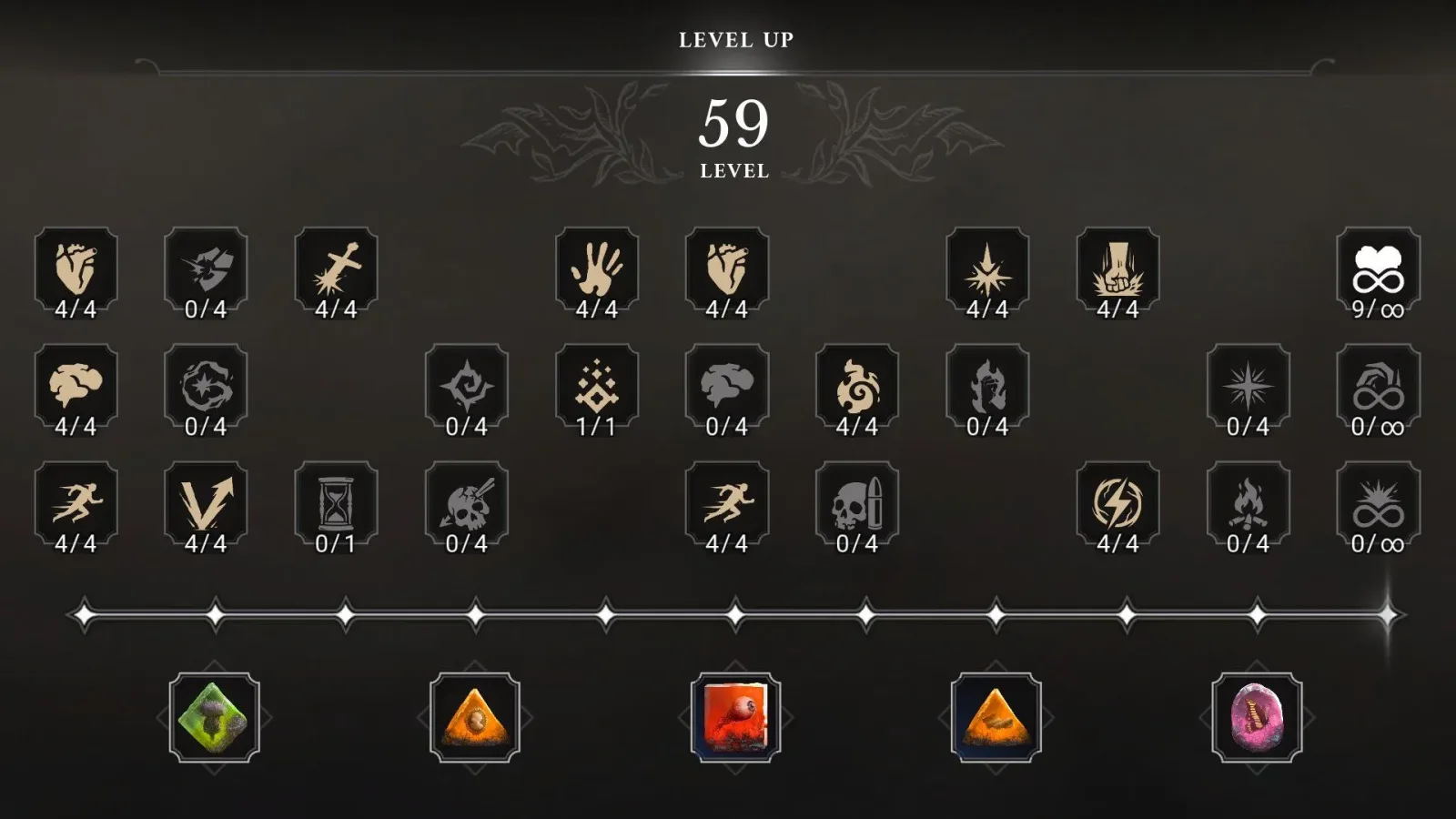
Valor Mortis handles character progression differently from the familiar Soulslike approach of steadily raising a list of core attributes. Instead, each level-up opens a selection of purchasable skills and abilities, asking players to make more targeted choices about survival, offense, and combat efficiency.
That can make the early game deceptively difficult to plan for. Many upgrades look useful in isolation, and plenty of them may suit a particular playstyle later. But the opening hours place a heavy emphasis on a resource that governs nearly every important action: Endurance. Attacking, defending, evading, and maintaining pressure all depend on being able to manage it well. As a result, the most valuable initial purchases are the ones that improve the melee tools available in every fight, regardless of how often a player uses special abilities.
The best early investments are Maximum Endurance, either Blocking Impact or Parrying Impact depending on the weapon being used, Melee Damage, and Melee Endurance Cost. Together, these upgrades create a more forgiving foundation for learning encounters while also making the character more effective over the long term.
Why melee skills should come first
It may be tempting to focus immediately on abilities that appear more dramatic, particularly Fire Transmutation in the game's early stages. Fire Transmutation is useful, and it can understandably become a major part of a player's offensive plan. However, its reliance on Nephtoglobin means it cannot replace melee combat entirely. Nephtoglobin is finite, and restoring the resources needed for other options will regularly bring players back into close-range exchanges.
For useful background on this topic, read AI-assisted Nintendo PC ports Are Spreading, but Legal Pressure Is Likely to Follow.
That makes weapon skills more than a fallback plan. Saber and Rapier attacks are the consistent part of the combat toolkit: they are available when special resources are low, they help create opportunities against enemies, and they are essential for sustaining the broader combat loop. Improving them early has a compounding benefit. Better stamina economy means more actions. Better defense means more chances to survive a mistake. More damage means fights end sooner and resource recovery becomes more efficient.
It is also worth remembering that early enemies can kill quickly. Extra health is useful eventually, but a larger health pool does not necessarily solve the immediate problem of being caught without enough Endurance to dodge, block, retaliate, or reposition. Early progression is therefore less about absorbing additional hits and more about avoiding the situations that lead to those hits in the first place.
1. Maximum Endurance is the first major priority
The first skill players should seriously consider is Maximum Endurance, available at Rank 1. Investing four points here creates a noticeable improvement in the character's ability to participate in combat without constantly reaching an empty stamina bar.
Endurance supports the core rhythm of Valor Mortis. It is spent when attacking, blocking, and dodging, meaning a shortage can leave the player unable to respond at exactly the wrong moment. A player who has committed to several attacks may not have enough remaining Endurance to evade an incoming strike. Likewise, someone who has been forced to block repeatedly can lose the ability to counterattack or safely retreat.
Increasing the maximum amount available gives more room for error, but it does more than that. It allows players to practice the game's timing-driven combat systems without feeling as constrained by every action. That is especially valuable while learning enemy attack patterns and working out when a block, parry, dodge, or aggressive follow-up is appropriate.
There is a useful long-term lesson in prioritizing Endurance as well. Valor Mortis rewards players who recognize openings and exploit them efficiently. More Endurance helps maintain pressure when an enemy is vulnerable, but it also provides the reserve needed to disengage if an exchange becomes dangerous. Four early points in Maximum Endurance can therefore make the opening stretch more manageable while encouraging stronger habits for later encounters.
2. Choose Blocking Impact for the Saber
The next recommended purchase depends on which of the early melee weapons feels more natural. Players who prefer the Saber should prioritize Blocking Impact, the Rank 2 defensive upgrade designed around a sturdier blocking style.
Blocking Impact reduces the Endurance spent while blocking. Since defensive exchanges can drain stamina rapidly, this is a significant improvement in fights where enemies attack in strings or where learning the safest response takes time. Spending less Endurance on defense means there is more available for a dodge, a retaliatory strike, or another block if the opponent does not stop attacking when expected.
The skill also improves the amount of health that can be recovered by attacking shortly after blocking. That gives Saber users an incentive to turn defense into offense rather than simply waiting for danger to pass. A successful block becomes the beginning of a counterattack window, allowing the player to regain momentum and potentially recover from previous damage.
Four points in Blocking Impact can substantially improve the Saber's reliability. Rather than treating the weapon as only an offensive choice, the upgrade supports a measured, resilient style: block efficiently, recognize when the enemy has overcommitted, then strike back before resetting the exchange. For players who prefer consistency and direct defensive answers, it is one of the best early skill paths available.
3. Choose Parrying Impact for the Rapier
Players who favor the Rapier should look instead at Parrying Impact. The Rapier's approach differs sharply from the Saber's. Rather than leaning on ordinary blocking, it is built around stronger parry utility and rewards players who are willing to meet attacks with precise timing.
Parrying Impact increases the posture damage inflicted by successful parries. That matters because posture damage can create more frequent opportunities for critical hits. In practical terms, a player who can reliably parry is not merely preventing damage; they are actively accelerating the point at which an enemy becomes vulnerable to a devastating response.
This is a high-reward choice, although its value is tied to comfort with the Rapier's rhythm. Players still learning parry timing may find the Saber's block-oriented safety more immediately useful. But for those already connecting successful parries, Parrying Impact is an excellent early investment because it strengthens the weapon's defining advantage rather than trying to make it behave like the Saber.
The important decision is not which skill is universally stronger. It is whether the player's chosen weapon uses blocking or parrying as its central defensive tool. Spending points to reinforce that tool gives immediate returns in regular encounters and prepares the player for more demanding foes later on.
4. Melee Damage remains essential for every build
At Rank 3, Melee Damage is the straightforward universal pick. It raises the damage dealt by melee weapons, benefiting both Saber and Rapier users without requiring a specific defensive preference or resource condition.
Simple upgrades are often the most dependable, and Melee Damage fits that description. Harder-hitting weapons reduce the length of standard encounters, which can lower the total number of dangerous exchanges a player has to survive. It also makes every opening more valuable. Whether that opening comes after a block, a parry, a dodge, or an enemy's missed attack, stronger melee strikes ensure the opportunity produces meaningful progress.
This upgrade remains important even for players who are leaning heavily on Fire Transmutation. Special attacks may carry an encounter's early momentum, but they do not eliminate the need to return to melee for Nephtoglobin management and general resource recovery. When the character has to swing a weapon anyway, there is little downside to making those swings more effective.
Investing in Melee Damage also prevents a common progression problem: having strong utility but insufficient finishing power. Defensive upgrades keep a player alive, but damage ensures the player can convert survival into victory. It is the natural offensive partner to the Endurance and weapon-defense investments made beforehand.
5. Reduce attack costs with Melee Endurance Cost
The next major stamina-focused purchase is Melee Endurance Cost, found later in the early progression path at Rank 5. As its name suggests, it reduces the Endurance required for melee attacks with any melee weapon.
This skill works especially well alongside Maximum Endurance. Increasing the stamina pool gives more total options, while lowering attack costs makes each point in that pool stretch further. The result is a character that can maintain offense longer, keep enough reserve for defense, and avoid the dangerous feeling of becoming exhausted immediately after committing to a combo.
It also supports both of Valor Mortis' early weapon identities. Saber users can block without draining themselves as quickly, then spend less Endurance during the counterattack. Rapier users can capitalize on posture-breaking parries with more efficient follow-up attacks. In either case, reduced attack cost improves the ability to pressure an enemy without abandoning the caution needed for survival.
Even players who do not consider melee their preferred method of dealing damage should not overlook it. Other abilities need replenishing, and melee remains part of the character's baseline toolkit under every circumstance. Lowering its Endurance demands ensures that returning to close combat is less punishing and more sustainable.
A practical early purchase order
For most players, the safest early progression plan is built around stamina first and weapon identity second. Start by putting four points into Maximum Endurance. From there, choose the Rank 2 defensive skill that matches the weapon currently in use: Blocking Impact for the Saber or Parrying Impact for the Rapier. Follow with Melee Damage at Rank 3, then work toward Melee Endurance Cost at Rank 5.
- Rank 1: Maximum Endurance -- aim for four points early.
- Rank 2: Blocking Impact for Saber users, or Parrying Impact for Rapier users.
- Rank 3: Melee Damage for a reliable increase to all weapon offense.
- Rank 5: Melee Endurance Cost to improve attack efficiency and sustain.
Maximum Health should not be ignored forever, but it is generally a less urgent opening investment than the tools that let a player avoid damage, manage enemy pressure, and exploit attack windows. The strongest early Valor Mortis build is not necessarily the one with the most elaborate ability setup. It is the one that can reliably block or parry, attack without exhausting itself, and stay effective when special resources are unavailable.
In short, build around Endurance, reinforce the defensive mechanic of the Saber or Rapier, and make melee hits count. Those choices give the opening hours a much steadier pace while remaining valuable long after the earliest fights are over.
Community
Discussion
Start the conversation.
No comments have been posted yet.