

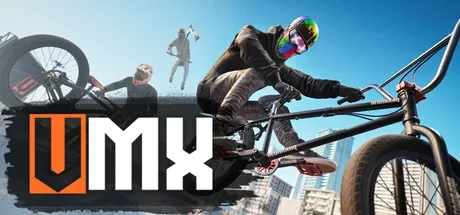
VMX, a virtual-reality riding game built around BMX, mountain bike and scooter action, is now available for Meta Quest 2 and Meta Quest 3. Developed by Break Free Interactive, the standalone VR release arrived on October 2, 2026, through the Meta Store, where it is priced at $14.99, £11.99 or EUR13.99.
The central idea behind VMX is straightforward but ambitious for a sports game: players are expected to ride and perform tricks through body-driven VR gestures rather than relying on long lists of conventional button combinations. The game combines that input approach with a custom control and physics system intended to make momentum, ramp launches, line selection and aerial tricks feel connected to a rider's physical movements.
Rather than presenting BMX, mountain biking and scootering as separate games, VMX brings all three ride types into a single VR package. It launches with five places to ride, includes both solo and multiplayer options, and offers a Workshop where players can alter the look of their equipment and avatar using cosmetics earned through play.
A VR riding game focused on movement
Extreme-sports games have traditionally asked players to translate a controller input into a trick animation. That can be satisfying, particularly when games reward timing and complicated sequences, but VMX is pursuing a different kind of relationship between the player and the action on screen. Its riding systems are designed around gesture controls, meaning physical movement is a core part of the experience.
For useful background on this topic, read Mike Tomlin's 12-Year Minecraft City Is Winning Fans With Its Meticulous Everyday Details.
Break Free Interactive says players can use their movement to manage the flow of a run, find an approach to an obstacle and launch from ramps. Tricks are also gesture-based. The goal is to make a successful line feel less like selecting an item from a move list and more like executing a motion in VR, while still operating within a game's scoring and physics rules.
That design direction places considerable importance on how the game interprets a player's hands, arms and body position. VR sports experiences often need to balance responsiveness against readability: a gesture has to feel immediate enough to be enjoyable, while the game also has to recognise it consistently and present a believable outcome. VMX's custom physics and control systems are intended to support that balance across each of its three ride categories.
The inclusion of BMX, MTB and scooters gives the game several distinct riding identities without changing its core premise. BMX action naturally suits skatepark-style ramps and compact trick lines, while mountain bike riding can complement dirt-oriented routes and bigger terrain. Scooters provide another familiar action-sports option for players who want to experiment with the same locations and gesture-led systems from a different perspective.
For another perspective on this story, read VMX Brings Gesture-Driven BMX, MTB and Scooter Riding to Quest.
Five launch locations, from skateparks to a megaramp stadium
VMX begins with five distinct environments. The roster includes Under the Bridge Skatepark, the Utah Desert Dirt Track, the Miami City Map, the Docks/Harbour Map, and a large stadium. Each setting gives players a different backdrop for pursuing scores, learning routes or simply riding without the pressure of a structured objective.
Under the Bridge Skatepark appears positioned as a natural home for technical ramp riding, with the kind of concentrated obstacles that can reward repeated attempts and careful positioning. The Utah Desert Dirt Track, meanwhile, broadens the game's visual and terrain variety by moving the action away from urban concrete into a dirt-focused environment.
Miami City Map and the Docks/Harbour Map add further city-based variety to the launch selection. Those names suggest spaces where players can seek out lines beyond a conventional skatepark layout, although the specific obstacle designs and route structures have not been detailed. What is clear is that VMX aims to avoid placing all of its riding disciplines in a single venue or visual style.
The stadium is the largest-scale setting named for launch, featuring a megaramp and an animated crowd. A megaramp environment is a natural showcase for the game's emphasis on momentum and launch control, since large descents and big airs place more weight on committing to an approach and carrying speed into a jump. The crowd is also a notable presentation touch, intended to give major runs more event-like atmosphere.
Across these environments, players can go after high scores, use Free Ride to practise and take part in multiplayer sessions with friends. That structure gives VMX room for both score-chasing and low-pressure experimentation. A player learning the timing of a gesture or the feel of a new ride type can spend time in Free Ride, then move into more competitive score attempts once they are more comfortable with the game's motion-driven controls.
Comfort and Immersive movement options
Locomotion is one of the most important considerations in VR, particularly in games about speed, drops and airborne movement. VMX addresses that with two movement approaches: Comfort Mode and Immersive Mode.
Comfort Mode is designed to provide a smoother experience intended to reduce motion discomfort. This may be particularly useful for players who are newer to VR, those returning after time away, or anyone who finds rapid virtual acceleration and elevation changes difficult to tolerate. A riding game that includes ramps, downhill momentum and big jumps can create a strong sensation of movement, so an option focused on comfort is an important part of making the experience approachable.
Immersive Mode is aimed at experienced VR players who want a more pronounced feeling of physical movement. For players already accustomed to virtual speed and freer camera motion, this setting is intended to deliver a stronger sense of being in the ride. The two options mean VMX is not limited to one comfort threshold, even as it leans into a deliberately physical style of sports gameplay.
Players should still approach an intense VR riding game at their own pace. The ability to practise in Free Ride and choose a movement mode offers a practical way to become familiar with the experience before tackling large ramps or pursuing higher scores in more demanding areas.
Workshop customisation and gameplay-earned gear
VMX also includes a Workshop, giving players ways to personalise both their rides and their rider. Bikes can be customised with spray-painted colours, gradients and patterns, allowing for looks that range from simple colour changes to more expressive designs. In a game built around repeated runs and multiplayer riding, that kind of visual identity can help make a preferred setup feel more personal.
Avatar customisation covers several wearable options. The available categories include helmets, goggles, full-face helmets, snapbacks, beanies and other gear. Cosmetics and equipment options are unlocked through gameplay, with points earned while riding used to obtain new items.
That progression system links the customisation loop directly to time spent in the game. Players can work on scores, practise routes or join friends in multiplayer while building up points for additional cosmetic choices. The announced information describes these items as gear and cosmetics, rather than suggesting they change riding performance, keeping the focus on appearance and personal expression.
A standalone Quest release for action-sports fans
VMX arrives as a standalone experience for Meta Quest 2 and Meta Quest 3, with no other platforms announced. Its $14.99, £11.99 and EUR13.99 pricing places it as a comparatively accessible VR sports release, while its feature set goes beyond a single score-attack course through multiple maps, three ride types, multiplayer, Free Ride and visual customisation.
The biggest question for prospective players will be how naturally its gesture system translates the feeling of action-sports riding into VR. VMX's promise rests on the idea that leaning into physical motions can create a stronger connection between a player's intent and their on-screen run than a traditional controller-led format. The game's dedicated Comfort and Immersive settings acknowledge that the same physicality can affect players differently.
For Quest owners looking for a new sports-focused VR option, VMX is now positioned as a place to chase tricks in a skatepark, tackle a desert dirt track, explore city and harbour environments, or take on a stadium megaramp with an animated audience watching. With BMX, mountain bike and scooter choices available from launch, it offers several ways to test its movement-led take on virtual riding.
Community
Discussion
Start the conversation.
No comments have been posted yet.