

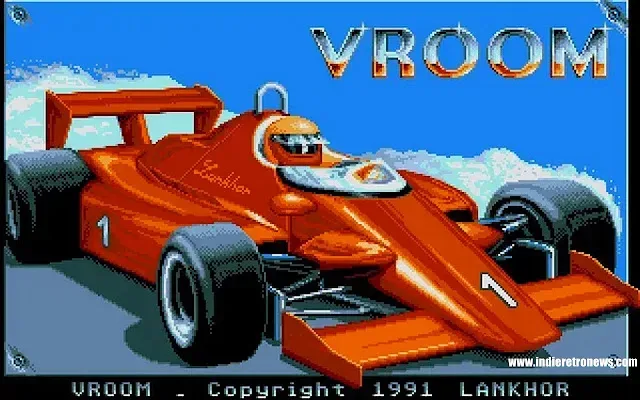
Vroom Enhanced is bringing a substantial technical refresh to one of the early 1990s' best-known computer racers. Developer Vesuri has released the new update for Vroom, the high-speed racing game originally programmed by Daniel Macré and published by Lankhor in 1991. The revised version is aimed squarely at expanded Amiga hardware, delivering faster and smoother play on machines fitted with a 68020 processor or above while also addressing several audio, control, and usability quirks.
For a game built around speed, the headline improvement is appropriately direct: on compatible 68020+ Amiga machines, Vroom Enhanced can run at the title's original NTSC speed even when played on PAL setups. The update renders at 50 or 60 frames per second and uses interpolated movement between game steps. That should make the already rapid racer look considerably more fluid during a race, particularly for players accustomed to the compromises historically associated with differing PAL and NTSC timing.
It is a meaningful update for a game whose appeal has always rested on immediacy. Vroom did not need elaborate simulation systems to earn its following. Its racing was simple to understand, demanding to master, and built to keep players focused on momentum, positioning, and the next stretch of track. The game's reputation for compulsive speed was apparent even in its original reception, with Amiga Computing once joking that the game had transformed its reviewer into a "driving freak."
More than three decades later, that sense of motion remains the feature worth preserving. Rather than recasting the 1991 racer into something fundamentally different, Vroom Enhanced concentrates on making its existing design feel better suited to stronger Amiga configurations. The result is less a replacement for the original than a performance-focused revision that recognizes why the game remained memorable in the first place.
For useful background on this topic, read 11 Gift Ideas for Grand Theft Auto 6 Fans This Holiday Season.
A 1991 racer built for speed
Vroom first appeared across the Atari ST, Amiga, and MS-DOS landscape in 1991. It arrived during an era when computer racing games were experimenting with how to sell the sensation of velocity using the hardware and display technology available at the time. Games could be visually impressive, technically inventive, or simulation-minded, but making a racer feel truly fast while keeping its action readable was a persistent challenge.
Vroom's answer was a straightforward, high-energy approach. Its identity was tied to pace and accessibility, allowing players to get into the action quickly without losing the need for concentration. A racer can have a detailed presentation and a long feature list, but the responsiveness of its controls and the consistency of its motion are often what decide whether repeated laps are exciting or tiring. Those fundamentals are exactly where this enhanced update places its attention.
The game's original multi-platform history also makes this Amiga-specific work notable. Although Vroom was not exclusive to Commodore's machine, the Amiga version has enduring relevance among retro computer players. It now receives an upgrade designed around the capabilities of systems beyond the baseline configuration, rather than attempting to force the same changes onto every historical version of the game.
That hardware focus is important. Vroom Enhanced is tailored for expanded Amigas, and its top performance features are specifically described for 68020+ machines. Players should therefore view the release as an enhancement for compatible systems, not a blanket statement that every Amiga configuration will suddenly offer the same speed or presentation.
Full NTSC speed on PAL hardware
The most technically significant change is the ability to unlock the original NTSC speed on PAL systems when the game is running on an eligible 68020+ Amiga. PAL and NTSC differences were a familiar issue for players of classic games. Timing, refresh rates, and region-specific assumptions could all influence how quickly a game ran or how it felt in motion. For a title such as Vroom, where speed is the point rather than merely a visual flourish, those differences can be especially noticeable.
Vroom Enhanced addresses that through 50 or 60 frames-per-second rendering with interpolation between game steps. In practical terms, interpolation is intended to fill in motion between the game's underlying updates, creating a smoother visual flow. The stated goal is not merely a higher numerical frame rate, but a more consistent impression of movement as cars tear through the course.
This is the kind of improvement that can be difficult to communicate with a static description yet immediately apparent with a controller in hand. Racing games depend on players reading the road, judging lateral movement, and reacting before a mistake becomes unrecoverable. Smoother motion can make those decisions feel clearer, while the return to the intended speed helps retain the aggressive rhythm that defined the game's original character.
It also gives owners of expanded vintage hardware another reason to revisit a familiar game. The retro scene is often at its most interesting when preservation and improvement meet: the original mechanics, artwork, and personality remain intact, but old limitations or longstanding rough edges are reduced through careful technical work. Vroom Enhanced sits comfortably in that space.
Audio and controls receive overdue attention
Performance is only part of the package. Vesuri's update also corrects audio timing on PAL systems, ensuring that both music and sound effects play at their proper tempo. Sound is easily overlooked in discussions of racing-game speed, but it contributes heavily to the sensation of pace. Music that plays at the wrong rate and effects that do not land as expected can subtly change the character of a game, even if its cars and track visuals remain the same.
The update additionally removes audio pops and clicks during the practice race. Such imperfections may seem minor in isolation, but they matter in a game that invites repetition. Practice modes are where players spend time learning the handling, trying to improve their line, or simply enjoying short bursts of retro racing. Cleaning up distracting sound artifacts makes that process more polished without altering the game's fundamental structure.
Control setup has also become more convenient. Players can now choose the Red Player's port and input device directly from the splash window. That is a useful quality-of-life change for an old game being played on varied Amiga setups, where different controllers and ports can be part of the everyday experience. Bringing the selection forward to the opening screen reduces friction before the race has even started.
There is also a fix for a particularly awkward long-standing bug involving mouse control. Previously, rapid mouse movement could cause the control marble to move in the wrong direction. Vroom Enhanced resolves that behavior, preventing fast inputs from producing that incorrect response. For a game that values fast reactions, a correction to directional input is more than a small maintenance note; it speaks directly to the reliability players expect when pushing for a better lap.
Settings support and a practical retro upgrade
The installed icon now automatically handles the new CUSTOM4, CUSTOM5, and CACHE settings. While that may be a more technical detail than the visual and audio upgrades, it reflects the same practical philosophy behind the rest of the update. The work is not solely about an eye-catching frame-rate improvement. It also considers the process of using the enhanced version on suitable hardware and makes the new settings easier to manage.
That attention to setup is welcome in the retro computing world, where the journey from launching a game to enjoying it can sometimes involve more configuration than players would prefer. Automating handling for those settings helps the enhanced edition feel more approachable while retaining the flexibility associated with classic Amiga software.
Vroom Enhanced therefore represents a focused restoration of feel. It preserves the 1991 game's simple, addictive racing premise while improving the technical conditions around it: full-speed operation on compatible PAL systems, smoother animation, correctly paced sound, fewer audio distractions, more direct input selection, and a repaired mouse-control problem.
For longtime fans, the update is an opportunity to return to a racer with renewed momentum. For newcomers exploring the Amiga's library through expanded hardware, it offers a version designed to present Vroom's core strengths with fewer compromises. The original game earned its name through speed, and this new revision makes a persuasive case that speed is still the right place to start.
Community
Discussion
Start the conversation.
No comments have been posted yet.