

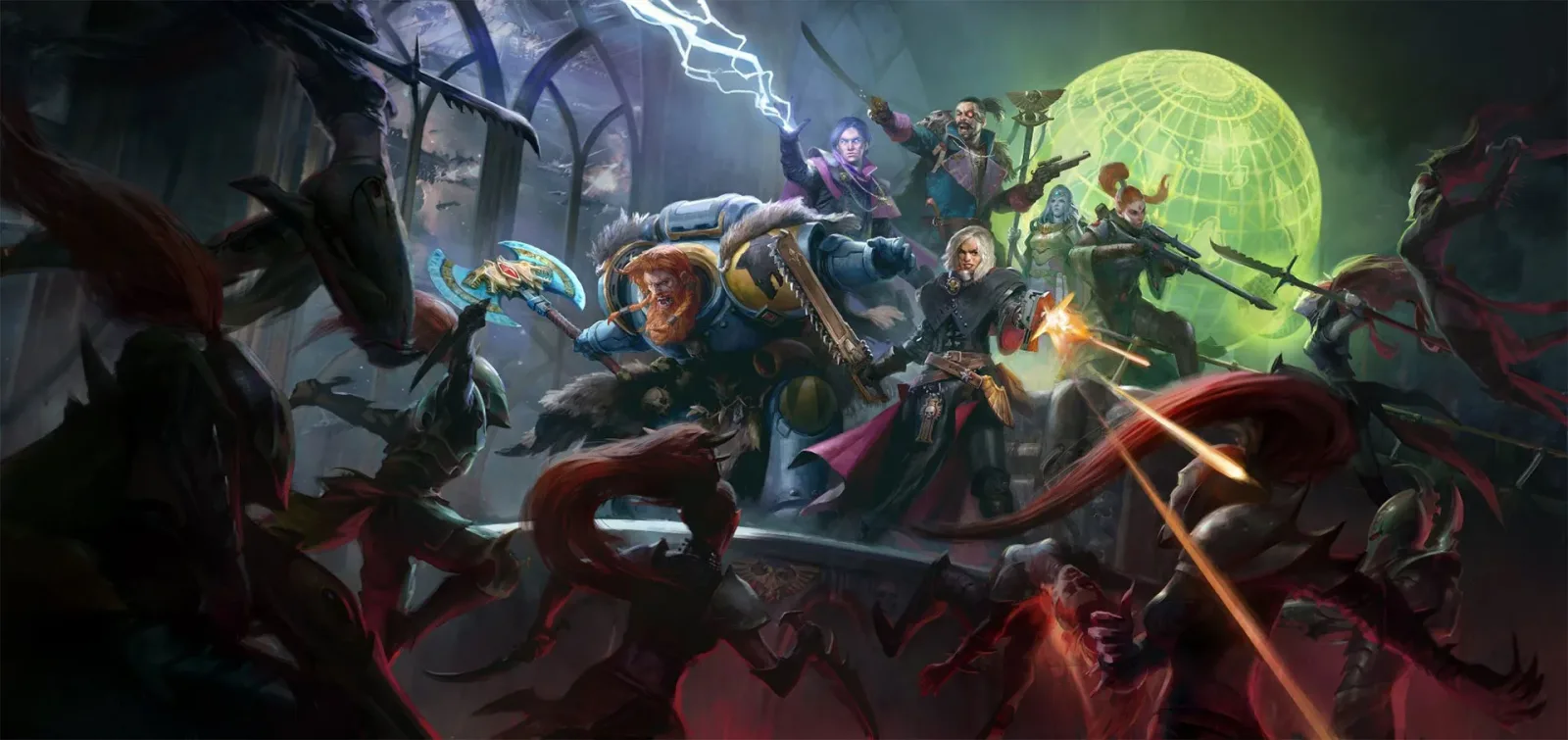
Warhammer 40,000: Rogue Trader has a particular talent for making terrible behavior feel contextually reasonable. Owlcat Games' turn-based CRPG drops players into a universe where religious certainty, institutional brutality, alien threats, and Warp corruption are everyday realities. In that setting, choosing the polite answer can seem less like compassion and more like a potentially fatal lapse in judgment.
That tone is a major part of why Rogue Trader can work so well as an entry point for people newly consumed by Warhammer 40K lore. The game is not about controlling a legendary Space Marine or reliving the galaxy-spanning civil war at the center of the Horus Heresy. Instead, it hands authority to a human scion of House von Valancius who is suddenly pushed into the role of Rogue Trader. The result is a story about command, survival, faith, and the ugly decisions required to maintain power in the Imperium.
It is also a game that encourages a different kind of role-playing instinct. Players who usually gravitate toward the most compassionate dialogue option may find themselves becoming noticeably harsher--not necessarily because they want to play an outright monster, but because Warhammer's grimdark setting has a way of reframing what responsibility looks like.
A Warhammer obsession finds a new outlet
For some fans, a recent animated Warhammer 40,000 story in Amazon's Secret Level anthology served as an unexpectedly effective gateway into the setting. The short helped inspire a deeper dive into the franchise's massive lore library, including the opening three novels of the Horus Heresy series and collected short-fiction anthologies. It can be a quick escalation from reading a few books to reorganizing video and social-media recommendations around lore explainers, faction history, and discussions of the Imperium's endless wars.
For useful background on this topic, read Hisense's 55-Inch CanvasTV Deal Brings a 144Hz Gaming Display Into Art Mode Territory.
There is, of course, one especially dangerous next step: getting into the tabletop miniature hobby. For anyone wary of the costs of collecting, assembling, painting, and playing physical armies, a video game is a much more contained way to spend time in the 41st Millennium. Rogue Trader offers the chance to encounter heretics, Chaos influence, Imperial dogma, and the ever-present Warp without acquiring an army's worth of tiny plastic soldiers.
That makes the premise initially intriguing, even for someone whose Warhammer fascination began with the Adeptus Astartes. The Space Marines are among the setting's most recognizable figures, and the Horus Heresy in particular is full of larger-than-life transhuman warriors, betrayal, and operatic tragedy. Rogue Trader takes a more grounded route. Its protagonist is human, politically important, and armed with extraordinary legal and economic authority, but is not a Space Marine. There is no Astartes origin available for the player character.
Rather than weakening the fantasy, that limitation becomes one of Rogue Trader's strengths. The game explores a section of Warhammer 40K where a mortal individual can still make consequential decisions across entire worlds and voidships. A Rogue Trader operates with immense freedom at the edge of Imperial space, and that freedom comes with the burden of deciding who receives mercy, who is punished, and which compromises are acceptable when disaster is always close at hand.
From succession candidate to Warp-touched commander
The game's opening quickly establishes the danger surrounding that position. The player begins aboard the voidship of Theodora von Valancius, a distant relative seeking to identify and prepare a successor. The protagonist is one among several possible candidates, but the situation collapses when heretics attack the vessel.
Amid the confusion, one of Theodora's operatives betrays the player character, knocking them unconscious and implanting a nascent Chaos entity within their mind. The creature becomes particularly active near the Warp, ensuring that corruption is not simply an external problem to solve with a bolter or a speech. It is also a personal threat lodged inside the protagonist's own consciousness.
Theodora then disappears during the assault, leaving the player to fight through the stricken ship and begin the search for her. Early on, flames block the path forward while an apparition offers the promise of power. The choice presented is quintessentially Warhammer: accept the apparition's assistance, trust in the Emperor's power and walk through the blaze, or turn back to aid the crew under siege.
For readers familiar with Galaxy in Flames, the third Horus Heresy novel, the faith-based option carries a recognizable resonance. Choosing to rely on the Emperor can echo Mersadie Oliton's experience in that story. In Rogue Trader, walking through the fire can allow the character to emerge unharmed while also burning away the Warp creature that had been implanted in them.
It is a small but effective example of how the game rewards familiarity with the wider setting. The reference is not merely decorative. Knowledge of Warhammer's history and religious imagery can influence how a player reads a situation and which decision feels most appropriate. Even a player without deep lore knowledge can understand the stakes, but longtime readers are likely to appreciate moments where their recent reading directly informs their instincts.
Tactical combat with room for command decisions
Rogue Trader is a top-down CRPG with a tactical structure that may feel approachable to players who know games such as Baldur's Gate III, though its systems have their own identity. Combat is turn-based and centers on movement points and action points. Characters move, attack, use abilities, and take advantage of their positions until those resources are spent, then the turn passes onward.
The framework is clear enough to support the bigger appeal: directing a crew through deadly encounters while defining the sort of leader the Rogue Trader will become. A Commissar build, for example, immediately fits the setting's ruthless military culture. One perk bears the appropriately severe name "One for the enemies, two for the traitors," leaving little doubt about the character fantasy on offer.
That class choice can also make the player's moral slide into authoritarian problem-solving feel mechanically supported. The Commissar's toolkit includes ways to shoot allies in the back in order to strengthen them. In a more conventional heroic fantasy, that might come across as absurdly cruel. In Warhammer 40K, it lands as darkly fitting: an extreme expression of discipline, sacrifice, and the belief that the mission outranks any individual.
This is one of the reasons the game's role-playing works. It does not simply allow players to select harsh dialogue for the sake of being unpleasant. Its classes, combat abilities, plot situations, and setting all reinforce the sense that the Imperium has produced people who see coercion as a practical leadership tool.
Why being kind is not always the obvious answer
The most memorable choices are often not the grand cosmic decisions involving Chaos or sacred visions. They are the smaller leadership moments that force the player to confront life aboard an Imperial voidship.
One early situation brings the Rogue Trader to the lower decks to address orphans whose worker parents died during the attack. The available responses include offering comforting encouragement, dismissing the children by throwing candy at them, or delivering an uncompromising message of tough love. The generous option is clearly the response many players would pick by habit in another RPG. It is the decent thing to do, at least on its surface.
But Rogue Trader makes the harder response understandable within its world. Telling the children that life is brutal and that they must grow stronger if they intend to change it is not warm, and it is certainly not gentle. Yet it can feel like the more honest answer in a civilization that demands endless labor, faces constant violence, and offers little protection to its lowest-ranked citizens.
That does not make the decision morally clean. It is still possible to be cruel, petty, or outright tyrannical in Rogue Trader. The important distinction is that the game gives players permission to inhabit a leader whose choices are shaped by fear, duty, and necessity rather than modern heroic ideals. The appeal is not necessarily becoming evil. It is discovering how quickly a player can become the sort of person who believes that empathy must be rationed.
A strong bridge between Warhammer stories and games
For someone drawn in by the high drama of the Horus Heresy and the image of Space Marines at war, Rogue Trader may not seem like the obvious next destination. It is more focused on a human dynasty, an unstable command structure, and life in a dangerous corner of the Imperium than on the Adeptus Astartes civil war. Yet that narrower focus helps reveal another side of the setting's appeal.
Warhammer 40K is not compelling only because of armored super-soldiers and vast legendary battles. It is also compelling because ordinary humans are forced to operate beneath the shadow of those conflicts. Rogue Trader turns that pressure into a decision-driven CRPG where knowledge of the lore feels useful, harshness can become an understandable survival strategy, and leadership is rarely flattering.
Several major quests into the campaign, the game's blend of tactical combat, recognizable Warhammer themes, and morally uncomfortable choices can make it hard to put down. And for players whose first love remains the Adeptus Astartes, it may serve as a persuasive detour before eventually moving on to Warhammer 40,000: Space Marine 2.
Community
Discussion
Start the conversation.
No comments have been posted yet.